Key Findings
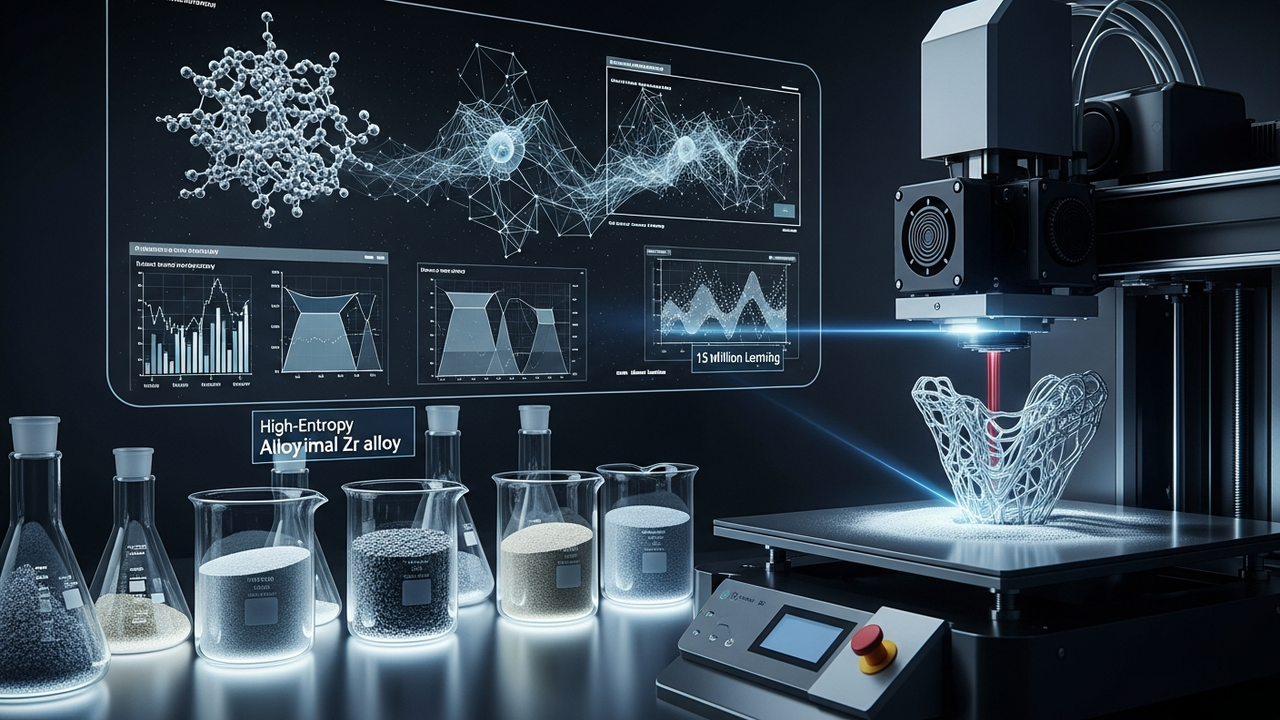
In a significant advancement for the design of biomedical high-entropy alloys (BioHEAs) for additive manufacturing (AM), an innovative machine learning (ML) framework has been successfully introduced and validated. This framework effectively identified and prioritized optimal BioHEA compositions that simultaneously achieve desirable properties such as low elastic modulus, high strength, and damage tolerance from a vast compositional space of approximately 15 million candidates. Notably, the study revealed that body-centered cubic (BCC) alloys rich in zirconium (Zr) are particularly promising for AM applications, establishing a crucial strategy for pre-optimization material selection. This development is expected to significantly reduce the time and cost associated with biomaterial development.
Technical / Clinical Details
The developed ML framework integrates a multi-stage approach of virtual screening and physical prototyping. Initially, based on data from existing material databases and computational chemistry methods like Density Functional Theory (DFT), the machine learning model learns the complex relationships between composition and anticipated mechanical properties (e.g., elastic modulus, yield strength, tensile strength). Using this trained model, approximately 15 million BioHEA candidate compositions are rapidly screened to identify promising candidates with the desired property profiles. The optimal compositions suggested by the ML model then proceed to the physical prototyping stage, where alloys are actually synthesized, and test specimens are fabricated using additive manufacturing techniques (e.g., Laser Powder Bed Fusion, LPBF). These specimens undergo experimental validation, including tensile tests, hardness measurements, and biocompatibility assessments, confirming the accuracy of the ML predictions. Specifically, Zr-rich BCC BioHEAs were found to exhibit high performance, balancing both low elastic modulus and high strength. This process optimizes data-driven material selection before AM manufacturing, minimizing wasted time and resources.
Background & Context
Biomedical alloys, used in implantable devices such as artificial joints, dental implants, and bone plates, require biocompatibility, high strength, fatigue resistance, and a low elastic modulus close to that of natural bone. A high elastic modulus can lead to a ‘stress shielding effect,’ potentially weakening the surrounding bone. High-entropy alloys (HEAs) are drawing attention as BioHEAs due to their potential to offer superior mechanical properties and corrosion resistance compared to conventional titanium and cobalt-chromium alloys. However, the compositional space of HEAs is vast, and designing optimal alloys, especially when combined with additive manufacturing, is extremely complex. The introduction of ML provides a powerful solution to this design challenge, fundamentally transforming traditional, trial-and-error-dependent development processes.
Strategic Significance & Outlook
This ML-guided BioHEA design framework significantly advances the paradigm of material development in the biomedical field. The research team plans to further refine this framework, aiming to incorporate the ability to predict material responses under more complex biological environments (e.g., long-term corrosion behavior, cellular response). Another key objective is to apply ML to optimize AM process parameters themselves, enhancing the integration between material properties and manufacturing processes. The widespread adoption of this technology is expected to enable the rapid development of customized implants for personalized medicine and next-generation biomaterials with superior performance and longevity, significantly contributing to the improvement of patients’ quality of life.
Source: #
Get our weekly technology intelligence — free
Receive an infographic that lets you judge at a glance whether each field’s analysis report is worth reading.
Subscribe Free — Weekly Tech Intelligence
By subscribing, you’ll receive Troy-Technical’s weekly technology intelligence newsletter.
- Your email and selected fields are used only to deliver the newsletter.
- We never share your information with third parties.
- You can unsubscribe anytime via the link in each email.
See our Privacy Policy for details.
Takes about a minute · Unsubscribe anytime








Comments