
Key Findings: AI Accelerates Materials Discovery and Design Multi-Dimensionally
Artificial Intelligence (AI) is dramatically reshaping data-driven discovery and functional applications in materials science. Notably, Large Language Models (LLMs) are demonstrating their capability in extracting knowledge from vast scientific literature and automatically generating simulation workflows, enabling researchers to leverage materials data at an unprecedented pace. This resolves materials knowledge bottlenecks and significantly enhances efficiency in the early stages of research.
Technical & Clinical Details: Evolution of MLIPs, Autonomous Experimentation, and Generative AI
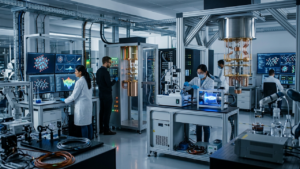
Machine Learning Interatomic Potentials (MLIPs) have drastically improved computational speed in atomic-scale simulations while maintaining accuracy comparable to quantum mechanics. This breakthrough enables large-scale molecular dynamics simulations previously deemed impossible, leading to a significant leap in predicting the stability and dynamic behavior of new materials. Concurrently, AI-integrated autonomous experimental systems, or “self-driving labs,” automate the entire process of material synthesis, characterization, and data analysis, reducing experimental cycles to a fraction of traditional methods. This allows for efficient discovery of materials with targeted properties by optimizing composition and process conditions without human intervention. Furthermore, generative AI models possess the capability for inverse design, proposing entirely new candidate materials that meet specific functional requirements, thereby dramatically expanding the search space beyond existing databases.
Background & Industry Context: Transition to Data-Driven Approaches
Traditional materials discovery heavily relied on trial-and-error, guided by experience and intuition, resulting in time-consuming and inefficient processes. However, the rapid advancement of data science and AI technologies over the past decade has ushered in a significant shift towards data-driven approaches in materials science. This transition has been fueled by the accumulation of vast computational, experimental, and literature data, enabling AI models to learn hidden patterns and correlations for predicting and controlling material behavior. Especially as climate change and resource depletion become pressing global issues, the rapid development of sustainable and high-performance materials is critical, making AI an indispensable tool for these solutions.
Strategic Significance & Outlook: MatSciAgent and Foundational MLIPs
Looking ahead, multimodal LLMs, such as “MatSciAgent,” are expected to become the next generation of AI research platforms in materials science. These systems will process diverse information, including text, images, and structural data, to enable more advanced reasoning and decision-making. Moreover, “Foundational Interatomic-Potential Frameworks,” pre-trained on massive datasets, will establish the basis for versatile MLIPs applicable across a wide range of material systems through fine-tuning for specific applications. These technologies are poised to accelerate innovation across the entire value chain, from material design to manufacturing, contributing to the creation of sustainable and high-performance materials for the future.
Source: #
Get our weekly technology intelligence — free
Receive an infographic that lets you judge at a glance whether each field’s analysis report is worth reading.
Subscribe Free — Weekly Tech Intelligence
By subscribing, you’ll receive Troy-Technical’s weekly technology intelligence newsletter.
- Your email and selected fields are used only to deliver the newsletter.
- We never share your information with third parties.
- You can unsubscribe anytime via the link in each email.
See our Privacy Policy for details.
Takes about a minute · Unsubscribe anytime








Comments