Background
The burgeoning demands of AI workloads are drastically increasing data center power consumption and cooling costs. Specifically, high-speed communication between GPUs and massive data movement in large-scale AI model training are pushing the limits of traditional electrical wiring in terms of bandwidth, latency, and power. Consequently, the industry recognizes optical technology as key to solving fundamental AI infrastructure challenges, prompting major technology companies like NVIDIA to accelerate investments in optical communications. This trend signifies a blurring of boundaries between the semiconductor and optical communications industries.
Key Findings
Optical communication is rapidly emerging as a central strategic direction for AI infrastructure, with NVIDIA actively driving this paradigm shift through strategic investments in key photonics companies such as Marvell, Lumentum, and Coherent. These investments aim to overcome the high costs and power consumption associated with Digital Signal Processors (DSPs) in current optical modules, thereby dramatically enhancing AI data center performance and efficiency.
To maximize AI computational power and resolve bottlenecks in traditional electrical interconnects, NVIDIA has made strategic investments across the optical communication supply chain. This includes Marvell, a leader in high-performance networking chips and optical device integration; Lumentum, known for optical modules and laser technologies; and Coherent, strong in VCSELs and Indium Phosphide (InP)-based lasers.
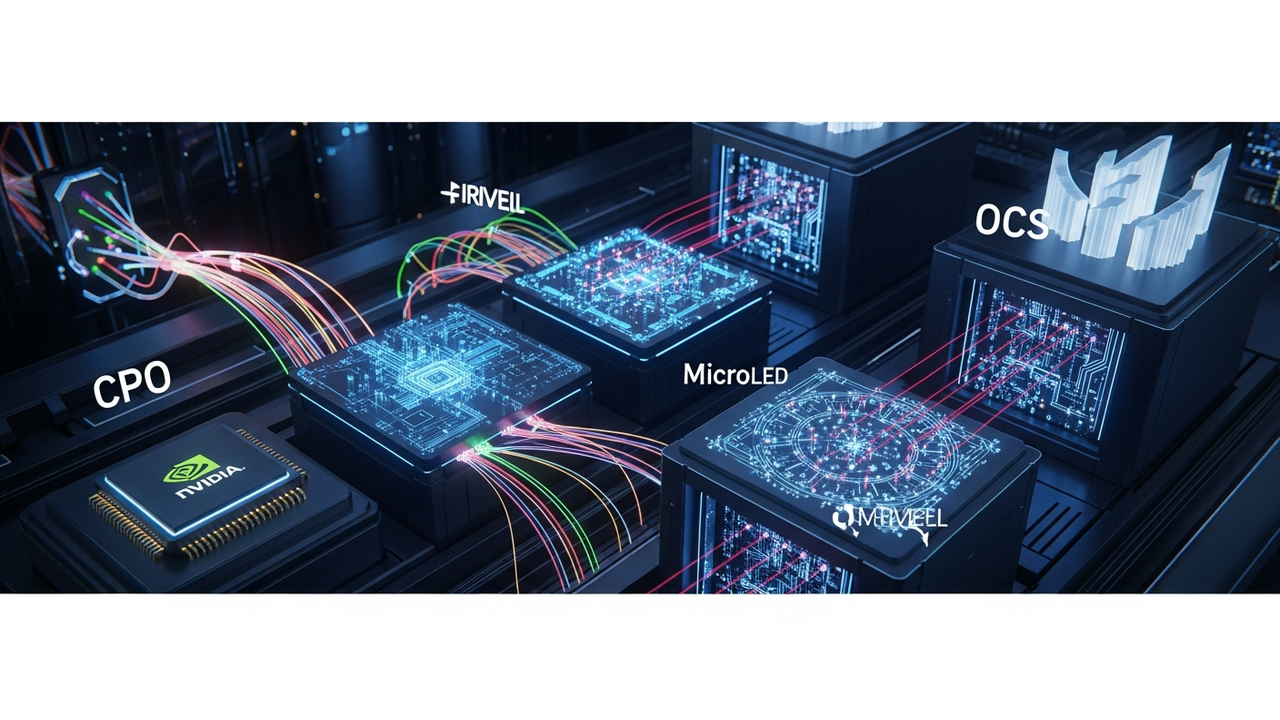
NVIDIA specifically advocates for three pivotal next-generation optical technologies, leveraging light’s inherent physical advantages over electrical signals—including less signal attenuation over long distances and immunity to electromagnetic interference, benefits demonstrated over decades in submarine cables and inter-city networks:
- Co-Packaged Optics (CPO): Integrates optical engines directly adjacent to network switches or processor chips, significantly shortening electrical signal paths. This dramatically reduces power consumption and latency, enabling high-speed, high-density interconnects within AI clusters. CPO is also key to reducing DSP dependence, mitigating current challenges.
- MicroLED: While primarily known for display technology, MicroLEDs are anticipated as ultra-fast, low-power optical interconnects for short-range data center connections and future chip-to-chip communication.
- Optical Circuit Switches (OCS): In large-scale data centers, OCS routes optical signals directly without electrical conversion, thereby reducing power consumption and latency, and enhancing network flexibility and efficiency.
NVIDIA’s aggressive investment and technological promotion in optics are expected to bring about a significant transformation in AI data center architectures. As CPO, MicroLED, and OCS technologies mature and are widely adopted, AI computing performance is projected to further improve, accompanied by enhanced energy efficiency. This will accelerate the continued evolution of AI and its application across a broader range of industrial sectors. However, the commercialization of these advanced optical technologies will still face challenges in reducing manufacturing costs, establishing standardization, and ensuring compatibility with existing infrastructure.
Source: https://www.36kr.com/p/2849303358040448
Get our weekly technology intelligence — free
Receive an infographic that lets you judge at a glance whether each field’s analysis report is worth reading.
Subscribe Free — Weekly Tech Intelligence
By subscribing, you’ll receive Troy-Technical’s weekly technology intelligence newsletter.
- Your email and selected fields are used only to deliver the newsletter.
- We never share your information with third parties.
- You can unsubscribe anytime via the link in each email.
See our Privacy Policy for details.
Takes about a minute · Unsubscribe anytime




Comments