Key Findings
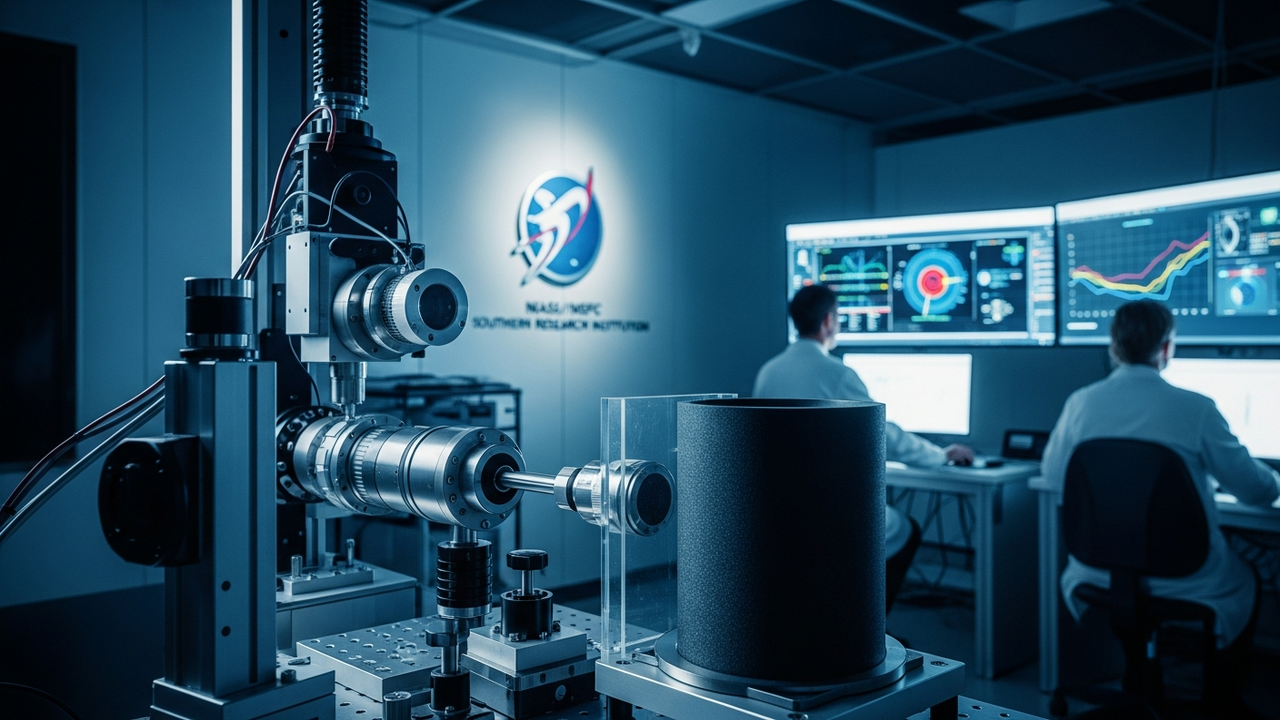
NASA Marshall Space Flight Center (MSFC), in close collaboration with the Southern Research Institution (SRI), is developing a comprehensive materials properties database for graphite throat materials utilized in the Space Launch System (SLS) propulsion systems. The focus is specifically on the testing and analysis of graphite materials applied in Solid Rocket Boosters (SRBs) and Booster Separation Motors (BSMs), providing precise data essential for ensuring the safety and performance of the SLS.
Technical Details
In the solid rocket motors of large launch vehicles like the SLS, the nozzle’s throat section is exposed to extremely high temperatures—thousands of degrees—and severe erosion from combustion gases. To withstand this harsh environment, specialized graphite materials are employed in the throat. SRI possesses unique testing facilities and expertise to evaluate the properties of these graphite materials (such as thermal conductivity, thermal expansion coefficient, mechanical strength, and erosion resistance) with exceptional accuracy and reproducibility. Their capabilities are crucial not only for understanding existing graphite materials in detail but also for evaluating candidate next-generation high-performance graphites. SRI’s testing capabilities are unparalleled in their ability to accurately simulate material behavior under extreme conditions like high temperature, high pressure, and high-velocity gas flow, thereby providing data closely representative of real-world environments. This database will serve as indispensable input for the design, performance prediction, and lifespan assessment of the SLS, maximizing the reliability of the rocket during operation.
Background & Industry Context
NASA’s SLS is the core human deep-space exploration rocket of the Artemis program, serving as the foundation for returning humans to the Moon and eventually venturing to Mars. In mission-critical systems like SLS, the reliability of every single component dictates the overall success. Propulsion system materials, in particular, directly determine the rocket’s performance and safety, making a complete understanding of their characteristics essential. Partnerships with research institutions like SRI represent NASA’s strategy to leverage external expertise and cutting-edge testing capabilities to meet the highest technical requirements cost-effectively. Such collaborations also contribute to enhancing the capabilities of the entire U.S. space industry supply chain.
Strategic Significance & Outlook
The development of the graphite throat materials properties database will significantly impact the continuous upgrades of the SLS and the design of its future derivatives. SRI’s unique testing capabilities and expertise could also be applied to the material development for other next-generation space propulsion systems and hypersonic aircraft. The insights gained from this project will expand the frontiers of materials science for high-temperature, high-pressure environments, paving new ways to improve the safety, efficiency, and economics of space transport systems. Ultimately, it will strengthen the essential technological foundation for accelerating humanity’s push into deep space.
Source: https://sam.gov/workspace/contract/opp/ef638175c3113ee4a26b2b72d59e2d1d/view
Get our weekly technology intelligence — free
Receive an infographic that lets you judge at a glance whether each field’s analysis report is worth reading.
Subscribe Free — Weekly Tech Intelligence
By subscribing, you’ll receive Troy-Technical’s weekly technology intelligence newsletter.
- Your email and selected fields are used only to deliver the newsletter.
- We never share your information with third parties.
- You can unsubscribe anytime via the link in each email.
See our Privacy Policy for details.
Takes about a minute · Unsubscribe anytime





Comments