Background
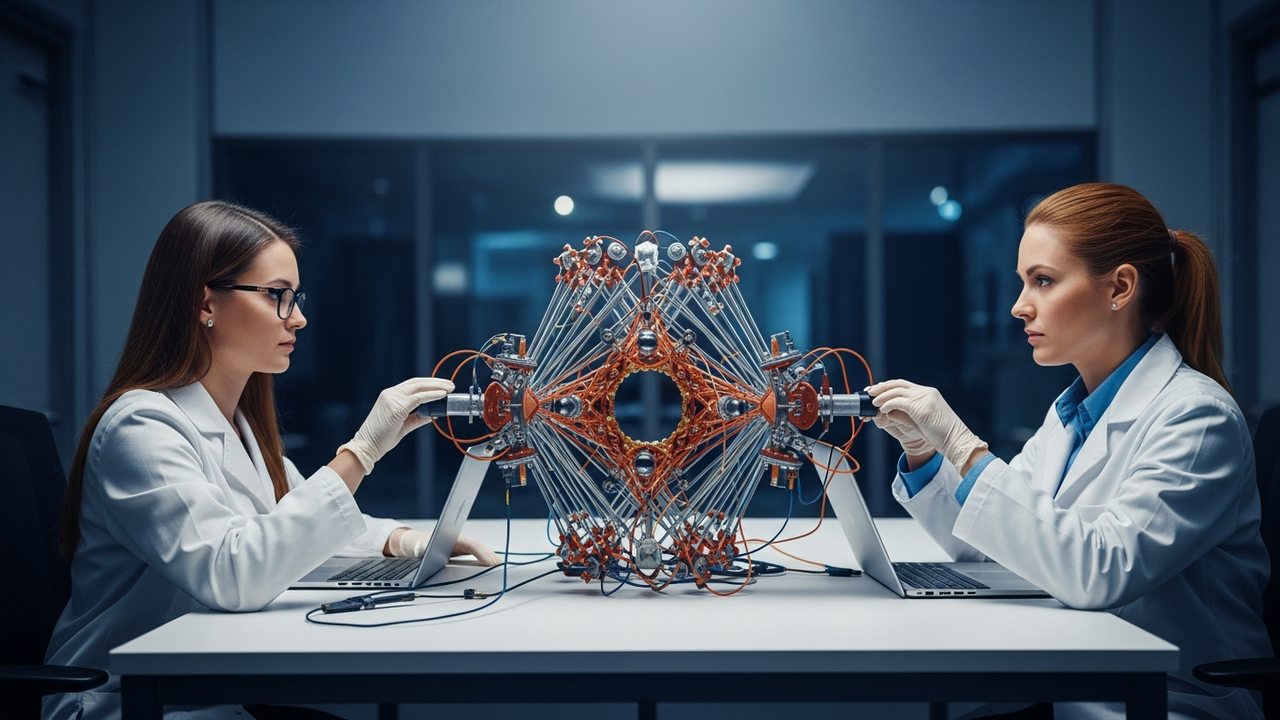
Metamaterials, engineered artificial materials, offer unprecedented control over electromagnetic and acoustic waves in ways impossible with natural substances, a field that has seen active research over the past few decades. Acoustic metamaterials, specifically, hold substantial promise for diverse applications such as noise control, seismic wave deflection, and enhanced ultrasound imaging. The U.S. Department of Defense (DoD) has a significant strategic interest in advancing acoustic cloaking technologies to protect vessels from enemy sonar and acoustic detection, alongside developing more precise underwater communication systems and advanced sensor technologies for defense applications. This substantial grant is specifically allocated to accelerate the transition of this fundamental research into practical, applied development, addressing these critical strategic requirements.
Key Findings
A research team at the Technion-Israel Institute of Technology, under the leadership of Professor Gal Shmuel, has successfully developed a theoretical model for novel metamaterials operating on a newly identified principle: electro-momentum coupling. This pioneering research has attracted a significant $7.5 million grant from the U.S. Department of Defense (DoD) to support its applied development. This milestone represents a critical advancement towards realizing compact devices capable of efficiently detecting and manipulating acoustic signals, poised to revolutionize diverse sectors including acoustic cloaking, advanced medical imaging diagnostics, and robust underwater communications.
Technical Details
The innovative metamaterials engineered by Professor Shmuel’s team are uniquely capable of converting incident acoustic signals into electrical signals, exhibiting a pronounced dependence on the signal’s direction of origin. This groundbreaking capability is achieved through the meticulous design of nanoscale asymmetries within piezoelectric materials—substances renowned for their ability to interconvert mechanical stress and electrical energy. Unlike conventional acoustic sensors and transducers, which face inherent limitations in precise signal directionality, these new metamaterials can effectively ‘cloak’ acoustic wave propagation paths or selectively harvest signals from highly specific directions. For medical imaging, this could enable more targeted delivery of ultrasound into biological tissues and the capture of high-resolution reflected signals, significantly enhancing diagnostic accuracy. In underwater communication, the technology is expected to facilitate the development of compact devices capable of transmitting acoustic signals over greater distances with superior resistance to ambient noise.
Strategic Significance & Outlook
The substantial $7.5 million grant will significantly accelerate the research efforts aimed at demonstrating the practical feasibility and eventual commercialization of the metamaterial model developed by Professor Shmuel’s team. Immediate applications under consideration include compact acoustic sensors for integration into unmanned underwater vehicles (UUVs) and small aerial drones, as well as incorporation into next-generation medical imaging devices. Looking further ahead, the application of acoustic cloaking technology to stealth vessels and submarines holds the potential to profoundly reshape military strategy. In the medical domain, this innovation is expected to foster the development of advanced non-invasive therapies and precision diagnostics. Ultimately, this pioneering metamaterial technology is poised to transcend conventional boundaries across physics, engineering, and applied sciences, playing a pivotal role in shaping the technological landscape of the future.
Get our weekly technology intelligence — free
Receive an infographic that lets you judge at a glance whether each field’s analysis report is worth reading.
Subscribe Free — Weekly Tech Intelligence
By subscribing, you’ll receive Troy-Technical’s weekly technology intelligence newsletter.
- Your email and selected fields are used only to deliver the newsletter.
- We never share your information with third parties.
- You can unsubscribe anytime via the link in each email.
See our Privacy Policy for details.
Takes about a minute · Unsubscribe anytime







Comments