Materials Informatics– category –
-

Vietnamese Researchers Accelerate New Material Discovery for Polymers, Pharmaceuticals, and Metals with AI-Driven Inverse Design
Vietnam News Vietnam Overview Vietnamese scientists are actively exploring AI-driven "inverse design" in materials science, accelerating new material discovery by identifying optimal structures from desired properties. Unlike traditional... -
Google DeepMind’s GNoME AI Discovers 2.2 Million New Crystal Structures, Equaling 800 Years of Experimental Data
Alcimed France Overview Google DeepMind's GNoME AI model has identified 2.2 million novel crystal structures, predicting 380,000 of them to be stable, an achievement comparable to 800 years of traditional experimental discovery. This bre... -
Materials Informatics Weekly Report September 13, 2026
▼ ▼ ▼ If the infographic makes you want to read the full report, please click the download button below. ▼ ▼ ▼ 📄 Weekly Report September 13, 2026 (PDF) — Download Weekly Report September 13, 2026 (PDF) — DownloadDownload 🎙 Podcast Septe... -
Machine Learning Potentials Grapple with Long-Range Interactions in Atmospheric Modeling: A DTU Deep Dive
DTU Research Database Denmark Overview Researchers at the Technical University of Denmark (DTU) evaluated AIMNet2 and PaiNN, two machine-learned interatomic potentials (MLIPs), for modeling molecular collisions critical to atmospheric cl... -
Hessian-Based Molecular Conformation Augmentation Improves Scalability and Efficiency of Machine Learning Interatomic Potentials
arXiv (Preprint Server) International Overview This preprint proposes two Hessian-derived data augmentation schemes, isotropic Gaussian displacement (UniAug) and normal mode-weighted displacement (ModeAug), for machine-learning interatom... -
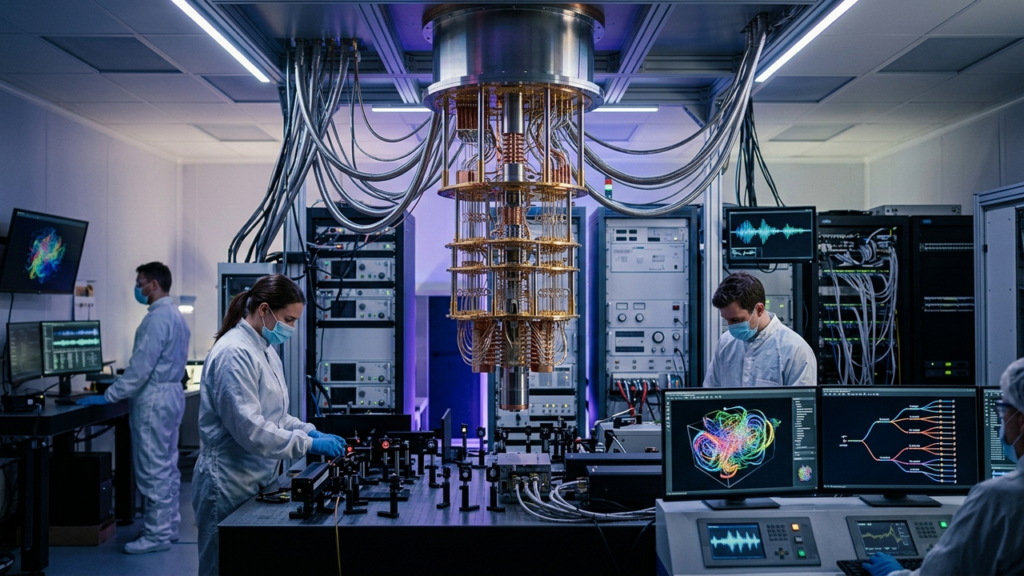
Faster Quantum Simulation Via Randomization Boosts Scalability & Precision for Markovian Open Quantum Systems
Quantum (Scientific Journal) International Overview Researchers have introduced novel non-probabilistic algorithms for simulating Markovian open quantum systems using randomization, aiming for faster and more accurate quantum simulations... -
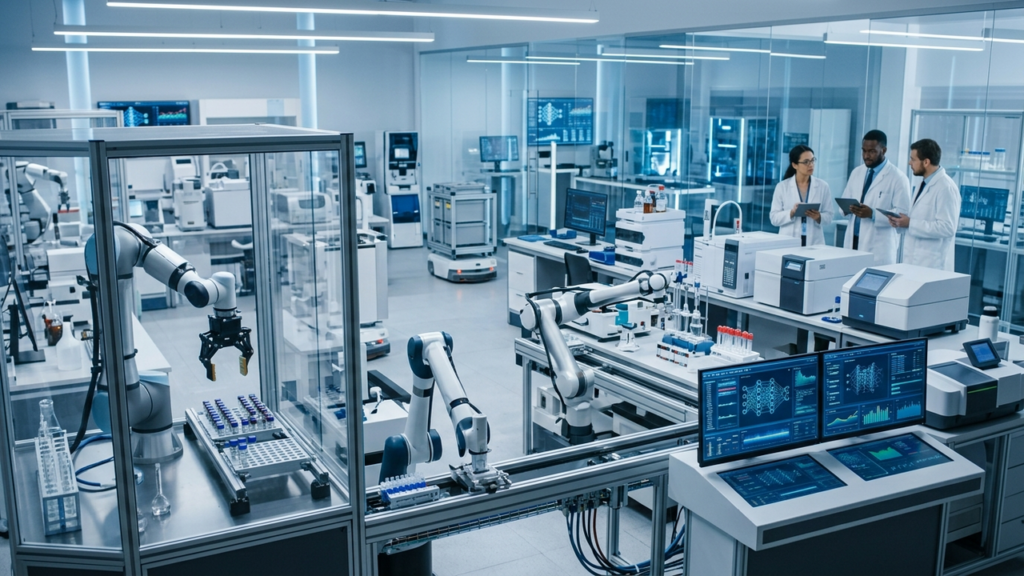
Autonomous Labs & Closed-Loop AI Transform Discovery Economics, Significantly Reducing R&D Cost and Time
Exponential Industry International Overview The integration of autonomous laboratories and closed-loop AI is fundamentally transforming the economics of scientific discovery, particularly in chemistry and materials science. Initiatives l... -
Geometry-Guided Model CDSM Achieves DFT-Comparable Accuracy in Collagen Structure Prediction, Cutting Computational Cost by 400-790x
bioRxiv USA Overview CDSM (Empirical Geometry-Guided Model) enables robust, high-throughput collagen structure prediction by explicitly encoding empirical geometric constraints. The model significantly compresses the structure-prediction... -
AI-Proposed Superconductor Generation Is Not Discovery: Physics Judge Highlights GNoME and MatterGen Limitations
arXiv USA Overview This paper introduces a 'physics judge' to assess whether AI-proposed superconductors possess necessary physical properties beyond mere thermodynamic stability. It critically evaluates generative models like GNoME and ... -
Physics-Aware AI Indispensable for Materials Research: Performance Gaps Highlighted in Thermal Conductivity Prediction
Columbia Engineering USA Overview Columbia Engineering emphasizes the critical need for physics-aware AI in materials science, particularly for machine learning interatomic potentials (MLPs) that predict macroscopic properties from quant...