Machine Learning– tag –
-

Energy-Constrained MLIP Embedding Improves Prediction Accuracy for Hydrogen Evolution Electrocatalysts
ACS Publications (Journal of Chemical Information and Modeling) Overview Researchers developed an "energy-constrained" machine learning framework integrating MLIP-derived energy descriptors with pre-trained Crystal Hamiltonian Graph Neur... -
Machine Learning Interatomic Potentials: Foundation Models Reshape Materials Discovery
Review of Peer-Reviewed Articles Overview A new comprehensive review critically examines Machine Learning Interatomic Potentials (MLIPs), a transformative technology bridging the accuracy of quantum mechanics with the efficiency of class... -
NVIDIA and Applied Materials Propel Semiconductor Innovation with GPU-Accelerated AI, Achieving Up to 55x Speedup
NVIDIA Technical Blog USA Overview NVIDIA and Applied Materials have announced a strategic partnership to revolutionize semiconductor innovation through the integration of AI and GPU-accelerated simulations. This collaboration leverages ... -
OMol25-Trained MLIPs Predict Na-Ion Battery Electrolyte Solvation Structures with DFT-Level Accuracy, Outperforming Inorganic-Only Models
ACS Publications (Journal of Physical Chemistry Letters) Overview This study demonstrates that machine learning interatomic potentials (MLIPs) trained with the Open Molecules 2025 (OMol25) dataset accurately predict and experimentally ve... -
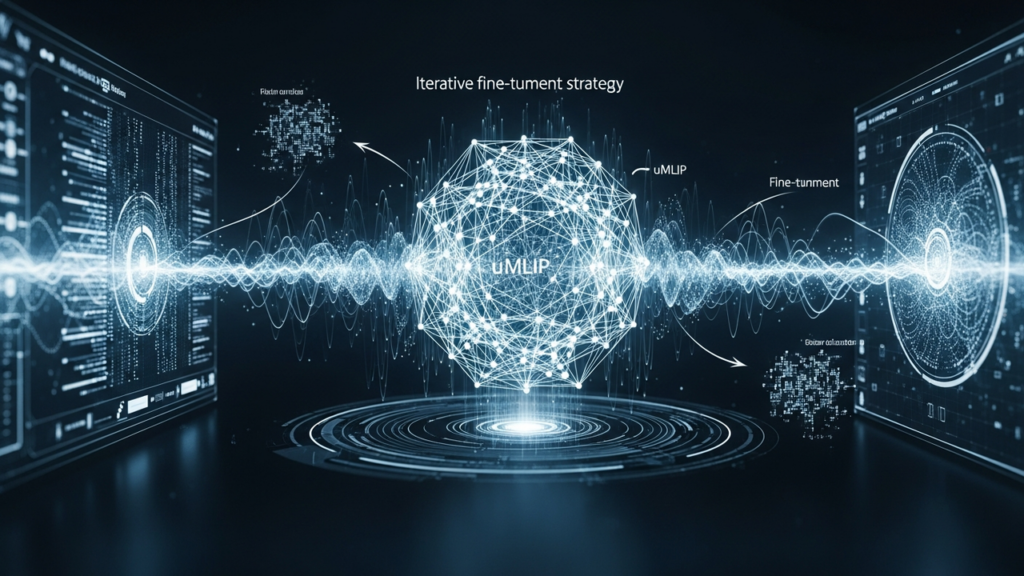
Iterative Fine-Tuning Strategy for Universal Machine Learning Interatomic Potentials (uMLIPs) Yields Stable, High-Accuracy Models for Out-of-Domain Tasks
PubMed Overview Research on universal machine learning interatomic potentials (uMLIPs) demonstrates that "iterative fine-tuning" effectively generates stable molecular dynamics simulations and high-accuracy models for out-of-domain tasks... -
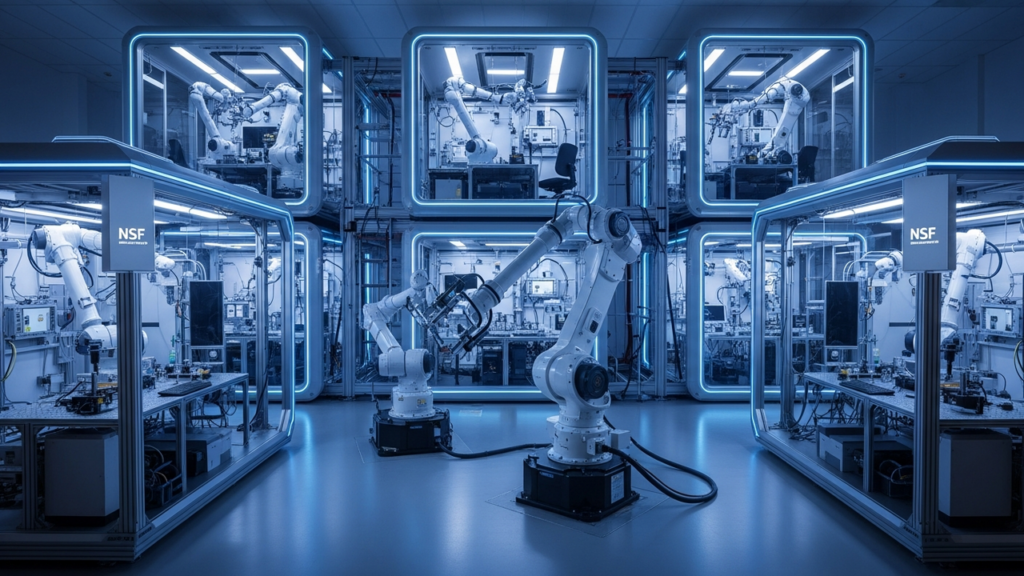
NSF Commits $380M to National ‘Self-Driving’ Lab Network, Aims for 100x+ Acceleration in Discovery
Source Unknown USA Overview The U.S. National Science Foundation (NSF) has launched a $380 million initiative to establish a national network of 'self-driving' laboratories. These AI-powered labs, featuring robotic execution and closed-l... -
UCSB’s BioPACIFIC MIP Secures $20M NSF Grant to Autonomously Advance Polymer & Soft Material Research via Cloud Lab ‘COAST PCL’
BioPACIFIC MIP (UC Santa Barbara) USA Overview The University of California, Santa Barbara (UCSB) has received a $20 million grant from the National Science Foundation (NSF) to establish 'COAST PCL,' a national resource for automated pol... -
Johns Hopkins University Secures $20M Grant to Build AI-Driven ‘Self-Driving’ Lab Network for Advanced Materials
Johns Hopkins University USA Overview Engineers at Johns Hopkins University have received a $20 million grant to establish a network of 'self-driving' laboratories guided by AI and robotic tools. This 'AIMD-Net' program will focus on adv... -
Unlocking Precision: Iterative Fine-Tuning Overcomes Bias in Universal MLIPs for Enhanced Material Simulations
Unknown Source Unknown Overview Universal Machine Learning Interatomic Potentials (uMLIPs) promise broad applicability across the periodic table, yet accurate out-of-domain predictions demand specialized fine-tuning. This study reveals t... -
AI’s Three Pillars: Accelerating Materials Discovery with Predictive Models, Generative Design, and Machine Learning Interatomic Potentials
Source Unknown USA Overview Artificial intelligence is fundamentally transforming materials science through three key advancements: highly accurate property prediction, autonomous generative design, and revolutionary machine learning int...