
Background and Technical Challenges
The commercialization of all-solid-state batteries (ASSBs) hinges on the stable and cost-effective mass production of high-performance solid electrolytes. Sulfide solid electrolytes are considered promising due to their high ionic conductivity and favorable processability, yet their manufacturing requires advanced techniques. Scaling up production while maintaining quality and reducing costs presents a significant challenge. Solid electrolyte manufacturers must overcome these hurdles to support the mass production plans of battery makers and automotive OEMs.
Key Findings and Technical Breakthroughs
Solid Power, a U.S. all-solid-state battery materials company, has released an investor presentation outlining its production strategy for sulfide solid electrolytes, revealing ambitious expansion plans. The key points of this announcement are as follows:
- Production Capacity Expansion: Solid Power aims to significantly increase its annual production capacity for sulfide solid electrolytes from the current 30 tons to 75 tons by the end of 2026. This represents a crucial strategic investment to meet the growing demand for all-solid-state batteries.
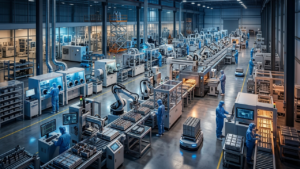
- Continuous Production Pilot Line: The company plans to implement a continuous production pilot line to efficiently supply stable, high-quality electrolytes. This is expected to optimize manufacturing processes and improve yields.
- Strong Financial Position: As of March 31, 2026, the company’s liquid assets reached $435.3 million, with no debt reported. This substantial funding will strongly support research and development investments and capacity expansion.
- Government Financial Support: Solid Power has received a substantial grant of up to $50 million from the U.S. Department of Energy (DOE). This aligns with the U.S. government’s strategy to strengthen the domestic battery supply chain and indicates that Solid Power’s technology is deemed nationally significant.
Solid Power positions itself not as a ‘cell manufacturer’ but as a ‘solid electrolyte supplier,’ aiming to be a core player in the all-solid-state battery ecosystem by supplying electrolyte materials and providing technology licenses to major battery manufacturers and automotive OEMs.
Technical Significance and Outlook
Solid Power’s significant expansion of electrolyte production capacity and strong government funding support are critically important for the all-solid-state battery supply chain. The stable supply of high-quality solid electrolytes is an indispensable factor for accelerating the mass production of ASSBs, and Solid Power’s actions are expected to help resolve this bottleneck. The DOE grant, in particular, aims to foster domestic next-generation battery technology and strengthen the supply chain, which is also vital for mitigating geopolitical risks.
Going forward, the focus will be on how the electrolytes supplied by Solid Power perform in the final products (battery cells) of its customers, the battery manufacturers and OEMs, and when they will be adopted on a large scale. Establishing cost-efficient production technologies and securing a broad customer base will contribute to the company’s long-term growth and the overall development of the all-solid-state battery industry. This progress indicates that all-solid-state batteries are not a distant future technology but are steadily moving towards mass production.





Comments