Background and Technical Challenges
The realization of energy independence and large-scale off-grid living, once a long-held dream, is becoming increasingly feasible due to recent technological innovations. At the core of this progress lies high-performance battery storage technology, particularly all-solid-state batteries (ASSBs). Conventional liquid-electrolyte lithium-ion batteries have limitations in terms of safety, energy density, and operating temperature range, rendering them insufficient for large-scale energy storage systems (ESS) or applications in extreme environments. ASSBs hold the potential to overcome these challenges, but their technological maturity and the establishment of cost-effective mass production processes remain key barriers to widespread adoption.
Key Findings and Technical Breakthroughs
This article emphasizes the role of all-solid-state batteries within the convergence of technologies enabling energy independence. As of 2026, it is estimated that mass production of ASSBs will still require another 2 to 3 years to reach cost-competitive volumes.
However, major players are making steady progress:
- Samsung SDI: Targets mass production in 2027 with a high volumetric energy density of 900 Wh/L.
- Toyota: Aims for automotive-scale cell mass production with its sulfide-based solid electrolyte platform, following a similar timeline to Samsung SDI.
- Blue Solutions: Targets a gravimetric energy density of 315-450 Wh/kg with its polymer-based Gen 4 cells.
- Factorial Energy: Pilot production cells have achieved an energy density of 375 Wh/kg and demonstrated 15-90% charging in 18 minutes.
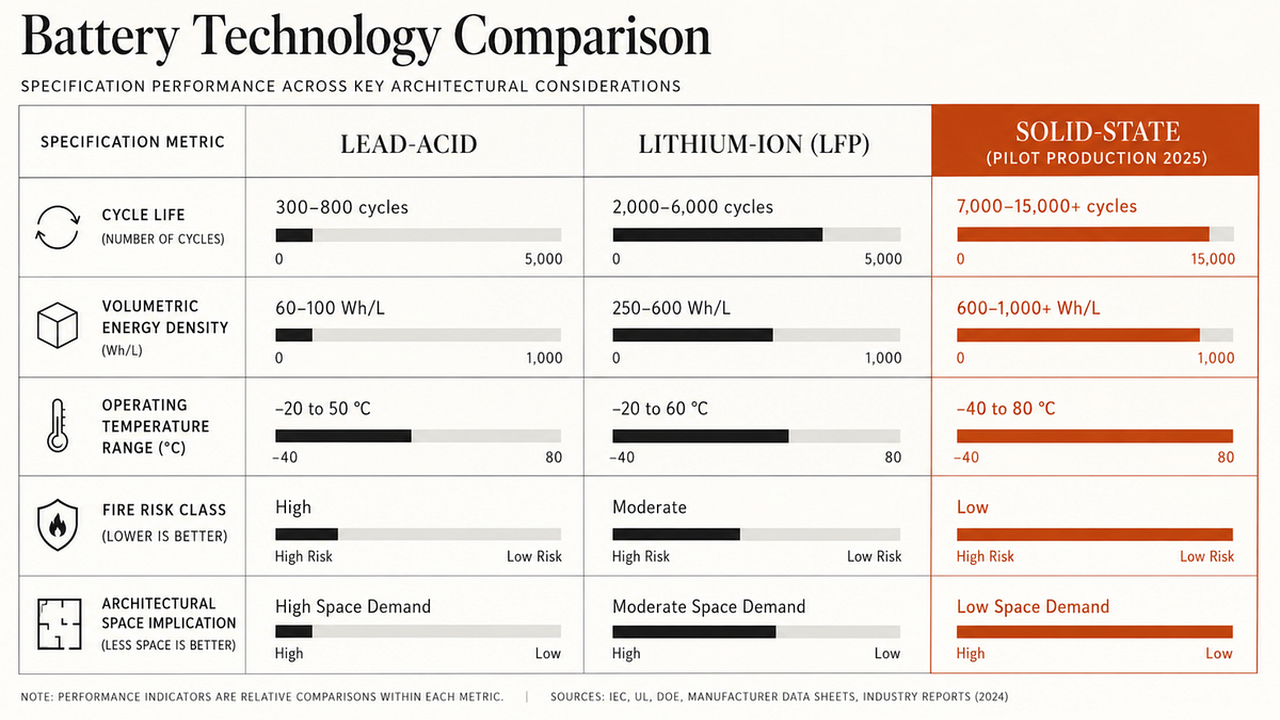
One of the greatest advantages of ASSBs is the elimination of flammable liquid electrolytes. This not only significantly enhances operational safety but also dramatically expands the operating temperature range. For instance, stable operation is possible over a very wide temperature range, from -50°C to 125°C, greatly improving reliability in extremely cold or hot environments.
Furthermore, for integration into homes and buildings, ASSBs offer structural advantages in terms of battery bank sizing, fire risk, and thermal management compared to conventional batteries, enabling safer and more efficient integration.
Technical Significance and Outlook
The maturation of all-solid-state battery technology will bring about revolutionary impacts not only on EV performance but also on energy storage systems, especially in off-grid, smart home, and industrial applications. Their high safety and wide operating temperature range increase flexibility in battery placement and enable use in environments where battery deployment was previously challenging.
The specific mass production targets and performance metrics announced by various companies indicate that ASSBs are transitioning from conceptual promise to tangible products entering the market. If cost competitiveness improves over the next 2-3 years, their adoption could accelerate rapidly. This would enhance energy independence at both individual and regional levels, strengthen resilience during disasters, and significantly improve the integration efficiency of renewable energy sources. In the long term, high-performance batteries are expected to become a crucial pillar for achieving a sustainable society.







Comments