Background: Robotic Operations in Confined Spaces and End-Effector Design Challenges
Robotic operations in confined and narrow spaces—such as those encountered in space exploration, medical surgery, precision inspection, and disaster response—are becoming increasingly important. In these applications, robot end-effectors (the manipulators at the end of an arm) must simultaneously possess accessibility to the workspace, precise operability, and robustness. However, rigid end-effectors are limited in their ability to pass through narrow passages or bypass complex obstacles due to their fixed shape. Conversely, fully flexible end-effectors often suffer from reduced operational precision or the inability to exert necessary gripping force. Overcoming this trade-off to develop end-effectors that function efficiently in confined spaces has been a long-standing challenge.
Key Findings: Evolution of Collapsible End-Effectors through Smart Materials
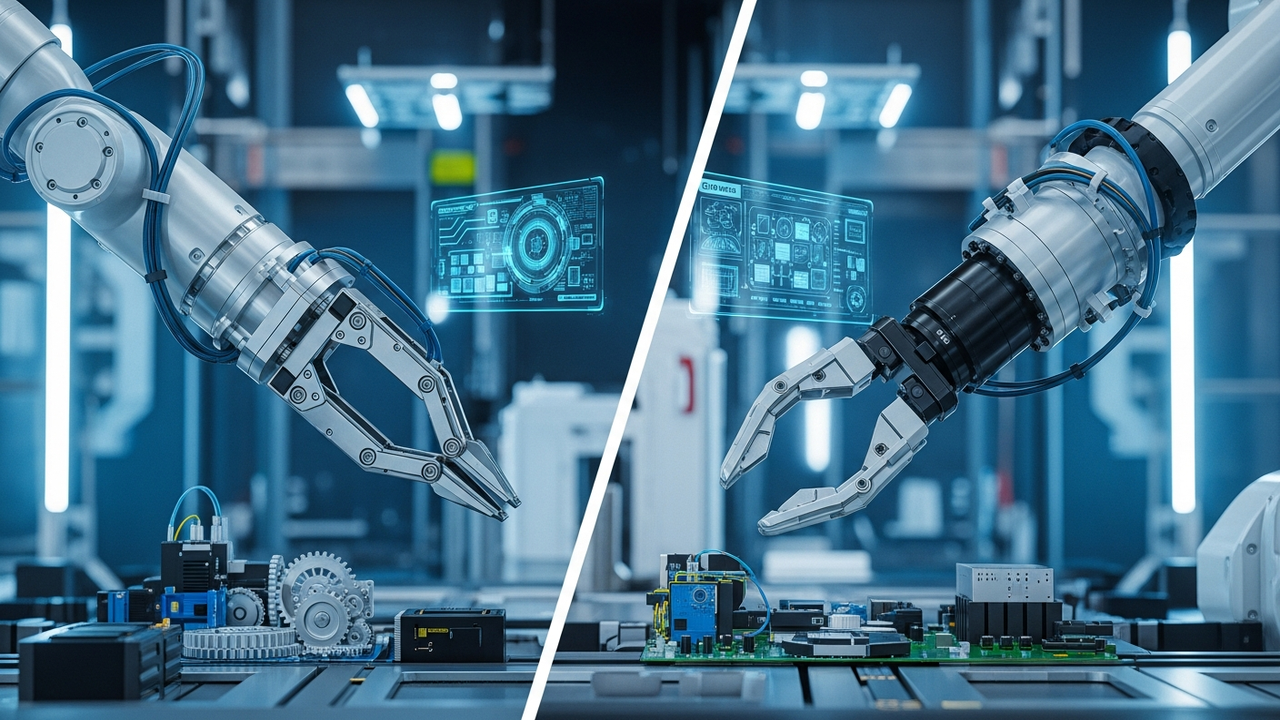
This article compares two main approaches for robotic end-effectors in compact spaces: traditional “rigid” end-effectors and the increasingly prominent “collapsible” end-effectors. The development of collapsible mechanisms has been significantly driven by breakthroughs in smart materials like Shape Memory Alloys (SMAs) and advanced polymer composites.
- Utilization of Shape Memory Alloys (SMAs): Specifically, nickel-titanium (NiTi) alloy-based actuators can switch their physical state between “rigid” and “flexible” through thermal activation. This allows the end-effector to fold flexibly to navigate narrow spaces and then regain rigidity to perform precise tasks once it reaches the working position. This property enables the simultaneous achievement of flexibility and operability, which was impossible with conventional rigid monolithic structures.
- Advanced Polymer Composites: These lightweight and high-strength materials are used as structural components in collapsible mechanisms, contributing to the overall lightweighting and enhanced durability of the end-effector.
The integration of these smart materials has enabled collapsible end-effectors to demonstrate superior performance in both accessibility and operability for compact applications.
Technical Significance and Outlook
Collapsible robotic end-effectors represent a significant technological advancement for dramatically improving operational capabilities in extreme or confined environments. This opens new possibilities in fields such as:
- Medicine: Small, flexible endoscopes and surgical instruments for minimally invasive surgery.
- Inspection and Maintenance: Robots for inspecting the interior of aircraft engines or narrow cracks in infrastructure.
- Space Exploration: Arms for spacecraft with limited payload and deployment space.
- Disaster Response: Robots designed to traverse debris-filled gaps for search and rescue operations.
Future research will focus on further improving response speed, enhancing energy efficiency, and developing more complex collapsible mechanisms with higher degrees of freedom. Furthermore, combining these with AI is expected to lead to more intelligent end-effectors that autonomously recognize their environment and determine optimal shape changes and operational strategies. This will further expand the contribution of robots in hazardous areas inaccessible to humans and in tasks requiring high precision.









Comments