Background: Challenges in Wearable Robotics and Actuators
The increasing elderly population, labor shortages, and the need for rehabilitation support for patients with neuromuscular diseases are driving the growing importance of wearable robots. However, existing wearable robots often contain many rigid components, making them heavy and bulky, which poses challenges for natural fit and comfortable wear on the human body. Furthermore, actuators—the components that generate movement—have struggled to combine high power output with flexibility, limiting their ability to provide natural and efficient assistance akin to human muscles.
Key Findings: KIMM’s SMA “Smart Threads” and Wearable Robot Development
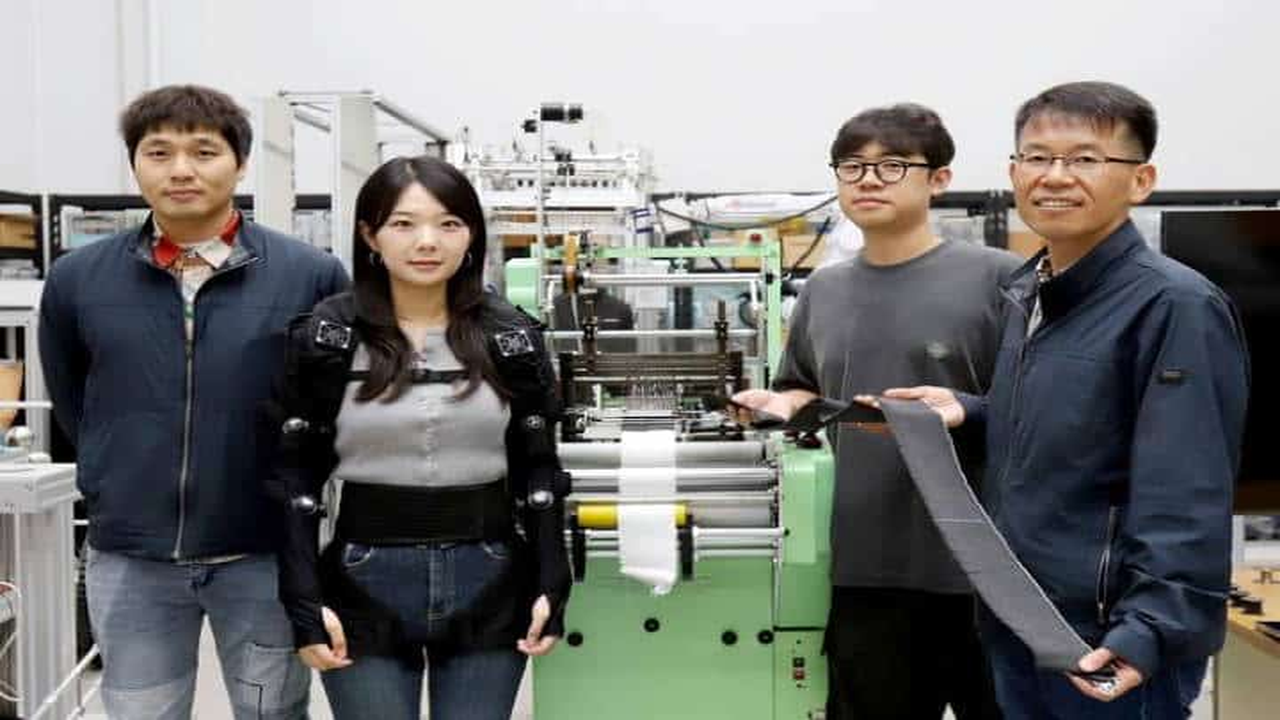
To overcome these challenges, a research team at the Korea Institute of Machinery & Materials (KIMM) has developed a groundbreaking wearable robot technology. The core innovation lies in precisely processing ultra-fine “Shape Memory Alloy (SMA)” wires, just 25 micrometers in diameter, into coiled structures. This creates “smart threads” that possess elastic properties and high power output closely resembling human muscle fibers. These SMA wires contract when thermally activated, generating force much like a contracting muscle. The research team constructed a flexible wearable robot by weaving these smart threads using a special method to effectively support human movement. Remarkably, users wearing this robot have reported an astonishing increase in physical strength by up to 40%.
These smart threads possess the following characteristics due to their high power density and flexibility:
- High Output: Generates strong contraction force with minimal thermal stimulation.
- Flexibility: Being fibrous, they conform naturally to the body like fabric, offering comfortable wear.
- Lightweight and Compact: Eliminates the need for bulky motors or gears, allowing for a lighter and more compact overall system.
Specifically, applications as soft exoskeletons to assist shoulder joints in patients with neuromuscular diseases are anticipated to improve daily living activities and enhance rehabilitation outcomes.
Technical Significance and Outlook
The wearable robot utilizing SMA smart threads developed by KIMM represents a major breakthrough in the convergence of actuator technology and wearable devices. Its ability to integrate naturally with the human body and provide powerful yet flexible assistance enables innovative applications across various fields:
- Medical and Rehabilitation: Assisting mobility for patients with muscle weakness, improving joint range of motion, and preventing falls.
- Industrial and Caregiving: Power-assist suits for lifting heavy loads, reducing caregiver burden.
- Sports and Entertainment: Performance-enhancing sportswear, immersive VR/AR experiences.
Future research will focus on further improving the response speed of SMAs, enhancing energy efficiency, and ensuring durability for prolonged continuous use. Furthermore, integrating sensor technology and AI is expected to lead to the evolution of “smart” wearable robots that can more accurately interpret user intent and provide assistance with optimal timing and strength. This technology marks a powerful step towards realizing a future society where humans and machines cooperate more seamlessly.
Source: https://en.futuroprossimo.it/2026/05/robot-indossabile-in-tessuto-ti-da-il-40-di-forza-in-piu/








Comments