Key Findings
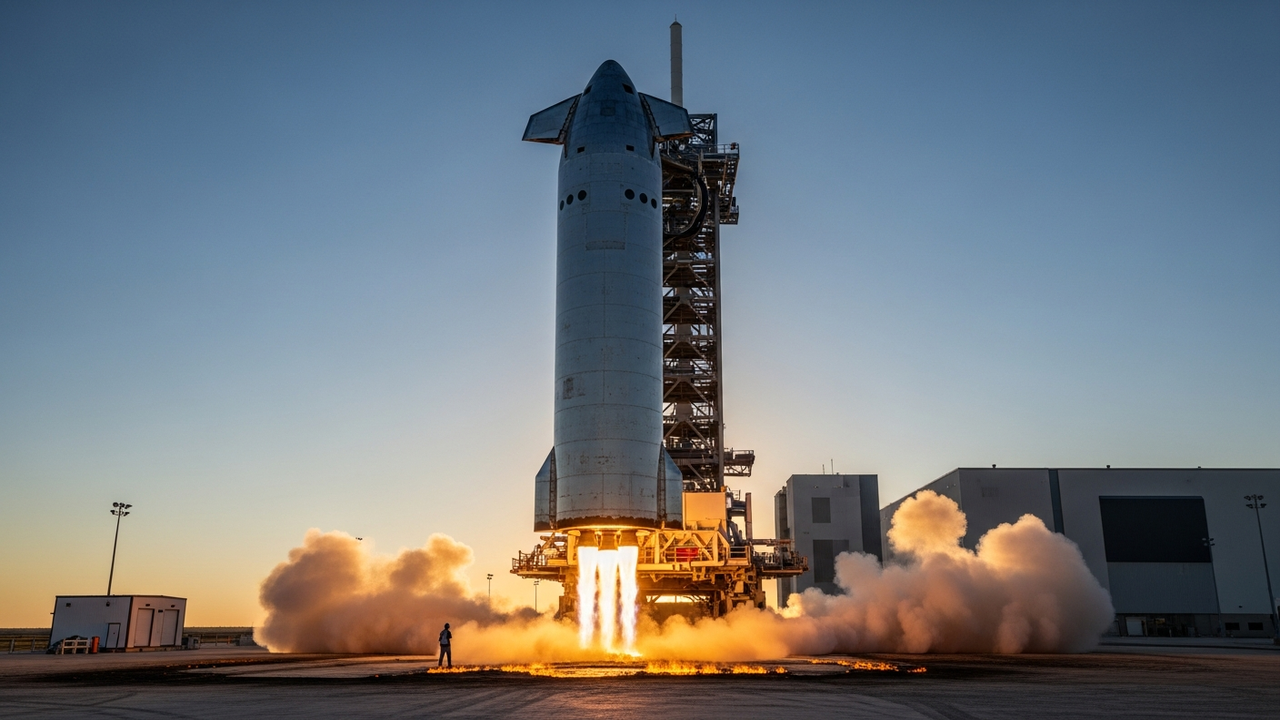
SpaceX successfully completed a single-engine static fire test of its Starship prototype, “Ship 40,” at the Massey’s Test Site in Starbase, Texas, on June 25, 2026. This 60-second full-duration test represents a significant technical advancement, indicating that preparations for Starship’s upcoming flight mission (Flight 13) are proceeding smoothly.
Test Details and Technical Significance
- Purpose of Static Fire Tests: Static fire tests are crucial processes for evaluating a rocket engine’s thrust, propellant delivery system, and structural integrity on the ground. The Ship 40 test involved firing a single Raptor engine at full power for 60 seconds, confirming that the engine performed as expected.
- Improved Raptor Engine Reliability: Starship’s Raptor engines are designed for reusability, featuring a high thrust-to-weight ratio and efficient methane-fueled combustion. The success of this test contributes to enhancing Raptor engine reliability and durability, providing important data for future flights with multi-engine configurations.
- Preparation for Flight 13: The success of this test is positioned as one of the final stages of preparation for Starship’s next flight, Flight 13. Flight 13 is expected to demonstrate further improvements in orbital insertion capabilities and validation of re-entry and landing technologies, and this engine test is an indispensable component for its success.
- Potential for In-Orbit Relight Sequence: Reports suggest that this test might also simulate an in-orbit engine relight sequence. This capability is crucial for missions to the Moon and Mars, where it would be essential for key maneuvers such as orbital insertion for landing or during liftoff, and for validating Starship’s deep-space exploration capabilities.
Background & Industry Context
The Starship program is central to SpaceX’s audacious goal of enabling human settlement on Mars. As a fully reusable, super heavy-lift rocket system, Starship aims to drastically reduce the cost of space transportation and democratize access to space. Therefore, test flights and ground tests of each prototype are indispensable processes for overcoming technical challenges and iterating and improving the design.
Future Outlook
The successful static fire test of Ship 40 instills confidence across the entire Starship program and raises expectations for the early execution of Flight 13. The upcoming flight mission is expected to validate more complex orbital maneuvers, thermal management during re-entry, and precise landing technologies. This will gather critical data for Starship to advance towards commercial satellite launches, space tourism, and eventual lunar and Martian missions. This progress marks a decisive step in SpaceX’s efforts to redefine the future of space transportation.
Source: https://www.basenor.com/blogs/news/spacex-fires-up-ship-40-in-single-engine-starship-static-fire
Get our weekly technology intelligence — free
Receive an infographic that lets you judge at a glance whether each field’s analysis report is worth reading.
Subscribe Free — Weekly Tech Intelligence
By subscribing, you’ll receive Troy-Technical’s weekly technology intelligence newsletter.
- Your email and selected fields are used only to deliver the newsletter.
- We never share your information with third parties.
- You can unsubscribe anytime via the link in each email.
See our Privacy Policy for details.
Takes about a minute · Unsubscribe anytime








Comments