Key Findings
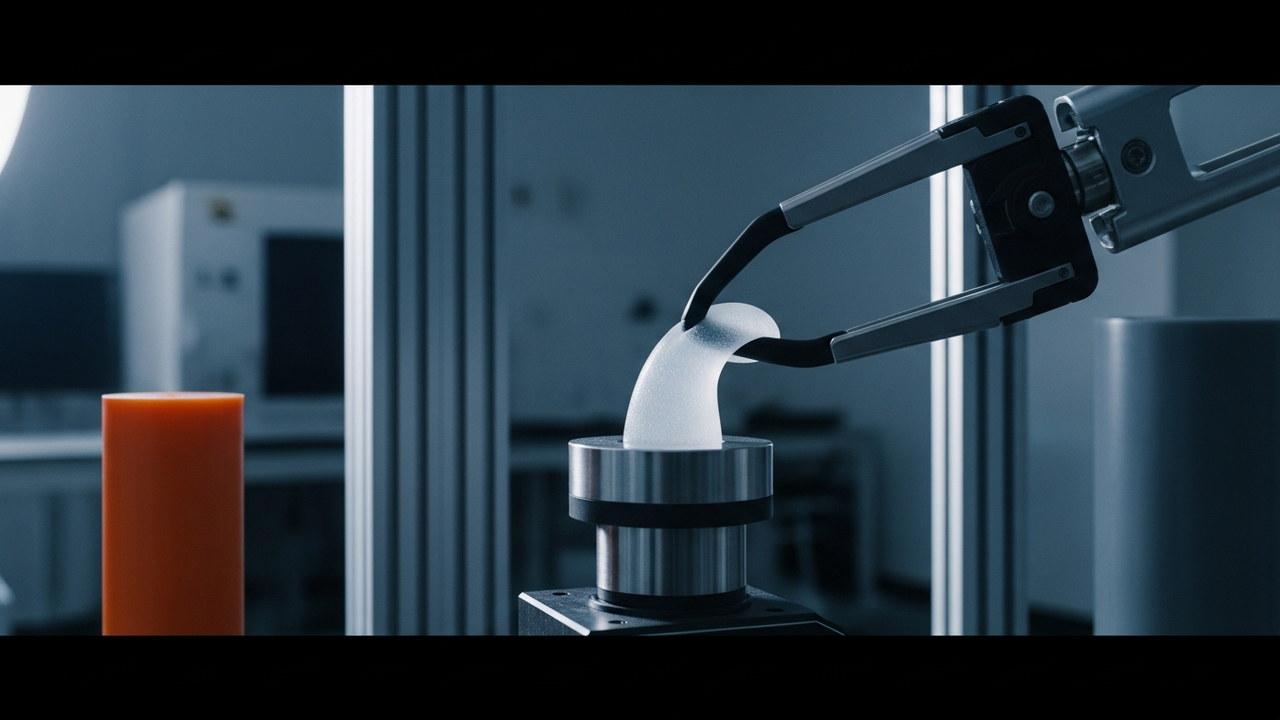
Thermoplastic Liquid Crystal Elastomers (TPLCEs) are garnering significant attention in the field of soft actuators due to their dynamic responsiveness, allowing for substantial deformation in response to external stimuli, and their melt-processability, which offers reprocessing advantages over conventional thermoset LCEs. This research reports the development of a series of TPLCEs based on hydrogen-bonded segmented polythiourethanes. These materials possess a groundbreaking characteristic: their nematic-to-isotropic transition temperature (TNI) for actuation and their melt temperature (Tm) for processing can be independently tuned. Furthermore, the realization of dual-active LCE bilayer actuators, which exhibit non-monotonic deformation with increasing temperature, significantly expands the application potential for a new generation of perceptive soft grippers.
Technical / Clinical Details
The developed TPLCEs feature a block copolymer design composed of soft segments (flexible polymer chains) and hard segments (hydrogen-bonding sites). The reversibility of hydrogen bonds, which break upon heating and reform upon cooling, enables the TPLCEs to be melt-processed. The research team demonstrated that by synthesizing polythiourethanes with varying compositional ratios and molecular weights, they could control both TNI and Tm across a broad range. Specifically, TNI can be tuned from near room temperature to over 100°C, and Tm can also be optimized according to specific application requirements. This allows for custom design tailored to applications demanding specific operating temperatures and processing parameters. The dual-active LCE bilayer actuators, fabricated by laminating two TPLCE films with different TNIs, achieve complex and precise bending and stretching motions in response to temperature changes.
Background & Context
Soft robotics is attracting attention in various fields such as medicine, manufacturing, and exploration, due to its ability to adapt to complex shapes, interact safely with humans, and manipulate delicate objects—capabilities difficult for traditional rigid robots. At the core of soft robotics are smart actuator materials that change shape in response to external stimuli. While conventional thermoset LCEs exhibit high responsiveness, they are difficult to reprocess once formed, posing challenges for complex shaping and recyclability. TPLCEs are expected to overcome these processing and recyclability issues, enabling the construction of more sustainable and diverse soft robotic systems. Perceptive soft grippers, integrating tactile feedback and environmental sensing capabilities, represent a frontier in future robotic technology.
Strategic Significance & Outlook
The development of these tunable TPLCEs will contribute to the design and manufacture of innovative soft actuators for a wide range of applications beyond perceptive soft grippers, including wearable devices, bio-inspired robots, smart textiles, and microfluidic devices. The research team plans to further evaluate the long-term stability, fatigue properties under repeated use, and programmable motion sequencing capabilities of these TPLCEs. The low-temperature actuation and weldability properties, in particular, represent crucial steps towards energy-efficient manufacturing processes and the realization of multi-functional soft robotic systems. This technology has the potential to accelerate a future where soft robots are more practical and ubiquitous.
Source: https://pubs.acs.org/doi/10.1021/acs.macromol.6c00633
Get our weekly technology intelligence — free
Receive an infographic that lets you judge at a glance whether each field’s analysis report is worth reading.
Subscribe Free — Weekly Tech Intelligence
By subscribing, you’ll receive Troy-Technical’s weekly technology intelligence newsletter.
- Your email and selected fields are used only to deliver the newsletter.
- We never share your information with third parties.
- You can unsubscribe anytime via the link in each email.
See our Privacy Policy for details.
Takes about a minute · Unsubscribe anytime






Comments