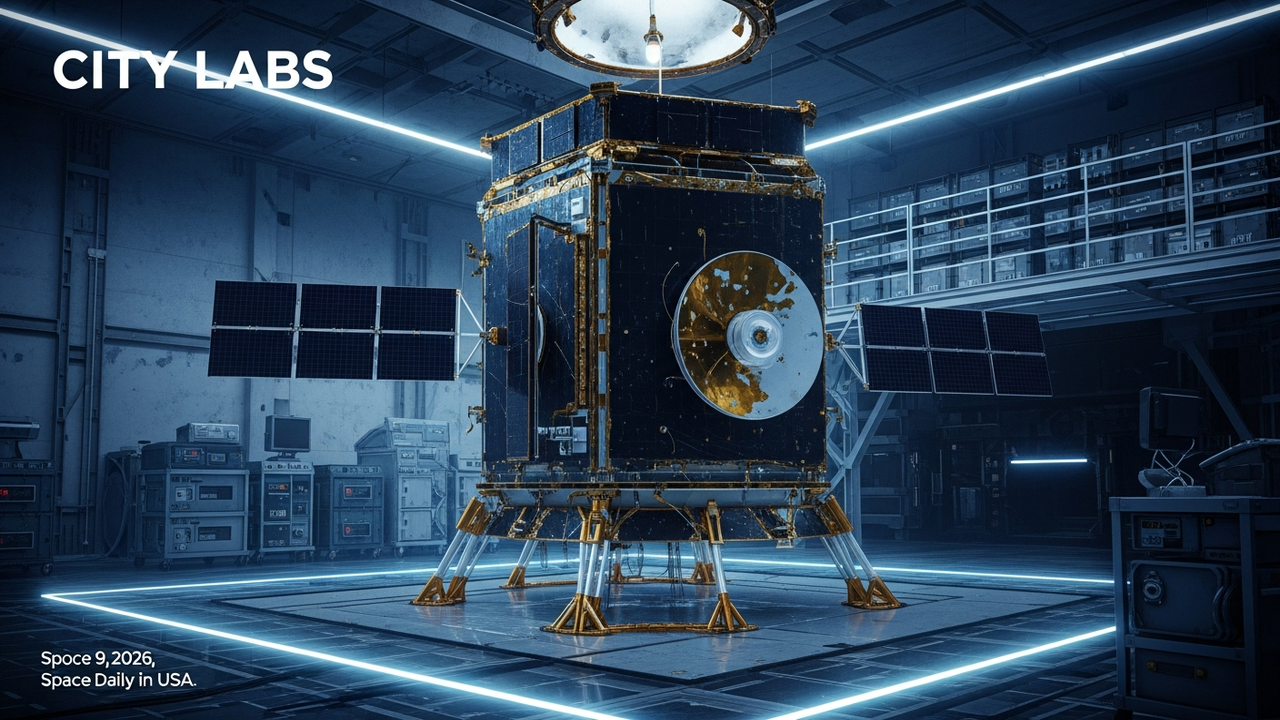
Key Achievement: City Labs Launches First FAA-Approved Commercial Nuclear-Powered Satellite, BOHR CubeSat
City Labs, a Miami, Florida-based startup, has successfully launched its ‘BOHR CubeSat,’ equipped with a tritium-powered betavoltaic battery, into orbit via a SpaceX Falcon 9 rocket. This BOHR CubeSat represents a historic first: the first commercial spacecraft cleared to carry a nuclear power source under the U.S. Federal Aviation Administration (FAA) pathway established following a 2019 White House memo. This success demonstrates that a safe, compact, and regulatory-approved nuclear power system is ready for commercial deployment.
Technical Details: Function and Applications of the Tritium Betavoltaic Battery ‘NanoTritium’
The betavoltaic battery onboard the BOHR CubeSat, known as the ‘NanoTritium micropower source,’ directly converts the energy of beta particles (electrons) emitted during the decay of the radioactive isotope tritium into electrical power. This technology is independent of solar power, offering the revolutionary advantage of continuous power supply in deep space where sunlight is unavailable, or under permanently shadowed conditions such as the two-week lunar night. This small, reliable power source is expected to be applied to various payloads requiring long-term autonomous operation, including low-power sensors, communication devices, security systems, and remote monitoring equipment.
Background & Industry Context: Diversification of Space Energy Sources and Regulatory Easing
Traditional space missions have primarily relied on solar cells and chemical batteries for power. However, for deep-space exploration and long-duration missions in lunar polar regions, solar power limitations have posed significant challenges. While large plutonium-based Radioisotope Thermoelectric Generators (RTGs) have a proven track record, they are unsuitable for small satellites and commercial missions. City Labs’ NanoTritium battery offers a new option for nuclear power sources in commercial space due to its small size, high safety profile, and FAA approval. The 2019 White House memo outlined a policy to promote the use of nuclear power sources in commercial space activities, and this launch can be seen as the culmination of regulatory easing and technological innovation.
Future Outlook: Accelerating Lunar Exploration and Expanding the Space Economy
The commercial use of tritium-powered nuclear batteries has the potential to significantly impact future lunar exploration, particularly the search for water ice resources in the lunar south pole region. Probes capable of operating during the lunar night will enable the acquisition of scientific data from previously inaccessible areas, providing crucial information for lunar base construction. Furthermore, this technology will facilitate the development of a wide range of commercial space applications, such as IoT devices requiring long-term operation in space and new space security systems. City Labs’ success marks a groundbreaking case in diversifying energy solutions within the space economy and creating new business opportunities.
Get our weekly technology intelligence — free
Receive an infographic that lets you judge at a glance whether each field’s analysis report is worth reading.
Subscribe Free — Weekly Tech Intelligence
By subscribing, you’ll receive Troy-Technical’s weekly technology intelligence newsletter.
- Your email and selected fields are used only to deliver the newsletter.
- We never share your information with third parties.
- You can unsubscribe anytime via the link in each email.
See our Privacy Policy for details.
Takes about a minute · Unsubscribe anytime








Comments