
Key Achievement: China’s Long March 10B Achieves World-First Controlled Net Capture Recovery
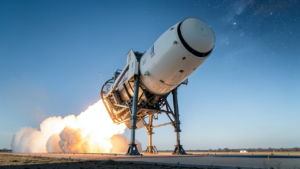
China has successfully recovered the first stage booster of its Long March 10B rocket using a specialized net capture system deployed on a maritime platform during its inaugural orbital launch test. This method of recovery is the world’s first demonstration of its kind, clearly indicating China’s breakthrough in reusable rocket technology and its entry into the ‘rocket recovery era.’ This success is paramount for significantly reducing launch costs and enhancing the international competitiveness of China’s commercial space industry.
Technical Details: Functionality and Advantages of the Groundbreaking Net Capture System
The Long March 10B’s first stage booster utilized an advanced guidance and control system, along with retropropulsion, to accurately descend towards a designated recovery platform at sea. On this platform, a large, expansive net was deployed to allow for a soft landing of the booster, enabling recovery with minimal structural damage. Compared to conventional vertical landings using landing legs, the net capture system potentially simplifies landing accuracy requirements and allows for lighter booster designs. This technology is expected to shorten booster re-use cycles and achieve rapid launch turnaround times, facilitating low-cost and high-frequency space transportation.
Background & Industry Context: China’s Rise as a Space Power and Technological Competition
Reusable rocket technology has been pioneered by SpaceX with its Falcon 9 and Starship, dramatically altering the cost structure of space transport. China is accelerating its indigenous space program, particularly aiming to expand its international influence in the commercial space sector. The success of the Long March 10B demonstrates that China is catching up to the United States and establishing itself as a key player in the cutting-edge space technology race. This technological innovation is crucial for achieving long-term national objectives such as satellite internet, deep-space exploration, and crewed missions to the Moon and Mars.
Future Outlook: Enhanced Space Access and International Collaboration
The success of the Long March 10B will significantly enhance China’s access to space, enabling more economical and efficient deployment of large-scale satellite constellations in low Earth orbit. This will usher China’s space industry into a new phase of growth, capable of meeting domestic and international commercial demands. Furthermore, the evolution of this technology opens new possibilities for future space infrastructure development, including areas like space-based solar power generation and in-orbit manufacturing. China’s progress in reusable rocket technology is expected to further invigorate the dynamics of cooperation and competition in international space development.
Source: https://www.globaltimes.cn/page/202607/1365624.shtml
Get our weekly technology intelligence — free
Receive an infographic that lets you judge at a glance whether each field’s analysis report is worth reading.
Subscribe Free — Weekly Tech Intelligence
By subscribing, you’ll receive Troy-Technical’s weekly technology intelligence newsletter.
- Your email and selected fields are used only to deliver the newsletter.
- We never share your information with third parties.
- You can unsubscribe anytime via the link in each email.
See our Privacy Policy for details.
Takes about a minute · Unsubscribe anytime







Comments