Key Findings
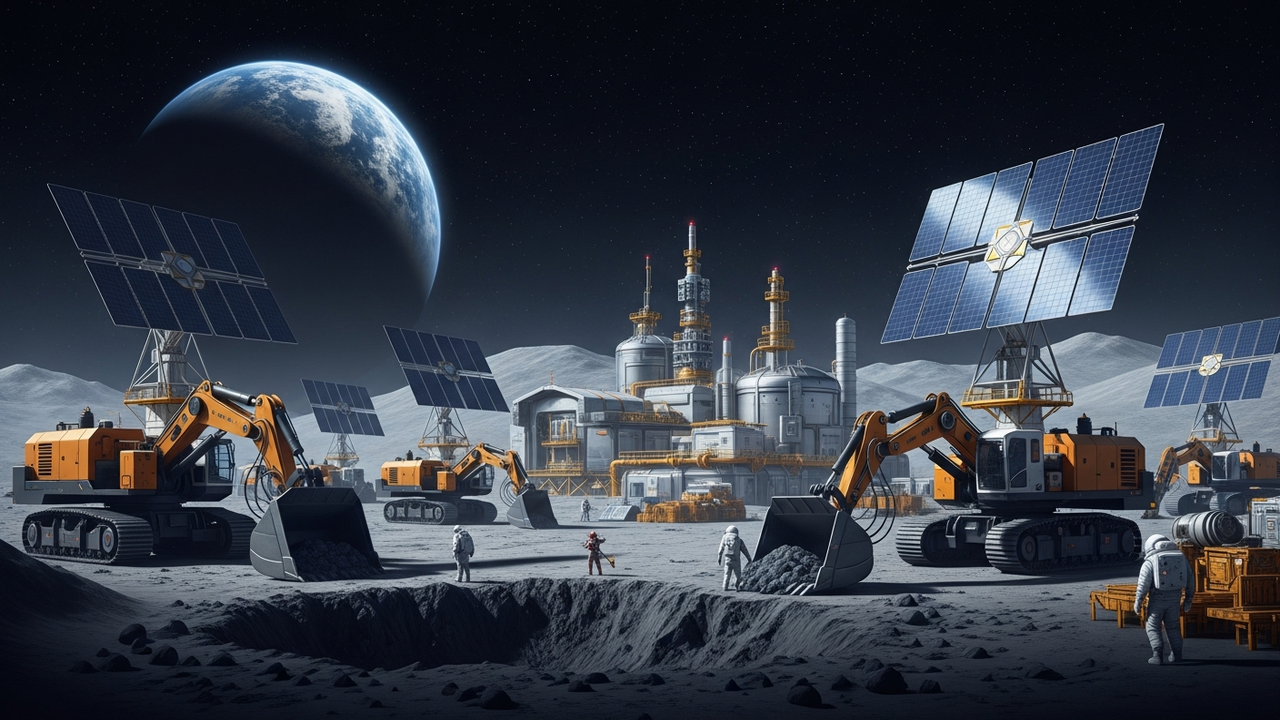
NASA has set an ambitious goal to establish a sustained human presence on the Moon by 2032, driven by a strategy that prioritizes the utilization of lunar resources. The agency believes that manufacturing and launching space solar power satellites from the lunar surface will be more cost-effective than producing and launching similar systems from Earth. This approach opens up the possibility of the Moon becoming a pivotal industrial hub for supporting in-space manufacturing activities in the future.
Technical & Clinical Details
Achieving a sustained human presence on the Moon necessitates resolving numerous challenges, including power supply, habitation, life support systems, and resource utilization. In-Situ Resource Utilization (ISRU) technologies, which involve extracting water, oxygen, and construction materials from lunar regolith, are crucial for enabling self-sufficient base operations independent of Earth resupply. Space solar power satellites, designed to collect solar energy in orbit and beam it back to Earth or lunar surfaces via microwaves or lasers, can significantly reduce launch costs and risks by manufacturing some or all components on the Moon. Lunar manufacturing leverages unique advantages offered by microgravity or low-gravity environments, such as easier assembly of large structures and precision manufacturing in a vacuum. Furthermore, polar ice resources on the Moon are expected to be a source not only of water but also of hydrogen and oxygen, which can serve as rocket propellant, fostering the concept of the Moon as an ‘orbital gas station.’
Background & Context
NASA’s Artemis program aims not only to return humans to the Moon for the first time since Apollo but also to establish long-term lunar habitation as a stepping stone for Mars exploration. This program actively encourages international cooperation and private sector participation, with the creation of a lunar economy at its core. By transforming the Moon into an industrial hub, the goal is to reduce space infrastructure costs, expand access to space, and ultimately generate new value for terrestrial economic activities. Space solar power also holds potential to contribute to solving Earth’s energy problems, making lunar manufacturing highly strategic.
Strategic Significance & Outlook
The dual objectives of sustained lunar presence by 2032 and establishing the Moon as an industrial hub signal a new paradigm shift in space development. The establishment of autonomous manufacturing capabilities on the Moon will not only cut costs for space solar power satellites but also accelerate diverse commercial activities such as lunar base construction, deployment of space telescopes, and even lunar tourism. NASA and its commercial partners are expected to continue focusing on developing ISRU technologies, advanced robotics, and energy infrastructure on the Moon. Consequently, the Moon is poised to undergo a significant transformation in its role, becoming a vital outpost for human activity and economic development.
Source: https://www.newsweek.com/nasa-moon-base-lunar-mission-everyday-life-reality-12175965
Get our weekly technology intelligence — free
Receive an infographic that lets you judge at a glance whether each field’s analysis report is worth reading.
Subscribe Free — Weekly Tech Intelligence
By subscribing, you’ll receive Troy-Technical’s weekly technology intelligence newsletter.
- Your email and selected fields are used only to deliver the newsletter.
- We never share your information with third parties.
- You can unsubscribe anytime via the link in each email.
See our Privacy Policy for details.
Takes about a minute · Unsubscribe anytime




Comments