Key Findings
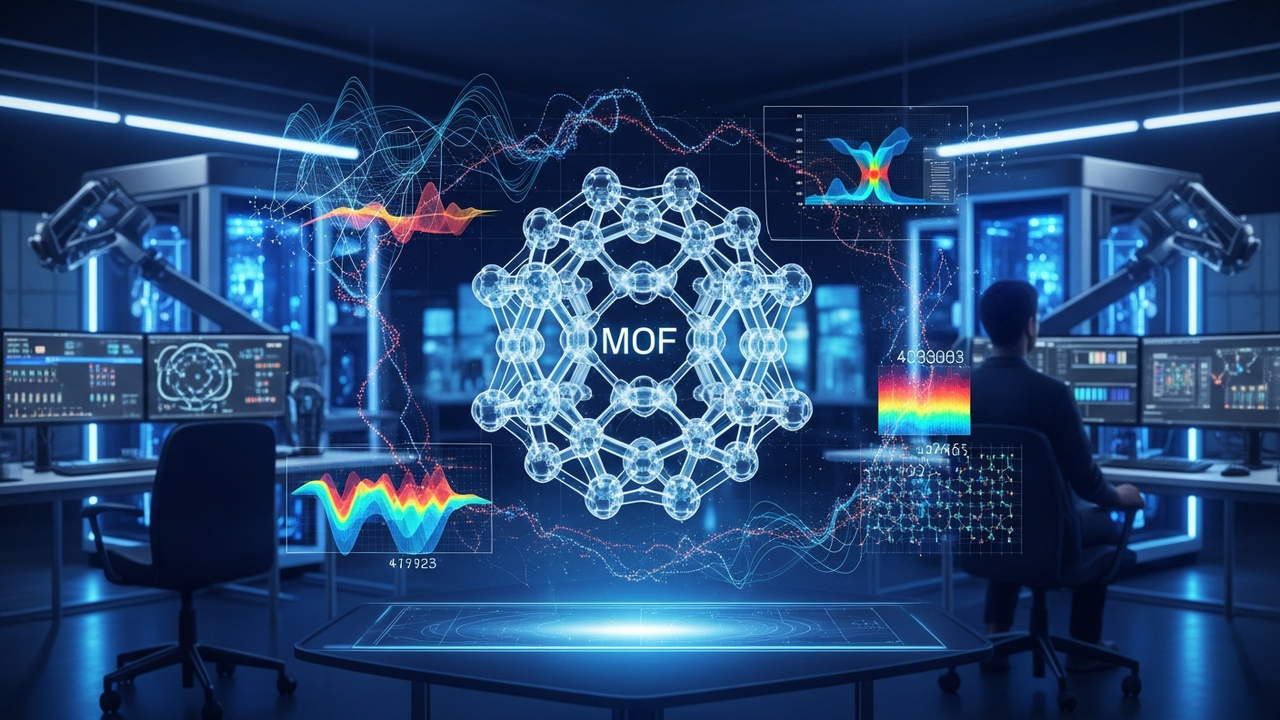
In research published in ‘Chemical Science’ by The Royal Society of Chemistry, a hybrid workflow has been introduced to revolutionize adsorption performance screening for metal-organic frameworks (MOFs). This novel methodology effectively integrates classical force fields with universal machine learning interatomic potentials (u-MLIPs), achieving high accuracy comparable to Density Functional Theory (DFT) calculations but at a significantly lower computational cost. This dramatically enhances the efficiency of evaluating adsorption performance across large MOF structural databases, a task previously hampered by computational constraints.
Technical / Clinical Details
The developed hybrid screening workflow consists of multiple stages. Initially, classical force fields are used for rapid exploration of candidate adsorption sites and fundamental adsorption mechanisms within MOF structures. While classical force fields excel in computational speed, they have limitations in accuracy. Therefore, promising candidates are then subjected to detailed simulations using u-MLIPs. U-MLIPs are machine learning models trained on interatomic interactions derived from DFT calculations, offering DFT-comparable accuracy while requiring several orders of magnitude less computational cost. This two-stage approach combines the speed of classical force fields with the high accuracy of u-MLIPs, optimizing computational resources to accurately describe complex interactions between MOFs and gas molecules. Specifically, it enables efficient evaluation of how gas molecules, such as CO2, adsorb into MOF pore structures, including their adsorption energies and selectivities, across vast MOF libraries.
Background & Context
Metal-organic frameworks (MOFs), with their diverse structures and tunable pore characteristics, are next-generation materials expected to have wide-ranging applications in gas storage, separation, CO2 capture, catalysis, and sensing. However, the theoretically possible number of MOF structures is astronomical, and evaluating the adsorption properties of individual MOFs experimentally or with high-accuracy DFT calculations is prohibitively time-consuming and costly. This computational bottleneck has been a major factor delaying the practical application of high-performance MOFs. The presented hybrid methodology breaks through this bottleneck, enabling large-scale virtual screening and opening the way to rapidly identify MOFs optimal for specific applications (e.g., CO2 separation from industrial flue gas).
Strategic Significance & Outlook
This hybrid screening workflow, integrating u-MLIPs and classical force fields, powerfully advances the application of ‘materials informatics’ in MOF research. Moving forward, this method is expected to be applied not only to MOFs but also to the design and screening of other porous materials and catalytic materials. Furthermore, by strengthening integration with experimental data to enhance prediction reliability, the timeframe from computational material discovery to practical application can be significantly reduced. This technology is anticipated to become a crucial foundation for accelerating the creation of high-performance materials essential for environmental technologies (e.g., improved CO2 capture efficiency) and energy-efficient process development, contributing to the realization of a sustainable society.
Source: https://xlink.rsc.org/?DOI=D6SC00831C
Get our weekly technology intelligence — free
Receive an infographic that lets you judge at a glance whether each field’s analysis report is worth reading.
Subscribe Free — Weekly Tech Intelligence
By subscribing, you’ll receive Troy-Technical’s weekly technology intelligence newsletter.
- Your email and selected fields are used only to deliver the newsletter.
- We never share your information with third parties.
- You can unsubscribe anytime via the link in each email.
See our Privacy Policy for details.
Takes about a minute · Unsubscribe anytime









Comments