Key Findings
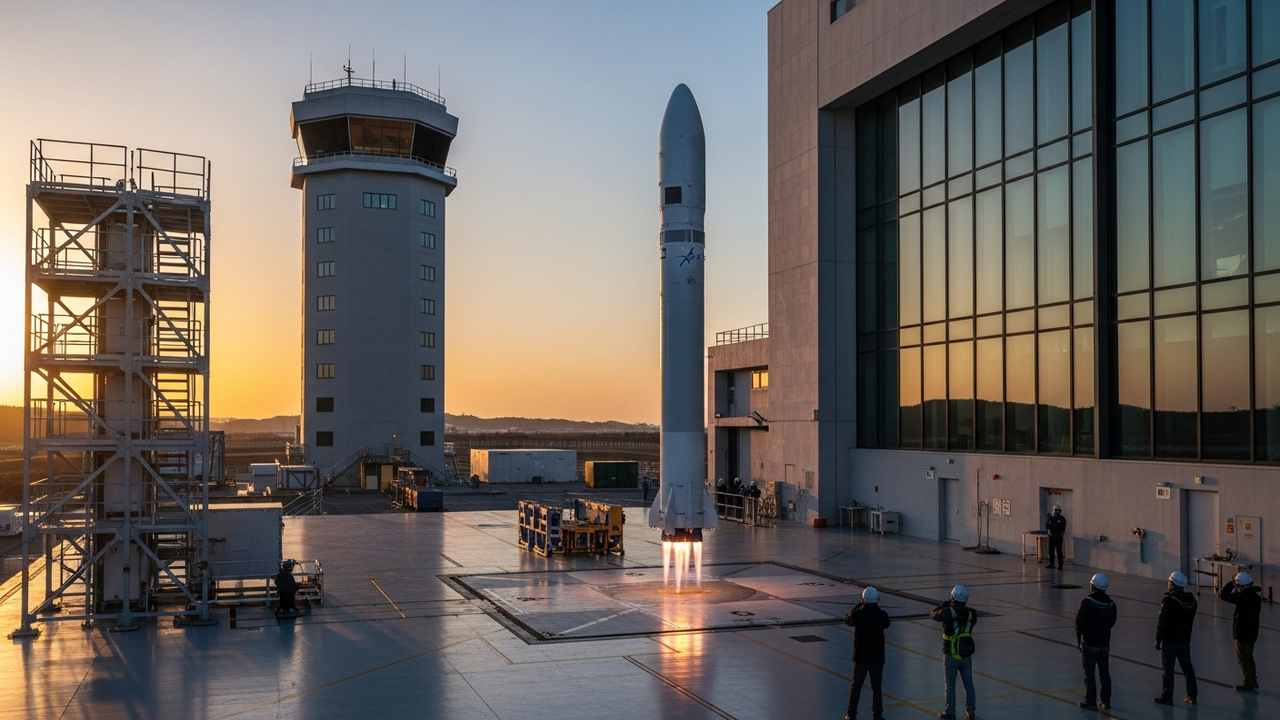
The Japan Aerospace Exploration Agency (JAXA) has announced the successful completion of a launch and landing test for a reusable rocket prototype at its Noshiro Test Facility. The prototype ascended to approximately 10 meters, performed a controlled 40-second flight, and then executed a precise, soft landing. This achievement marks a critical step for Japan in the global race to develop reusable launch vehicle technology, a field currently spearheaded by companies like SpaceX, which aims to drastically reduce the cost of space access.
Technical / Clinical Details
The reusable rocket prototype demonstrated vertical take-off and vertical landing (VTVL) capabilities. Despite the initial modest altitude and flight duration, the test validated several key technologies, including advanced guidance and control systems, the deployment mechanism for landing legs, and the precise thrust vectoring required for a stable descent and landing. JAXA engineers collected comprehensive data on flight dynamics, engine performance, and structural behavior, which will be instrumental in refining future designs. The agency plans to leverage these insights for the development of larger, more capable reusable rockets, ultimately aiming for orbital launch and recovery capabilities.
Background & Context
Reusable rocket technology is a game-changer in the space industry, offering the potential to dramatically lower launch costs and increase flight frequency by repurposing expensive hardware. This paradigm shift, exemplified by SpaceX’s Falcon 9 and Starship, has spurred a global competition among spacefaring nations and private companies. JAXA’s successful test signifies Japan’s commitment to developing an indigenous reusable launch capability, crucial for maintaining its autonomy in space activities and securing a competitive edge in the burgeoning commercial space market. The move is strategically important for Japan’s long-term space exploration and utilization goals, aligning with international trends towards more sustainable and economical space access.
Strategic Significance & Outlook
This successful test is expected to accelerate JAXA’s reusable rocket development program, with long-term goals of achieving significant reductions in satellite launch costs and enhancing the frequency of access to space. By fostering greater operational efficiency, Japan aims to strengthen its position in the global commercial launch services market. Furthermore, reusable technologies will be vital for future deep-space missions, including lunar and Martian exploration, by providing more economical transportation solutions. JAXA is anticipated to proceed with further flight tests and address engineering challenges to mature the technology for practical applications, contributing broadly to Japan’s multifaceted space strategy.
Get our weekly technology intelligence — free
Receive an infographic that lets you judge at a glance whether each field’s analysis report is worth reading.
Subscribe Free — Weekly Tech Intelligence
By subscribing, you’ll receive Troy-Technical’s weekly technology intelligence newsletter.
- Your email and selected fields are used only to deliver the newsletter.
- We never share your information with third parties.
- You can unsubscribe anytime via the link in each email.
See our Privacy Policy for details.
Takes about a minute · Unsubscribe anytime





Comments