Key Findings
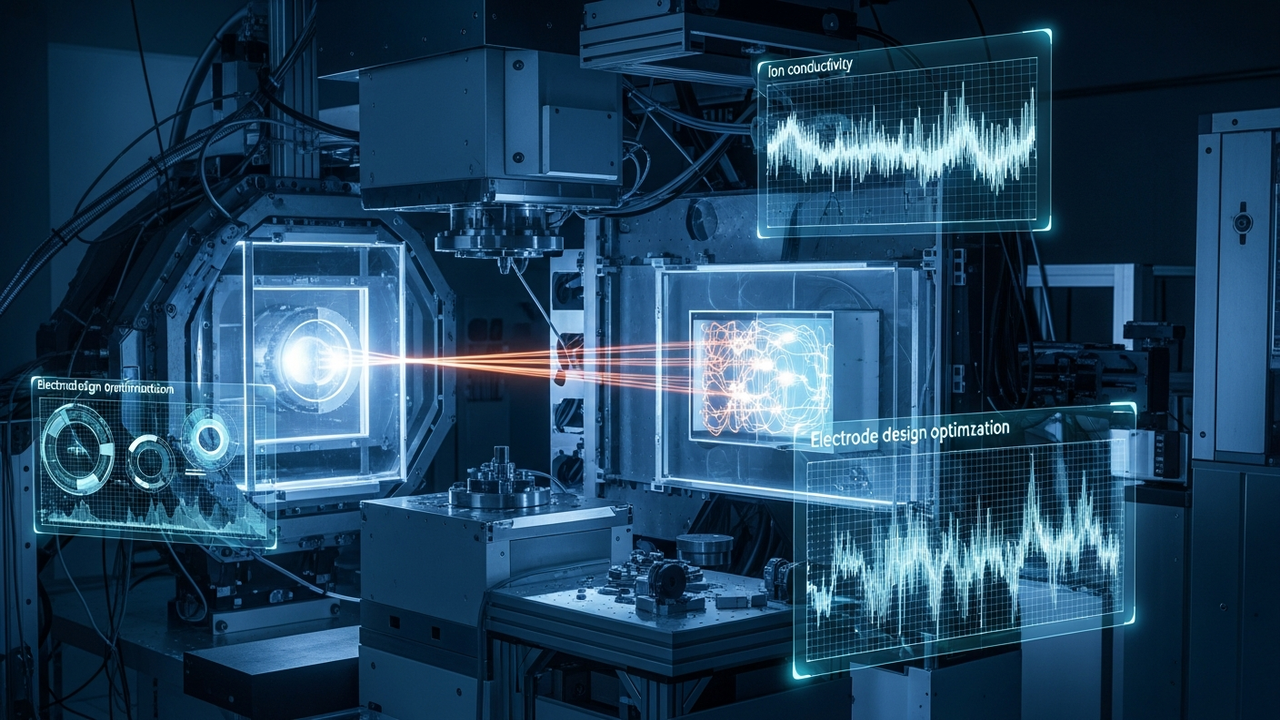
Groundbreaking neutron diffraction experiments conducted at the Institut Laue-Langevin (ILL) in Grenoble, France, have for the first time meticulously tracked the behavior of lithium ions inside thick all-solid-state batteries in real-time during operation. This pivotal research provides an unprecedentedly clear and comprehensive overview of how critical factors such as electrode design, ionic conductivity within the solid electrolyte, and various operating conditions influence the uniformity of electrochemical reactions inside the battery. This direct observation lays a crucial scientific foundation for addressing the fundamental challenges of all-solid-state batteries.
Technical / Clinical Details
Neutron diffraction is a unique tool capable of non-destructively and in detail observing the positions and movements of light elements like lithium. In this study, by using thick all-solid-state batteries, researchers simulated lithium migration under conditions closer to actual battery operation and collected in-situ data. Specifically, they directly visualized how lithium moves from the anode to the cathode, and through the solid electrolyte, including its speed, pathways, and inhomogeneities. This led to a clearer understanding of mechanisms like dendrite formation under high current density and lithium accumulation at the solid electrolyte-electrode interface. The data obtained provides invaluable information for identifying battery degradation processes and optimizing the microstructure of electrode materials and solid electrolytes.
Background & Context
All-solid-state batteries are anticipated as next-generation battery technology for electric vehicles (EVs) and large-scale energy storage systems due to their numerous advantages over conventional liquid-electrolyte lithium-ion batteries, including higher energy density, superior safety (elimination of thermal runaway risk), and long lifespan. However, sluggish lithium-ion transport within solid electrolytes and high resistance at electrode-electrolyte interfaces have been major hurdles for their commercialization. Crucially, directly observing what happens inside a battery during operation has been extremely difficult, acting as a bottleneck for development. The neutron diffraction experiment at ILL plays a decisive role in demystifying this ‘black box’ and bridging theory with experiment.
Strategic Significance & Outlook
The insights gained from this research will directly guide the design of future all-solid-state batteries. By smarter optimization of electrode material selection, solid electrolyte composition and microstructure, and battery operating conditions, it will be possible to maximize the efficiency of lithium-ion transport and minimize interfacial degradation. This is expected to accelerate the development of higher-performance, longer-lasting, and safer all-solid-state batteries. Specifically, it holds the potential to significantly contribute to extending EV driving range, improving fast-charging capabilities, and enhancing the reliability of grid storage solutions for renewable energy integration. This neutron diffraction technology can also be applied to research on other battery systems and energy materials, becoming an important tool for accelerating the bridge from scientific discovery to industrial application.
Get our weekly technology intelligence — free
Receive an infographic that lets you judge at a glance whether each field’s analysis report is worth reading.
Subscribe Free — Weekly Tech Intelligence
By subscribing, you’ll receive Troy-Technical’s weekly technology intelligence newsletter.
- Your email and selected fields are used only to deliver the newsletter.
- We never share your information with third parties.
- You can unsubscribe anytime via the link in each email.
See our Privacy Policy for details.
Takes about a minute · Unsubscribe anytime









Comments