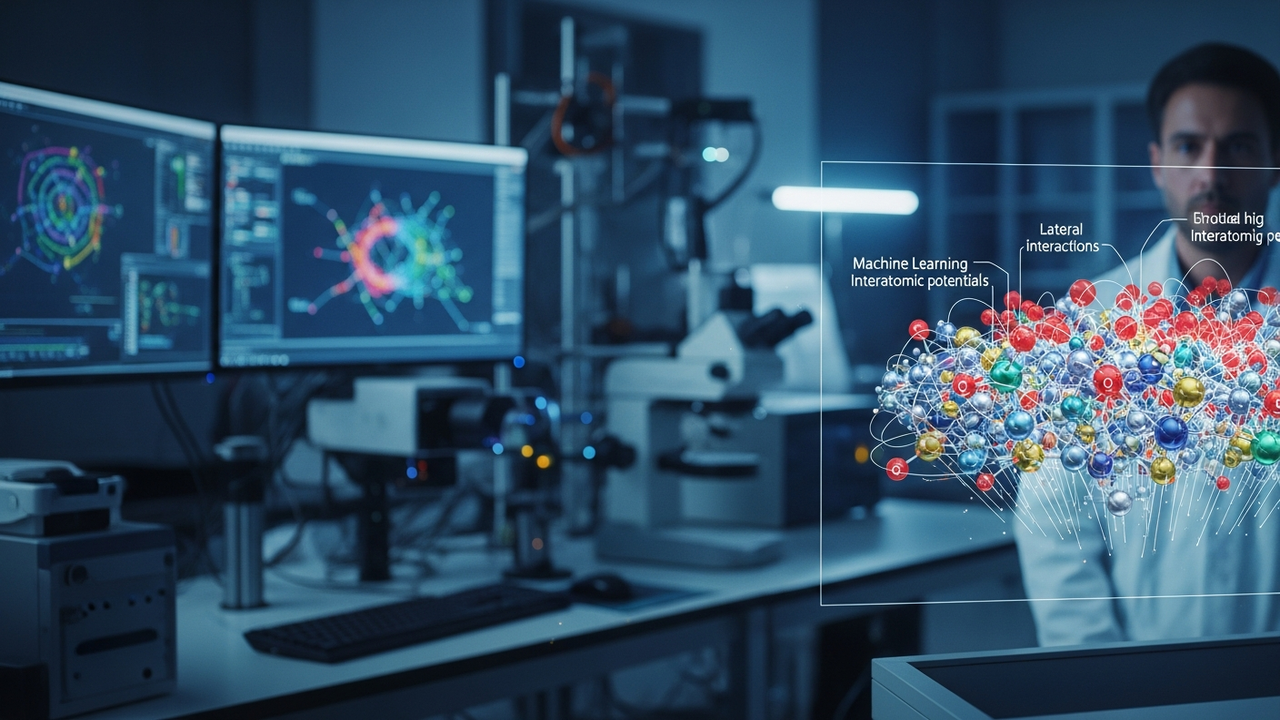
Key Findings: MLIPs Elucidate Lateral Interactions as Determinant of Electrocatalytic Activity in High-Entropy Alloy Oxygen Reduction
Researchers at MIT have developed an innovative framework leveraging Machine Learning Interatomic Potentials (MLIPs) to model the oxygen reduction reaction (ORR) within the vast compositional space of Ag-Ir-Ru-Pd-Pt-Cu-Rh-Re high-entropy alloys (HEAs), which comprise eight distinct metals. The most significant finding of this study is the unprecedented emphasis on the critical role of “lateral interactions” between adjacent atoms in evaluating electrocatalytic activity, particularly during the competitive co-adsorption of O* and OH* intermediates on crowded catalyst surfaces.
Technical & Business Details: High-Precision MLIP Analysis of Complex Multicomponent Alloy Interactions
High-entropy alloys, due to their diverse compositions and atomic arrangements, have the potential to exhibit superior performance compared to conventional catalysts. However, their complexity has historically made understanding atomic-level reaction mechanisms challenging. The MLIP framework models interatomic interactions across the extensive compositional space of HEAs, maintaining the accuracy of Density Functional Theory (DFT) calculations while achieving the computational efficiency of classical molecular dynamics simulations. This capability allowed for detailed tracking of changes in the binding energies of adsorbed intermediates as a function of coverage (the proportion of adsorbed species covering the surface), providing new insights into how specific compositions and surface structures influence the electrocatalytic performance of HEAs.
Background & Industry Context: The Importance of Electrocatalysts in Clean Energy Technologies
The oxygen reduction reaction plays a central role in clean energy conversion technologies such as fuel cells, metal-air batteries, and electrolysis. Developing more efficient and cost-effective electrocatalysts is crucial for the widespread adoption and practical implementation of these technologies. High-entropy alloys are garnering significant attention as next-generation catalyst materials, expected to show superior activity and stability compared to traditional single-metal or low-entropy alloy catalysts. This research, by utilizing AI, elucidates the design principles of complex material systems like HEAs, thereby substantially enhancing the efficiency of catalyst development.
Strategic Significance & Outlook: Towards Rational Design of Next-Generation High-Performance Electrocatalysts
The findings of this study provide a crucial foundation for the rational design of high-performance high-entropy alloy catalysts. By quantitatively understanding the impact of lateral interactions on electrocatalytic activity, researchers and engineers can now pursue more targeted optimization of compositions and design of surface structures. This will contribute to improving fuel cell efficiency, developing CO2 reduction catalysts, and maximizing energy conversion efficiency in other electrochemical processes. The integration of AI and computational materials science is poised to open new frontiers in catalyst design, playing an indispensable role in accelerating technological innovation towards a sustainable society.
Source: https://pubmed.ncbi.nlm.nih.gov/42473151/
Get our weekly technology intelligence — free
Receive an infographic that lets you judge at a glance whether each field’s analysis report is worth reading.
Subscribe Free — Weekly Tech Intelligence
By subscribing, you’ll receive Troy-Technical’s weekly technology intelligence newsletter.
- Your email and selected fields are used only to deliver the newsletter.
- We never share your information with third parties.
- You can unsubscribe anytime via the link in each email.
See our Privacy Policy for details.
Takes about a minute · Unsubscribe anytime




Comments