Key Findings
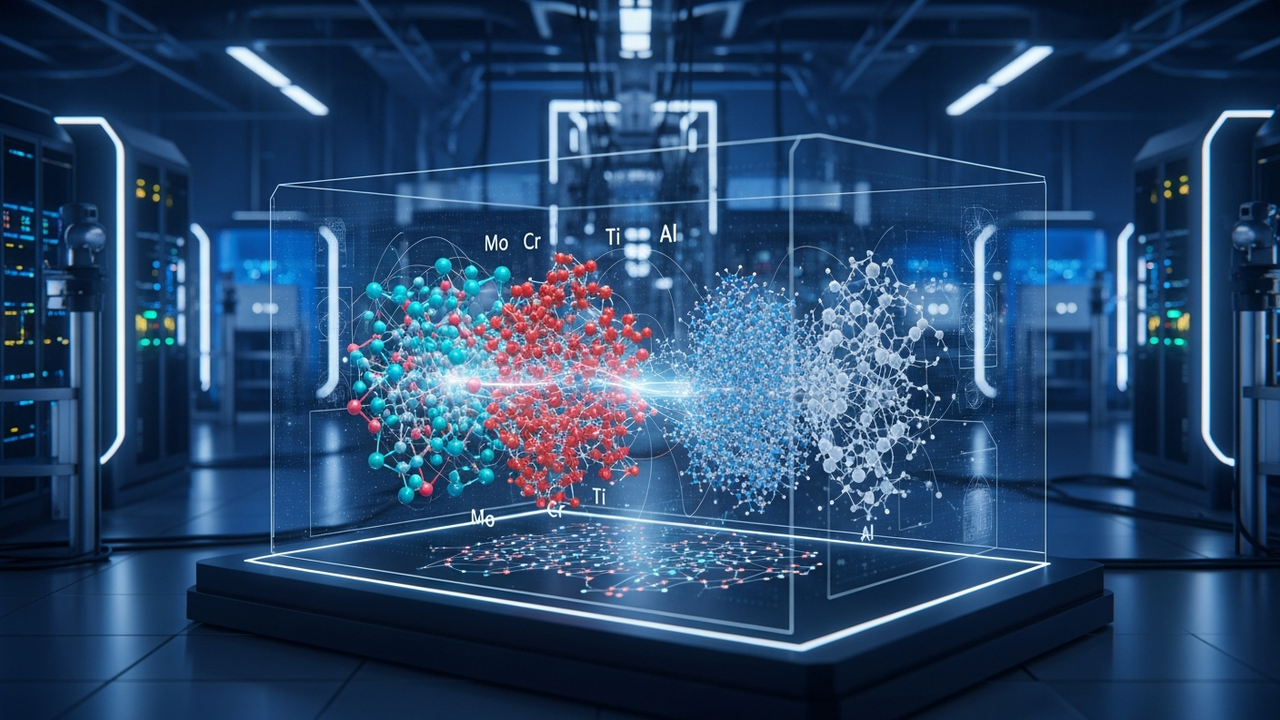
A recent research paper, utilizing simulations powered by universal machine learning interatomic potentials (MLIPs), has uncovered groundbreaking insights into the chemical ordering and mechanical properties of (MoCrTi)$_{100-x}$Al$_x$ refractory high-entropy alloys (HEAs). Notably, the study reveals a distinct order-disorder transition behavior and a non-monotonic compositional dependence of mechanical stiffness within this alloy system.
Technical / Clinical Details
This research employed a powerful combination of machine learning interatomic potentials (MLIPs) with Hybrid Monte Carlo (HMC) and Molecular Dynamics (MD) simulations to comprehensively investigate the complex behavior of High-Entropy Alloys (HEAs). The focus was on (MoCrTi)$_{100-x}$Al$_x$ refractory HEAs, a class of materials promising high-performance applications, where the influence of aluminum (Al) content (denoted by ‘x’) on material properties was explored. Simulation results clearly demonstrated that these alloys undergo a distinct order-disorder transition within specific temperature ranges. More significantly, the study found that the mechanical stiffness (e.g., elastic modulus) of the alloy does not change linearly with aluminum composition ‘x’ but exhibits a non-monotonic dependence, reaching maximum or minimum values at certain compositions. This suggests the potential for tailoring optimal mechanical performance within specific compositional ranges and validates the MLIP as a powerful tool for efficiently predicting complex phase behavior and properties in multi-element systems.
Background & Context
High-Entropy Alloys represent a novel class of materials formed by mixing multiple principal elements in roughly equiatomic ratios, exhibiting superior properties such as high-temperature strength, corrosion resistance, and wear resistance, which surpass traditional alloys. Refractory HEAs, in particular, are being explored for extreme environment applications like jet engines, gas turbine components, and fusion reactor materials due to their exceptional heat resistance. However, the vast compositional space of HEAs makes experimental screening prohibitively time-consuming and labor-intensive. Computational materials science, especially atomistic simulations using MLIPs, becomes a crucial method to efficiently navigate this vast search space and guide experimental efforts. This research exemplifies how the fusion of AI and high-performance computing can accelerate new materials development.
Strategic Significance & Outlook
The elucidation of order-disorder transitions and the non-monotonic compositional dependence of mechanical stiffness in (MoCrTi)$_{100-x}$Al$_x$ refractory HEAs provides invaluable guidance for the rational design of these high-performance materials. Researchers and engineers can now leverage this insight to target optimal compositions that meet specific application requirements, such as high stiffness at elevated temperatures or phase stability within certain operating ranges. This will accelerate the development of next-generation materials for extremely harsh environments, including aerospace engines, power generation turbines, and structural components for fusion reactors. Furthermore, the success of MLIPs in this complex multi-component alloy system suggests broader applicability to other intricate alloy systems and dynamic processes (e.g., deformation under stress, fatigue behavior), signifying a critical advancement for the field of materials informatics.
Source: https://arxiv.org/abs/2607.18099
Get our weekly technology intelligence — free
Receive an infographic that lets you judge at a glance whether each field’s analysis report is worth reading.
Subscribe Free — Weekly Tech Intelligence
By subscribing, you’ll receive Troy-Technical’s weekly technology intelligence newsletter.
- Your email and selected fields are used only to deliver the newsletter.
- We never share your information with third parties.
- You can unsubscribe anytime via the link in each email.
See our Privacy Policy for details.
Takes about a minute · Unsubscribe anytime




Comments