Key Findings
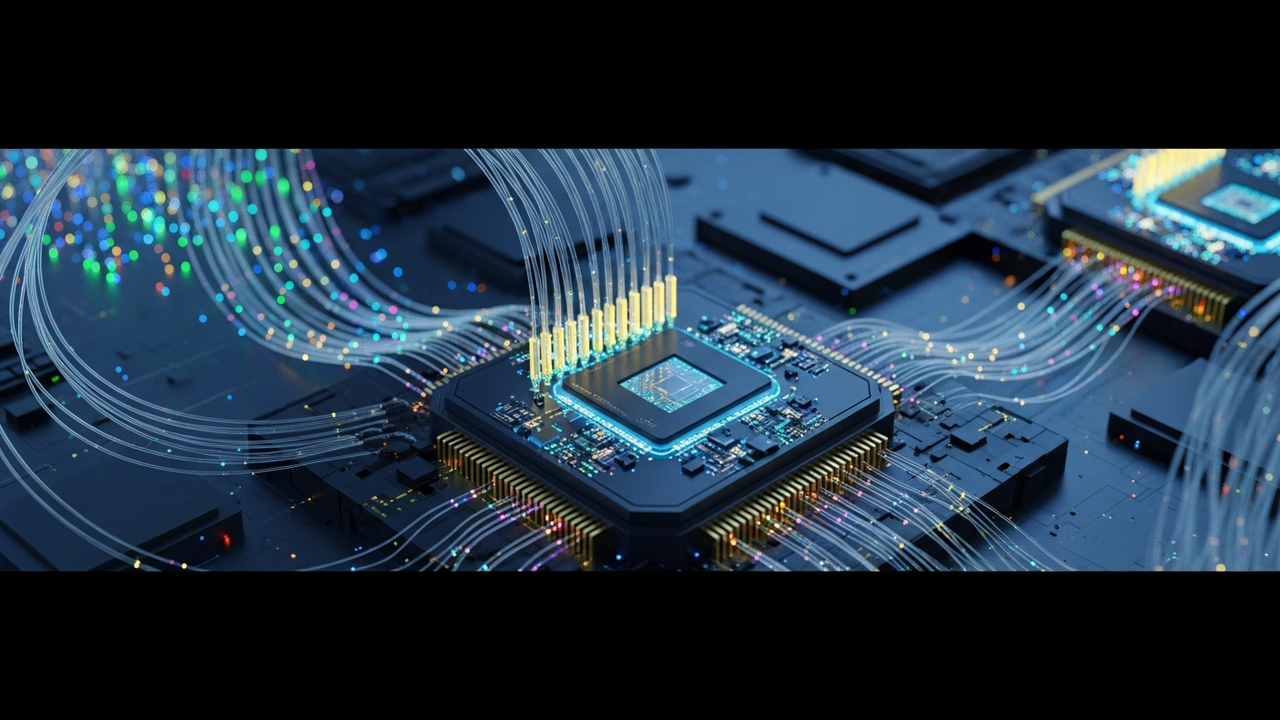
Silicon photonics technology is emerging as a core solution to the ‘memory wall’ problem, expanding its application scope from long-haul links to short-reach inter-chip interconnects within data centers and AI accelerators for high-speed data transfer. NVIDIA is making multi-billion dollar investments in this photonics technology for its next-generation Rubin and Blackwell GPU architectures. The goal is to replace traditional copper wiring with high-performance silicon photonics links, thereby achieving petabit-scale bandwidth (quadrillions of bits per second) with minimal heat generation.
Technical / Clinical Details
Silicon photonics leverages optical signals to transmit data, overcoming the bandwidth, latency, and power consumption limitations inherent in electrical signals. NVIDIA’s Rubin and Blackwell GPUs will integrate advanced silicon photonics technologies such as co-packaged optics (CPO) and on-chip optical I/O, dramatically boosting data transfer speeds between GPUs. This enables the immense volumes of data required for AI model training and inference to be processed faster and more power-efficiently. Compared to copper wiring, optical links suffer less signal attenuation and generate significantly less heat, contributing to higher-density AI clusters and reduced cooling costs. NVIDIA is further accelerating its photonics integration by heavily investing in laser suppliers like Lumentum and Coherent.
Background & Context
The explosive growth of AI workloads has exacerbated the ‘memory wall’ problem, which is the gap between data center computing power and data transfer capabilities. In large AI models, GPUs often spend a dominant amount of time waiting for data to be transferred from memory to the CPU/GPU while computations are idle, thus degrading overall performance. As Moore’s Law approaches its physical limits, this issue cannot be solved solely by increasing chip speed. Therefore, industry leaders like NVIDIA are turning to optical technology to resolve data transfer bottlenecks. This massive investment in silicon photonics is a strategic move to redefine the future of AI computing, signifying a fundamental paradigm shift from conventional electronic technologies.
Strategic Significance & Outlook
NVIDIA’s integration of silicon photonics into its Rubin and Blackwell GPUs will dramatically enhance AI computing performance and energy efficiency. Petabit-scale bandwidth with minimal heat generation will enable the training and inference of larger and more complex AI models, elevating AI capabilities to new levels. In the future, this technology is expected to accelerate progress in all fields where AI is applied, including autonomous driving, robotics, medical diagnostics, and scientific research. Furthermore, silicon photonics is anticipated to fundamentally transform data center design philosophy, serving as a foundational technology for achieving more dense and sustainable computing environments. NVIDIA’s investment marks a crucial step in leading the entire AI industry into the optical era.
Source: https://medium.com/illumination/the-speed-of-light-why-photonics-is-the-new-backbone-ai-2597953551da
Get our weekly technology intelligence — free
Receive an infographic that lets you judge at a glance whether each field’s analysis report is worth reading.
Subscribe Free — Weekly Tech Intelligence
By subscribing, you’ll receive Troy-Technical’s weekly technology intelligence newsletter.
- Your email and selected fields are used only to deliver the newsletter.
- We never share your information with third parties.
- You can unsubscribe anytime via the link in each email.
See our Privacy Policy for details.
Takes about a minute · Unsubscribe anytime







Comments