Key Findings: Smart Hydrogels and 4D Printing Revolutionize Regenerative Wound Therapy, Paving Way for Precision Drug Delivery with Vascularized Scaffolds
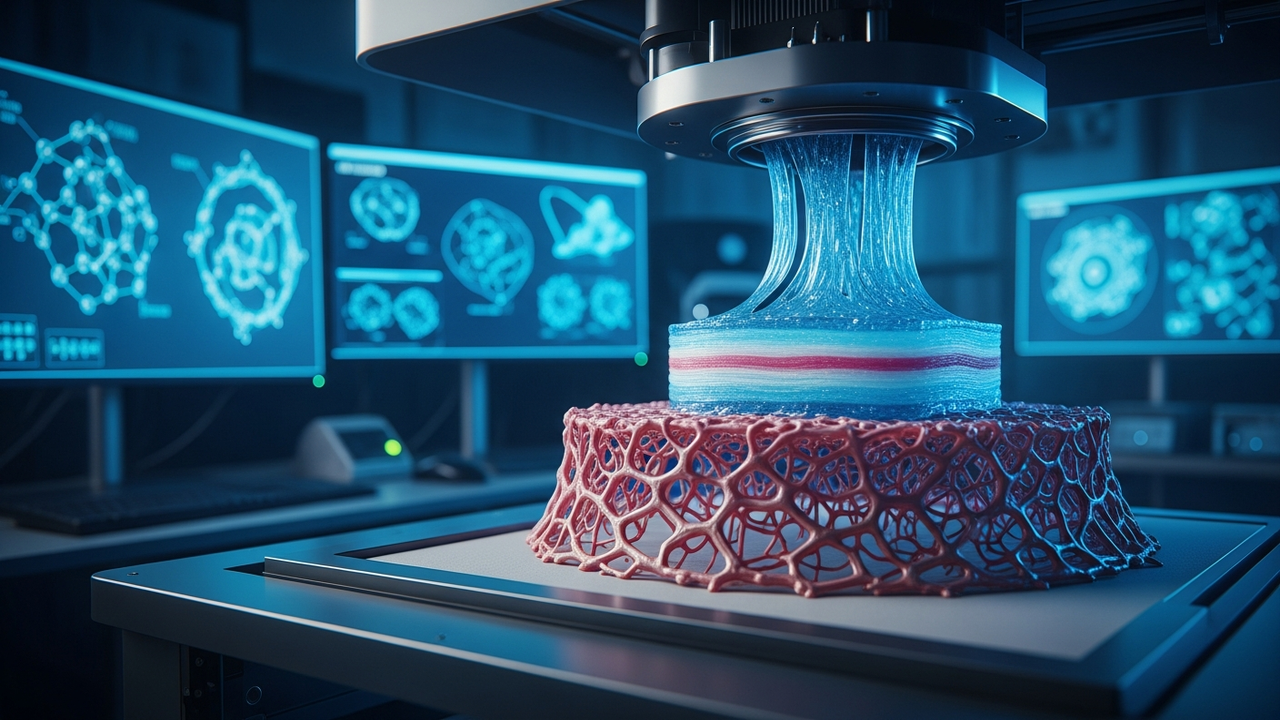
In the fields of precision drug delivery and regenerative wound therapy, innovative paradigms are emerging, ranging from smart hydrogel design to scaffolds incorporating 4D printing technology. Notably, the remarkable progress in 3D bioprinting technology is making the fabrication of vascularized scaffolds, essential for efficient nutrient and oxygen transport in tissue regeneration, a reality. Hydrogel-based scaffolds are particularly useful for skin tissue regeneration due to their high water retention capabilities, optimal porosity, excellent biocompatibility, biodegradability, and biomimetic properties. These scaffolds, when loaded with stem cells, hold the potential to promote angiogenesis and significantly accelerate the healing process of intractable wounds, though challenges such as ensuring cell viability and managing immunogenicity persist.
Technical and Application Details: Hybrid Approaches for Personalized Medicine
- Importance of Vascularized Scaffolds: For regenerating complex tissues and organs, it is essential to construct efficient vascular networks internally to ensure the supply of oxygen and nutrients to cells and the removal of waste products. 3D bioprinting serves as a powerful tool for precisely fabricating these vascularized scaffolds, enabling the survival and functional maintenance of thicker tissues.
- Multifunctionality of Hydrogels: Hydrogels are ideal as drug delivery systems because they can encapsulate biomolecules and cells and release them in a controlled manner. Their high water content provides an environment similar to biological tissues, supporting cell proliferation and differentiation. ‘Smart’ hydrogels, which change their physical properties in response to specific stimuli, enable precise therapies by releasing drugs when needed.
- Stem Cell Loading and Wound Healing: Incorporating stem cells, such as mesenchymal stem cells (MSCs), into scaffolds can promote angiogenesis, suppress inflammation at the wound site, and accelerate tissue regeneration through the secretion of growth factors and immunomodulatory effects. This holds potential as a groundbreaking treatment for difficult-to-heal wounds like diabetic foot ulcers and severe burns.
- Prospects of 4D Printing: 4D printing is a technology where 3D-printed structures change their shape or function over time or in response to external stimuli (e.g., temperature, pH, light). This allows for the creation of scaffolds and devices that adapt to dynamically changing environments in vivo and function optimally. For example, scaffolds that change shape in response to wound contraction are envisioned.
Background and Industry Context: Evolution of Tissue Engineering and Unmet Needs
The field of tissue engineering is rapidly evolving, aiming to repair and replace damaged tissues. Chronic wounds and large-scale tissue defects, in particular, represent significant unmet medical needs that are challenging to address with existing treatments, hence the high expectations for regenerative medicine technologies. The combination of 3D/4D bioprinting with hydrogels and stem cells is expected to play a central role in providing personalized therapeutic solutions tailored to patient-specific needs. International research collaboration and funding are accelerating the development of this field.
Future Outlook: Challenges and Optimization Towards Clinical Application
For the clinical application of stem cell-laden scaffolds, solving challenges such as further improving cell viability, reducing immunogenicity, and ensuring manufacturing process reproducibility and scalability is essential. In vivo evaluation of vascular integration and long-term tissue function will be critical for determining treatment success. Furthermore, the clinical application of 4D printing technology requires detailed consideration of material biocompatibility, safety, and regulatory approval processes. If these challenges are overcome, these innovative technologies are poised to drive the next generation of precision drug delivery and regenerative wound therapy, dramatically improving patients’ quality of life.
Source: https://pmc.ncbi.nlm.nih.gov/articles/PMC13205502/
Get our weekly technology intelligence — free
Receive an infographic that lets you judge at a glance whether each field’s analysis report is worth reading.
Subscribe Free — Weekly Tech Intelligence
By subscribing, you’ll receive Troy-Technical’s weekly technology intelligence newsletter.
- Your email and selected fields are used only to deliver the newsletter.
- We never share your information with third parties.
- You can unsubscribe anytime via the link in each email.
See our Privacy Policy for details.
Takes about a minute · Unsubscribe anytime