Background
The ability to engineer functional artificial tissues and organs has long been hampered by a fundamental biological challenge: vascularization. For tissues exceeding a mere millimeter in thickness, a robust supply of oxygen and nutrients via intricate blood vessel networks is indispensable for survival and function. Previous tissue engineering endeavors have been significantly constrained by this limitation, restricting the size and complexity of fabricated tissues. Addressing this bottleneck is paramount for advancing regenerative medicine and enabling the development of larger, more functionally superior artificial organs.
Key Findings
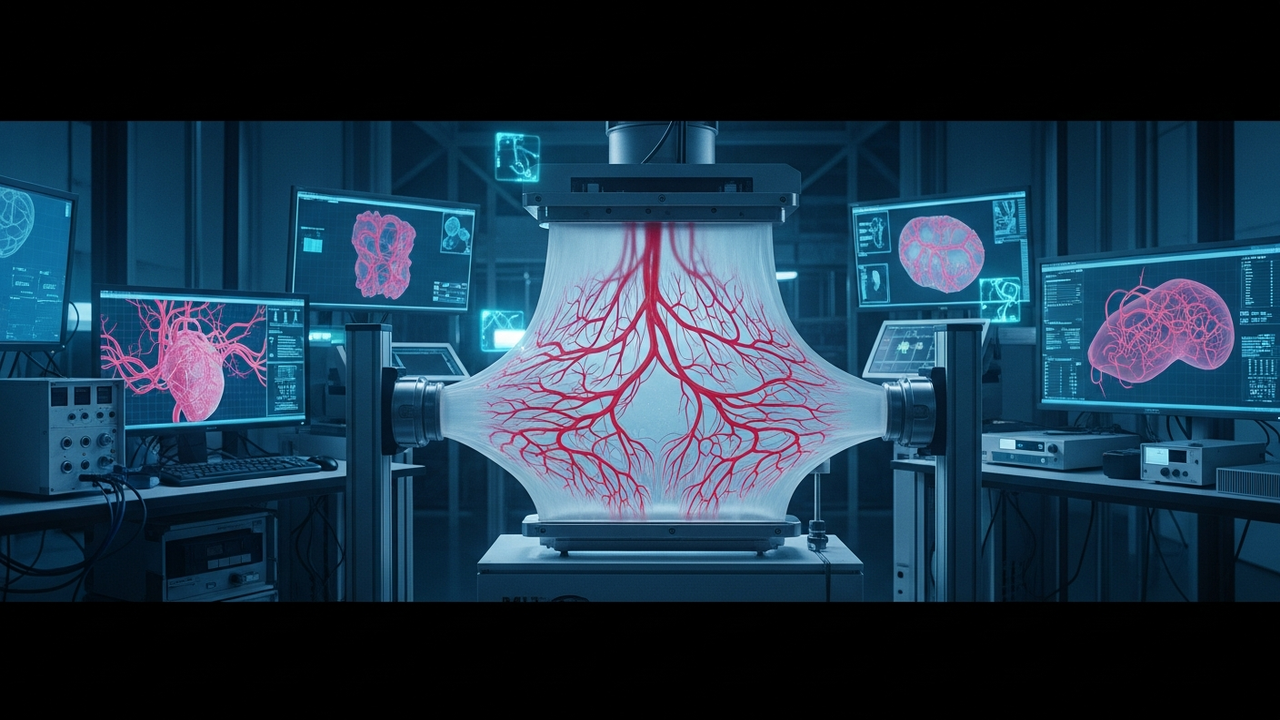
Researchers at the Massachusetts Institute of Technology (MIT) have achieved a groundbreaking advance, demonstrating precise control over the growth of vascular networks through the application of mechanical strain. This novel approach leverages the inherent self-organizing capabilities of cells, providing a scalable solution to a major hurdle in artificial organ manufacturing.
At the core of this discovery is the observation that vascular cells naturally respond to mechanical stimuli, such as shear stress from blood flow and tensile forces from surrounding tissues, by growing and differentiating. The MIT team artfully mimicked this physiological mechanism by applying external tensile forces to endothelial cells, showing that these forces can precisely induce and control angiogenic processes, including cell proliferation, migration, and tube formation.
To validate their findings, the researchers developed a sophisticated ‘human vessel on a chip’ platform. This microfluidic device, fabricated using advanced microfabrication techniques, is designed to culture human endothelial cells within a central channel that mimics a large blood vessel. Critically, the device allows for the formation of complex capillary networks around this central artery. By applying programmed mechanical stretch stimuli to this platform, the team achieved unprecedented control over key capillary parameters, including density, orientation, and connectivity.
This mechanical strain-mediated approach offers a significant advantage over traditional 3D bioprinting technologies. While bioprinting excels at constructing relatively large vascular structures, it struggles to precisely create intricate, micron-scale capillary networks in complex, patient-specific patterns. By combining cellular self-organization with precise physical stimulation, MIT’s technology holds the potential to overcome these limitations, enabling the reproducible and scalable manufacturing of highly functional engineered tissues.
Looking ahead, this technology promises to accelerate the clinical application of regenerative medicine. Future research will focus on applying this method to more complex artificial tissues and organs, such as livers, kidneys, and hearts. Essential next steps include validating the long-term function and stability of these engineered vascular networks in vivo, ensuring consistent blood flow and successful integration with host tissues. Scaling up the technology and establishing Good Manufacturing Practice (GMP)-compliant processes will be critical for commercialization, ultimately offering a viable alternative to organ transplantation for numerous diseases and injuries.
Get our weekly technology intelligence — free
Receive an infographic that lets you judge at a glance whether each field’s analysis report is worth reading.
Subscribe Free — Weekly Tech Intelligence
By subscribing, you’ll receive Troy-Technical’s weekly technology intelligence newsletter.
- Your email and selected fields are used only to deliver the newsletter.
- We never share your information with third parties.
- You can unsubscribe anytime via the link in each email.
See our Privacy Policy for details.
Takes about a minute · Unsubscribe anytime