Key Findings
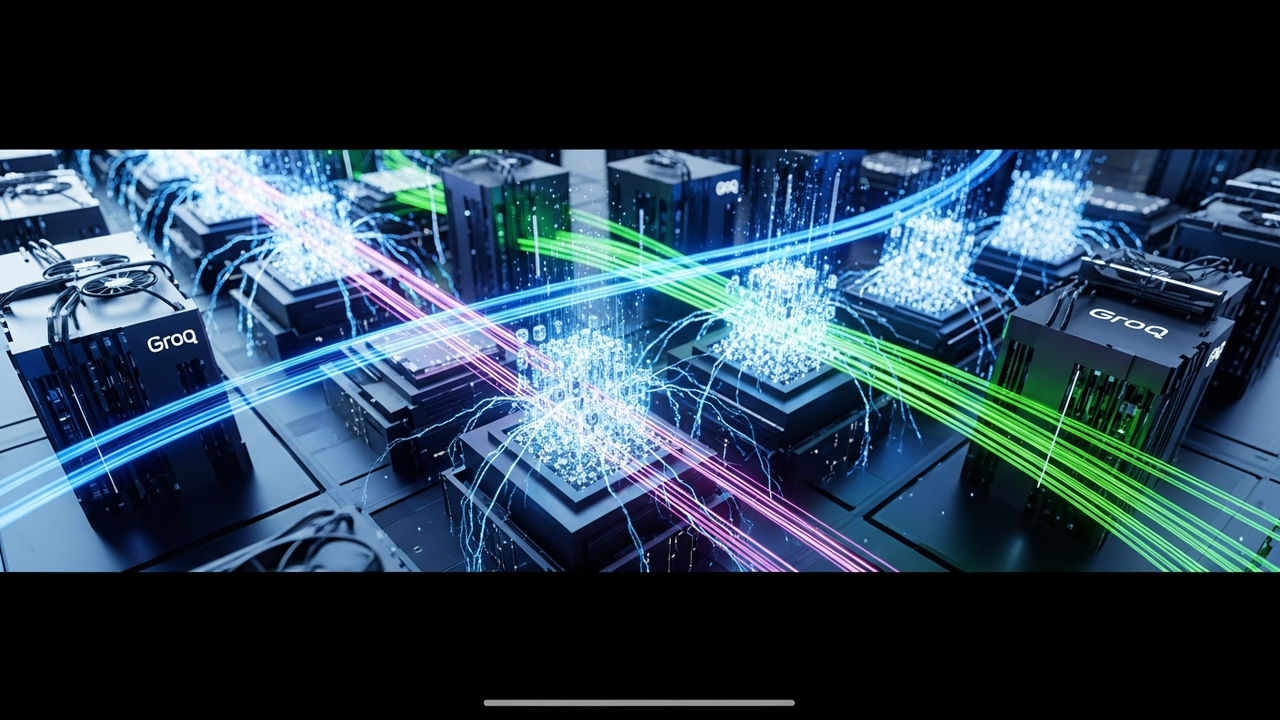
AI accelerators are a transformative technology, boosting the performance of AI applications such as neural networks and machine learning algorithms by up to 1000 times. Developed by leading semiconductor manufacturers like Nvidia and Groq, these specialized hardware units deliver unparalleled speed and energy efficiency, particularly in AI model training and inference (prediction execution), compared to conventional general-purpose processors. This advancement empowers AI developers to rapidly iterate on complex models, significantly shortening the time to market for new AI products and services, and thus accelerating the overall pace of AI innovation.
Technical / Clinical Details
At the core of AI accelerators lies their architecture, optimized for parallel processing, and circuitry specifically designed for AI computations. Nvidia’s GPUs, for example, repurposed their massive parallel computing capabilities, initially developed for graphics, to drive breakthroughs in deep learning. In contrast, companies like Groq have introduced unique architectures such as the Language Processing Unit (LPU), which significantly outperforms GPUs in terms of low latency and high throughput for large language models like Transformer. These accelerators efficiently execute fundamental AI mathematical operations, such as tensor computations (multi-dimensional array calculations), reducing training times and enabling real-time AI service delivery.
Background & Context
General-purpose CPUs historically struggled with the immense computational load of complex AI models, creating bottlenecks that hindered progress. The demand for specialized hardware optimized for AI workloads grew to address this challenge, leading to the development of AI accelerators. As AI adoption expands across diverse sectors—including cloud-based AI services, autonomous driving, medical diagnostics, and natural language processing—processing speed and power efficiency have become critical for both performance enhancement and cost reduction. Particularly for deep learning models trained on vast datasets, AI accelerators are indispensable in overcoming computational bottlenecks, allowing enterprises to integrate more sophisticated AI functionalities into their products and services and bolster their competitive edge.
Strategic Significance & Outlook
The continuous evolution of AI accelerators is directly linked to the broader proliferation of AI technologies and the opening of new application frontiers. Anticipated future developments include even more power-efficient accelerators and those highly optimized for specific applications. With the expansion of edge AI, where processing occurs on devices rather than in the cloud, there will be an increasing demand for compact, low-power accelerators. Furthermore, co-design approaches, where software and hardware are developed in tandem, will become even more crucial, improving flexibility and efficiency in AI development. The AI accelerator market is projected to maintain its rapid growth, pushing the boundaries of AI performance and playing a central role in shaping the future digital society.
Source: https://grooper.com/blog_posts/ai-accelerator/
Get our weekly technology intelligence — free
Receive an infographic that lets you judge at a glance whether each field’s analysis report is worth reading.
Subscribe Free — Weekly Tech Intelligence
By subscribing, you’ll receive Troy-Technical’s weekly technology intelligence newsletter.
- Your email and selected fields are used only to deliver the newsletter.
- We never share your information with third parties.
- You can unsubscribe anytime via the link in each email.
See our Privacy Policy for details.
Takes about a minute · Unsubscribe anytime