Key Findings
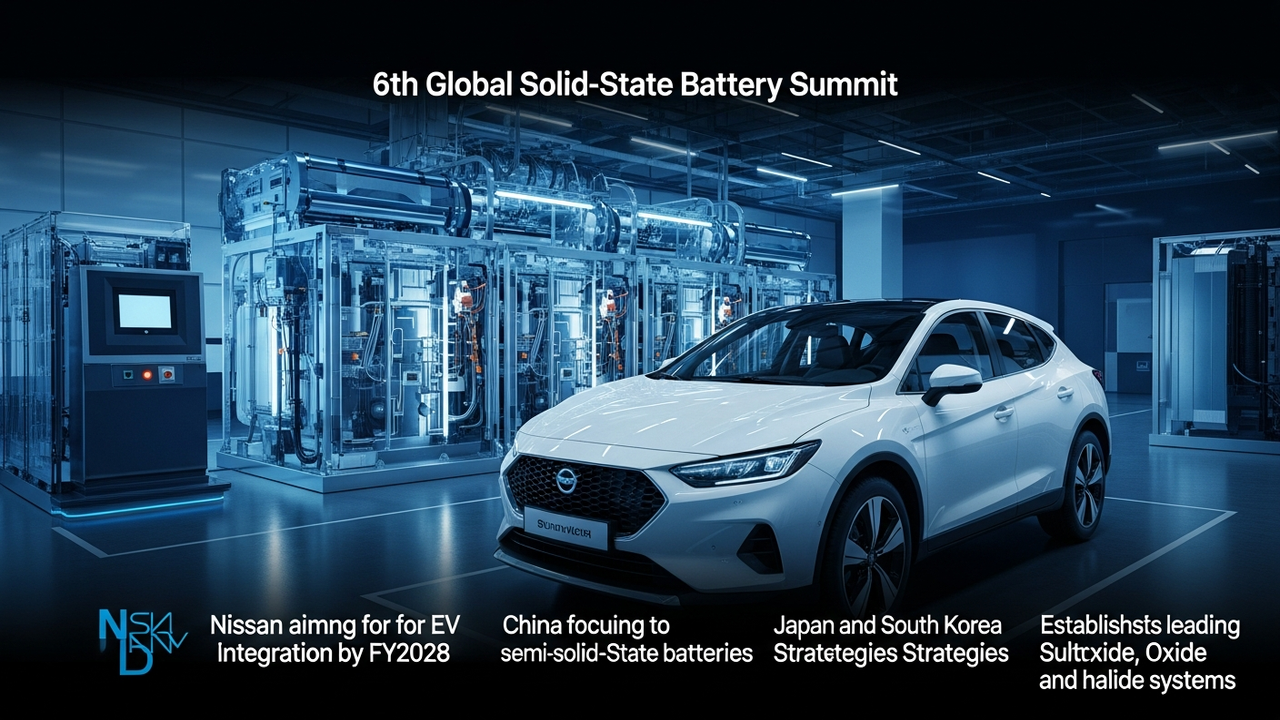
The 6th Global Solid-State Battery Summit, which commenced in Chicago on August 11, 2026, served as a crucial platform to discuss core issues in next-generation electric vehicle (EV) battery technology, clearly outlining various national strategies and technological advancements. Notably, Nissan Motor Company announced the completion of automotive-grade solid-state battery prototype testing at its Yokohama plant in April 2026, with an ambitious target for EV integration by fiscal year 2028. This exemplifies a global multi-pronged strategy where Japan and South Korea aim to lead with cutting-edge full solid-state technology, while China is advancing industrialization via a semi-solid approach as a foundational step.
Technical & Industry Details
- Discussion Focus: Key topics at the summit included various types of all-solid-state electrolytes (sulfide, oxide, halide), innovative anode materials like lithium metal, and scalable process technologies for cost-effective mass production.
- Japan-Korea Strategy: Manufacturers from Japan and South Korea are concentrating on full All-Solid-State Battery (ASSB) technology, which offers the highest performance potential, seeking to establish technological leadership. Nissan’s concrete development and deployment targets underscore this strategy.
- China’s Strategy: China is adopting a “Semi-Solid-State Battery” approach as its initial step towards industrialization, aiming for earlier market entry and a phased technological transition. This strategy attempts to incorporate benefits of solid-state technology while mitigating risks associated with a complete departure from existing liquid lithium-ion battery technology.
- Diverse Technology Pathways: Different solid electrolyte types—sulfide, oxide, and the recently emerging halide systems—are being developed in parallel. Each type presents unique advantages and challenges: sulfides offer high ionic conductivity, oxides boast enhanced safety, and halides show promise for good stability and high voltage tolerance.
Background & Context
All-solid-state batteries are widely hailed as the “ultimate battery” by the automotive industry, as they promise to overcome limitations in safety (thermal runaway risk), energy density, and cycle life inherent in current lithium-ion batteries. Governments and corporations worldwide have designated this technology as a strategic priority, investing heavily to accelerate its development. This summit served as a vital forum for sharing progress and directions in this critical field.
Strategic Significance & Outlook
Nissan’s target for EV integration by FY2028 indicates that the widespread market introduction of all-solid-state batteries is imminent. China’s semi-solid battery approach could enable faster market penetration and accelerate the overall adoption of solid-state battery technologies. Future efforts will focus on achieving automotive-grade durability and reliability, along with establishing cost competitiveness. ASSBs are poised to gain a substantial foothold in the EV market by the 2030s, and these technological advancements will have long-term impacts across the automotive, aerospace, and robotics industries.
Source: https://www.sunsirs.com/uk/prodetail-10023696504.html
Get our weekly technology intelligence — free
Receive an infographic that lets you judge at a glance whether each field’s analysis report is worth reading.
Subscribe Free — Weekly Tech Intelligence
By subscribing, you’ll receive Troy-Technical’s weekly technology intelligence newsletter.
- Your email and selected fields are used only to deliver the newsletter.
- We never share your information with third parties.
- You can unsubscribe anytime via the link in each email.
See our Privacy Policy for details.
Takes about a minute · Unsubscribe anytime