Key Findings
In the field of high-voltage all-solid-state sodium-ion batteries, a groundbreaking solution has been identified to address the critical challenge of interfacial instability exhibited by halide solid electrolytes (HSEs) against high-voltage cathodes. A research team performed a high-throughput computational screening of 12,800 sodium-containing compounds, discovering several innovative coating materials that effectively suppress undesirable interfacial side reactions. These coatings promote a stable solid electrolyte-cathode interface and ensure chemical compatibility even under high-voltage operation, significantly advancing the commercialization prospects of next-generation all-solid-state sodium-ion batteries.
Technical Details
- Potential and Challenges of Halide Solid Electrolytes (HSEs): HSEs are considered promising solid electrolytes for all-solid-state sodium-ion batteries due to their high ionic conductivity and relatively low cost. However, particularly at the interface with high-voltage cathodes, chemical instability often leads to undesirable side reactions (e.g., electrolyte decomposition, increased interfacial resistance), causing battery performance degradation and reduced cycle life.
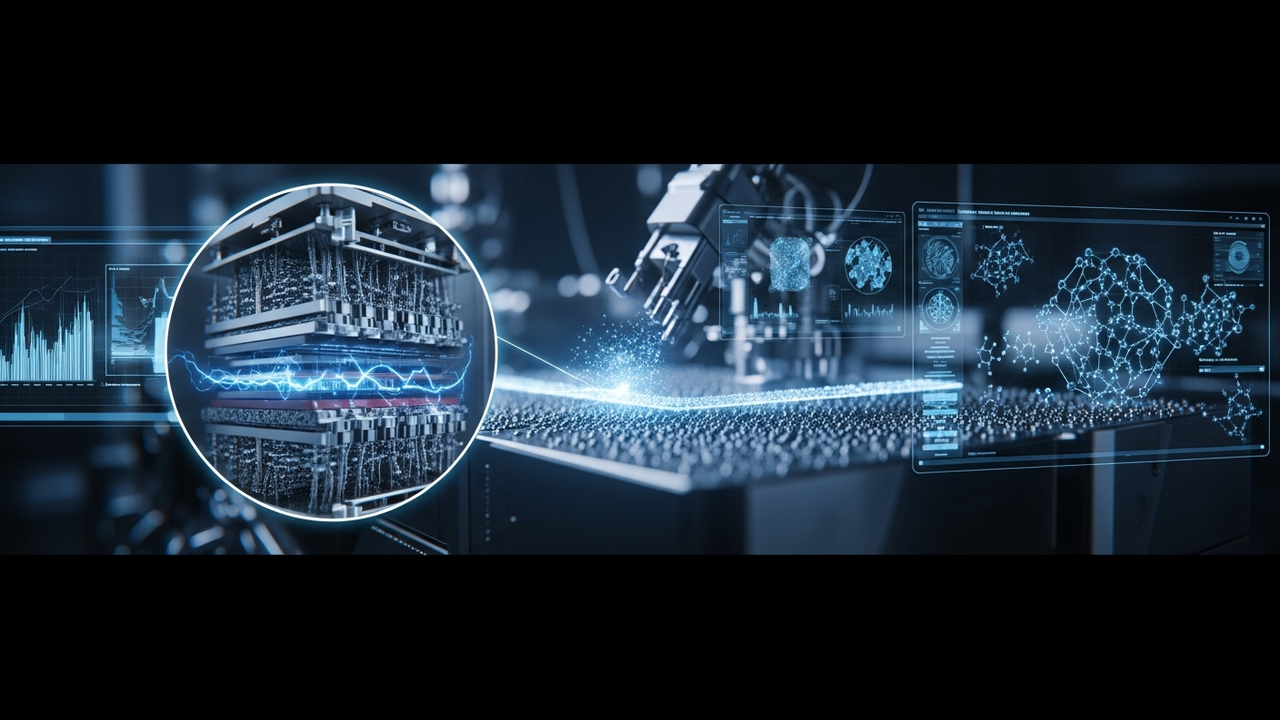
- High-Throughput Computational Screening: To efficiently identify optimal materials from a vast number of candidates, advanced high-throughput computational methods were employed in this study. Specifically, density functional theory (DFT)-based calculations were performed on a database of 12,800 different sodium-containing compounds to search for materials that contribute to stable interface formation.
- Identification of Interfacial Stabilization Coatings: The screening process successfully identified multiple novel coating materials. These materials form a protective layer between the solid electrolyte and the cathode, effectively suppressing the driving force for decomposition and side reactions that can occur during high-voltage operation. This maintains a stable ionic transport path, thereby enhancing overall battery performance and reliability.
- Ensuring Chemical Compatibility: The introduction of interfacial stabilization coatings enables the battery to operate under high voltage for extended periods while maintaining chemical compatibility. This is crucial for increasing the energy density of sodium-ion batteries and achieving practical cycle life.
Background & Context
Amid concerns about the uneven distribution and rising costs of lithium resources, sodium-ion batteries are gaining attention as a next-generation battery technology that can utilize abundant and inexpensive sodium resources. All-solid-state sodium-ion batteries, in particular, are expected to achieve significant improvements in safety and energy density, similar to lithium-ion batteries. However, interfacial stability between the solid electrolyte and electrodes has been a major technical challenge. The results of this research are highly significant as they address this bottleneck and accelerate the commercialization of sodium-ion batteries.
Strategic Significance & Outlook
The discovery of this interfacial stabilization coating technology is a critical breakthrough for the practical realization of all-solid-state sodium-ion batteries, and it will likely promote their adoption in future electric vehicles (EVs) and large-scale energy storage systems (ESS). Future efforts will focus on experimental validation of the identified coating materials, optimization of manufacturing processes, and scaling up for mass production. The establishment of this technology is expected to contribute significantly to reducing battery costs and alleviating resource constraints, thereby facilitating a sustainable energy society.
Get our weekly technology intelligence — free
Receive an infographic that lets you judge at a glance whether each field’s analysis report is worth reading.
Subscribe Free — Weekly Tech Intelligence
By subscribing, you’ll receive Troy-Technical’s weekly technology intelligence newsletter.
- Your email and selected fields are used only to deliver the newsletter.
- We never share your information with third parties.
- You can unsubscribe anytime via the link in each email.
See our Privacy Policy for details.
Takes about a minute · Unsubscribe anytime