Key Findings
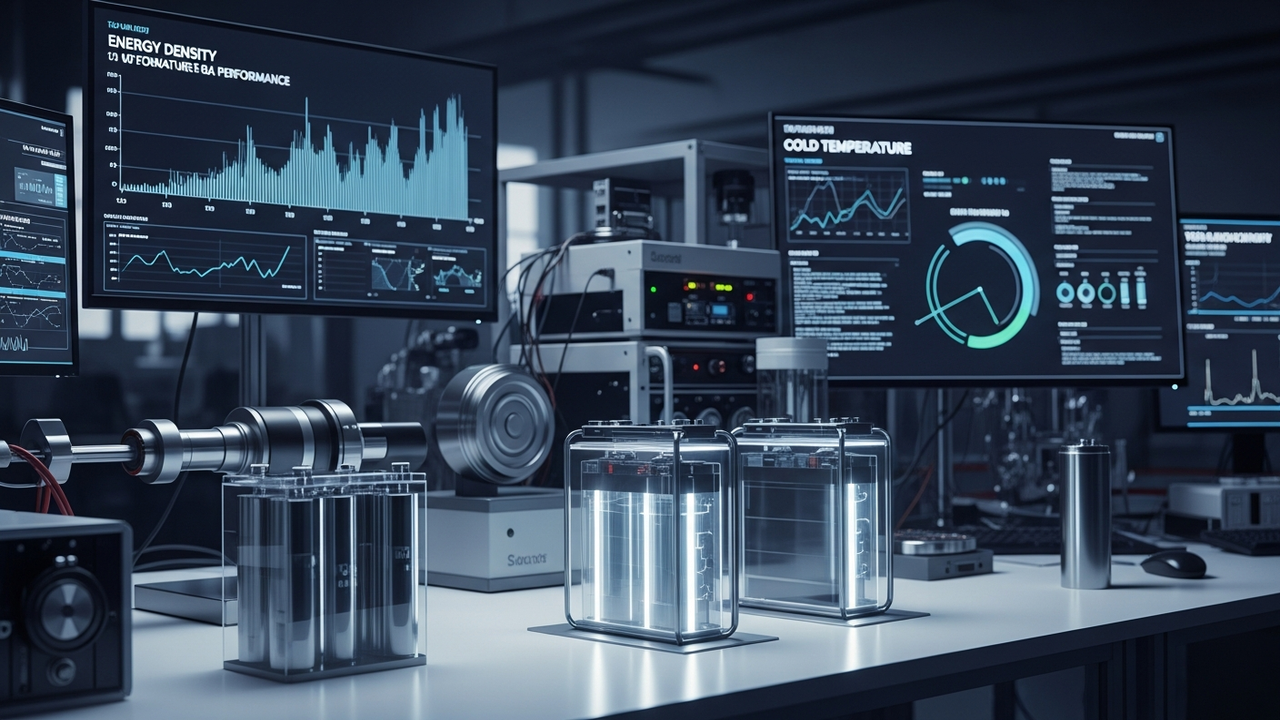
Progress in sodium-ion battery technology has led to the development of advanced prototypes achieving energy densities close to 200 Wh/kg, a substantial improvement over the 100–160 Wh/kg of commercially available devices. Crucially, a 2026 report by the International Energy Agency (IEA) confirms that sodium-ion batteries exhibit superior low-temperature performance, maintaining approximately 90% of their nominal capacity even at -40°C, a significant advantage over lithium iron phosphate (LFP) batteries.
Technical and Application Details
Current sodium-ion batteries typically offer an energy density of around 175 Wh/kg. While this is still less than the 205 Wh/kg of LFP cells, the unique performance characteristics of Na-ion technology make it highly competitive for specific applications. Its exceptional cold-weather operation makes it particularly suitable for electric vehicles (EVs) in cold climates, backup power systems, and industrial uses where sub-zero temperatures are common. However, further performance enhancements hinge on advancements in cathode materials; most existing cathodes are limited to a reversible specific capacity of 100–150 mAh/g. The primary research challenges involve increasing energy density and average operating voltage, as well as overcoming structural defects and conductivity limitations within these materials.
Despite these challenges, companies like CATL, Faradion, and TIAMAT have already launched first-generation commercial sodium-ion devices for light mobility and stationary energy storage. For instance, CATL’s next-generation sodium-ion battery is reported to achieve a 200 Wh/kg energy density and -40°C operational capability, underscoring the rapid march towards practical implementation.
Background and Industry Context
Sodium-ion batteries are gaining considerable traction as a promising alternative for large-scale energy storage and specific mobility sectors, driven by concerns over lithium price volatility and supply chain security. Sodium, being far more abundant and geographically dispersed than lithium, offers a more stable and cost-effective raw material base. While LFP batteries remain the standard for many commercial and industrial (C&I) projects due to their maturity and safety, sodium-ion cells present a compelling alternative for applications prioritizing low-temperature reliability, diversified raw material sourcing, and where ample installation space for stationary storage is available. This includes urban EVs, commercial fleets, forklifts, and two- and three-wheelers, where cost and safety are often weighted more heavily than maximum driving range.
Future Outlook
The emergence of prototypes nearing 200 Wh/kg and demonstrated superior cold-weather performance signals that sodium-ion batteries are steadily closing the performance gap with lithium-ion technologies. Continued innovation in cathode materials and scaling up manufacturing processes will be crucial for sodium-ion to solidify its position in the energy storage market. As a sustainable battery solution with significant cost advantages, its role in integrating renewable energy, stabilizing grids, and supporting the global energy transition is expected to grow substantially.
Get our weekly technology intelligence — free
Receive an infographic that lets you judge at a glance whether each field’s analysis report is worth reading.
Subscribe Free — Weekly Tech Intelligence
By subscribing, you’ll receive Troy-Technical’s weekly technology intelligence newsletter.
- Your email and selected fields are used only to deliver the newsletter.
- We never share your information with third parties.
- You can unsubscribe anytime via the link in each email.
See our Privacy Policy for details.
Takes about a minute · Unsubscribe anytime