Key Findings
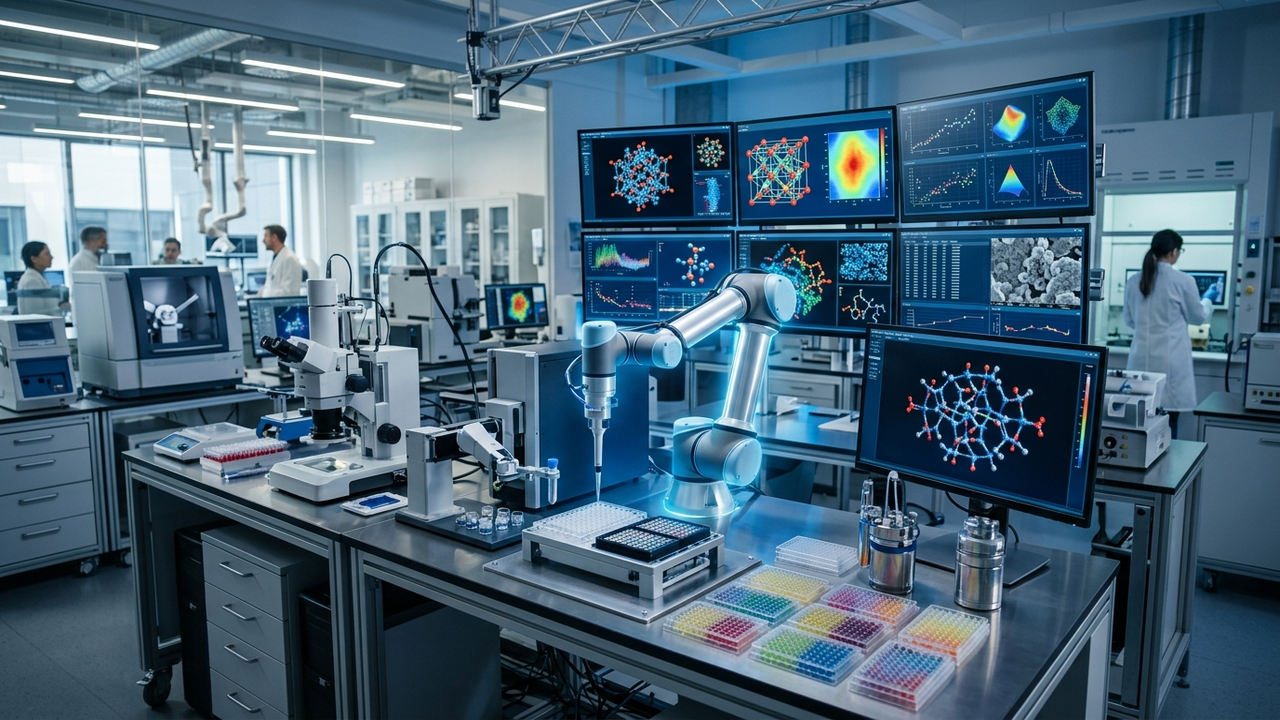
A recent perspective article from Scifiniti highlights the transformative potential of AI-guided ‘self-driving laboratories’ in revolutionizing the materials discovery process. This innovative approach, which integrates closed-loop machine learning with robotic experimentation, is projected to dramatically cut the discovery timeline for high-performance materials and alloys from decades down to mere weeks. This represents a monumental breakthrough with profound implications for industrial product development cycles.
Technical / Clinical Details
At the core of these ‘self-driving labs’ is a closed-loop machine learning system that autonomously learns from experimental data generated by robotic platforms. This system then intelligently proposes optimized experimental conditions for subsequent iterations. Specifically, sequential learning methods are employed to efficiently navigate the vast materials property space, while generative modeling is used to design promising new material structures. Hybrid model-based strategies, incorporating fundamental physics, further enhance experimental precision and predictive reliability. This autonomous cycle of exploration and validation minimizes human intervention, allowing for an unprecedented acceleration in pushing the boundaries of material performance.
Background & Context
Traditional materials discovery has historically relied on manual, trial-and-error experimentation and expert intuition, a process that is both time-consuming and costly. However, the increasing demand for high-performance and functional materials in modern society has pushed these conventional methodologies to their limits. The convergence of rapid advancements in AI and mature robotics has given rise to the ‘self-driving lab’ as a powerful solution to this challenge. This innovation is expected to catalyze accelerated innovation across a wide array of industries, including aerospace, energy, electronics, and medicine.
Strategic Significance & Outlook
The AI-guided autonomous materials discovery platform is not merely an efficiency tool; it redefines the very nature of discovery in materials science. In the future, it is conceivable that entirely novel materials with properties unimagined by humans could be autonomously designed and synthesized by AI. This technology is poised to accelerate the development of critical materials for sustainable energy, high-performance batteries, and environmental-resistant structural components, thereby contributing to the resolution of global challenges. The establishment of standardized data sharing protocols and ethical guidelines will be crucial for its responsible and robust development.
Source: https://www.scifiniti.com/3104-4719/3/2026.0041
Get our weekly technology intelligence — free
Receive an infographic that lets you judge at a glance whether each field’s analysis report is worth reading.
Subscribe Free — Weekly Tech Intelligence
By subscribing, you’ll receive Troy-Technical’s weekly technology intelligence newsletter.
- Your email and selected fields are used only to deliver the newsletter.
- We never share your information with third parties.
- You can unsubscribe anytime via the link in each email.
See our Privacy Policy for details.
Takes about a minute · Unsubscribe anytime








Comments