Background
Polymer electrolyte membranes (PEMs) are fundamental components in both fuel cell and water electrolysis technologies. Their performance, especially gas permeability, directly dictates the overall efficiency, durability, and safety of these energy devices. Unwanted permeation of hydrogen or oxygen through the membrane can drastically reduce efficiency, generate undesirable reaction byproducts, and pose significant safety risks. Historically, evaluating the complex gas permeation characteristics of multilayer PEMs has been a time-consuming, costly, and often insufficient process. Toyota CRDL’s new technology directly addresses these longstanding industry challenges by introducing a faster, more reliable evaluation method, effectively resolving a critical bottleneck in the commercialization pathway for fuel cell and hydrogen energy technologies.
Key Findings
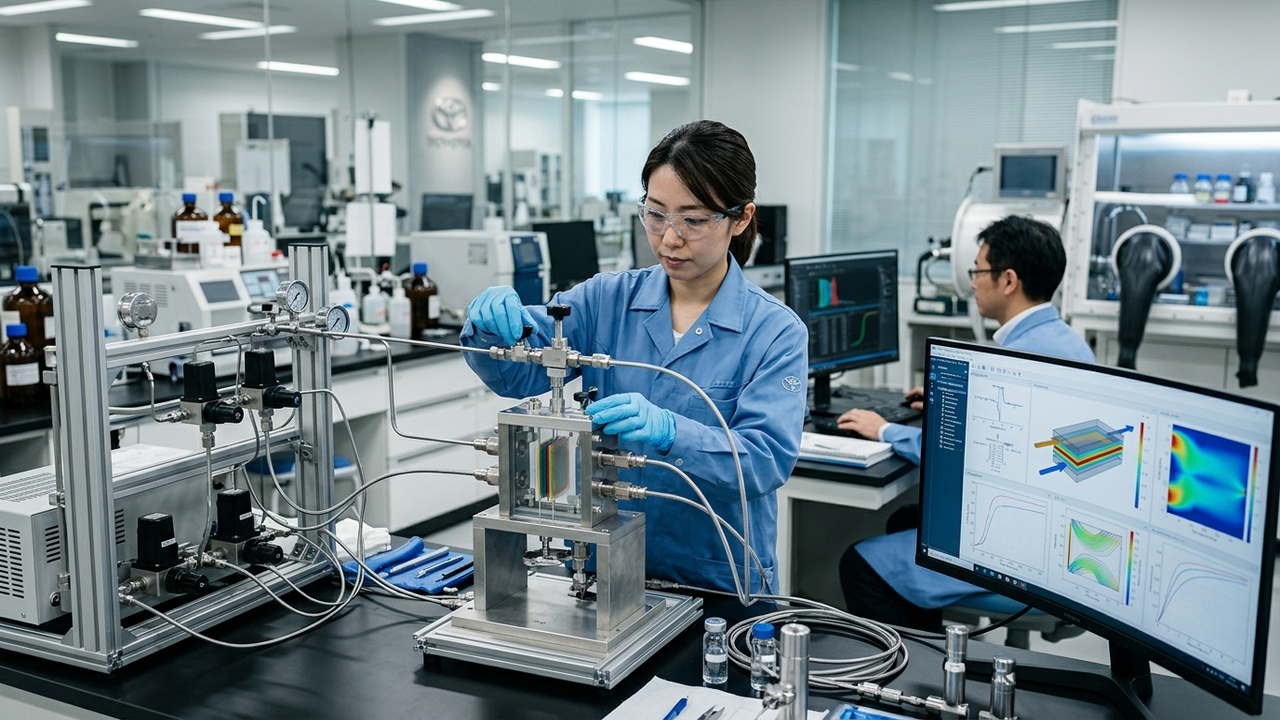
Toyota Central R&D Labs (Toyota CRDL) has announced the development of a groundbreaking technology designed to significantly simplify the evaluation of gas permeability in multilayer polymer electrolyte membranes (PEMs). These membranes are pivotal components in advanced fuel cells and water electrolysis cells. The new methodology empowers researchers and engineers to conduct gas permeability measurements with unprecedented speed and accuracy, overcoming the complexities and time constraints inherent in previous approaches. This significant gain in efficiency marks a crucial advancement set to accelerate the development cycle for next-generation PEMs, directly contributing to enhanced performance in Fuel Cell Vehicles (FCVs) and lowering the production costs of green hydrogen.
Technical Details
The core of this advanced evaluation technology lies in its modification of existing gas permeability measurement devices, enhancing their capability to precisely capture gas diffusion behavior, particularly at the intricate interfaces characteristic of multilayer membranes. The system achieves this by meticulously controlling the pressure gradient and temperature within a specialized measurement chamber. This precision allows for the simultaneous or sequential evaluation of permeability across various crucial gas species, such as hydrogen and oxygen. A key advantage of this system is its exceptional ability to rapidly identify how even subtle variations in the laminate structure or chemical composition of PEMs impact their gas barrier performance. This granular insight empowers material designers to efficiently pinpoint optimal membrane architectures, thereby minimizing critical gas leakage risks while simultaneously ensuring maximum ion conductivity—essential for the development of truly advanced and efficient membranes.
Strategic Impact & Future Outlook
The deployment of this new gas permeability evaluation technology is poised to significantly accelerate the widespread adoption of fuel cell vehicles and the advancement of hydrogen production technologies powered by renewable energy. Toyota CRDL intends to leverage this technology not only for its internal material development efforts but also plans to make it available to external research institutions and industries in the future. This strategic dissemination will bolster the overall efficiency of the polymer electrolyte membrane R&D community, fast-tracking the development of higher-performance and more durable fuel cells and water electrolysis cells globally. In the long term, this innovation is expected to emerge as a foundational technology critical for building a robust hydrogen society. Investors should recognize how such advancements in materials technology within the clean energy sector are key drivers that will accelerate its exponential growth.
Get our weekly technology intelligence — free
Receive an infographic that lets you judge at a glance whether each field’s analysis report is worth reading.
Subscribe Free — Weekly Tech Intelligence
By subscribing, you’ll receive Troy-Technical’s weekly technology intelligence newsletter.
- Your email and selected fields are used only to deliver the newsletter.
- We never share your information with third parties.
- You can unsubscribe anytime via the link in each email.
See our Privacy Policy for details.
Takes about a minute · Unsubscribe anytime







Comments