Key Findings
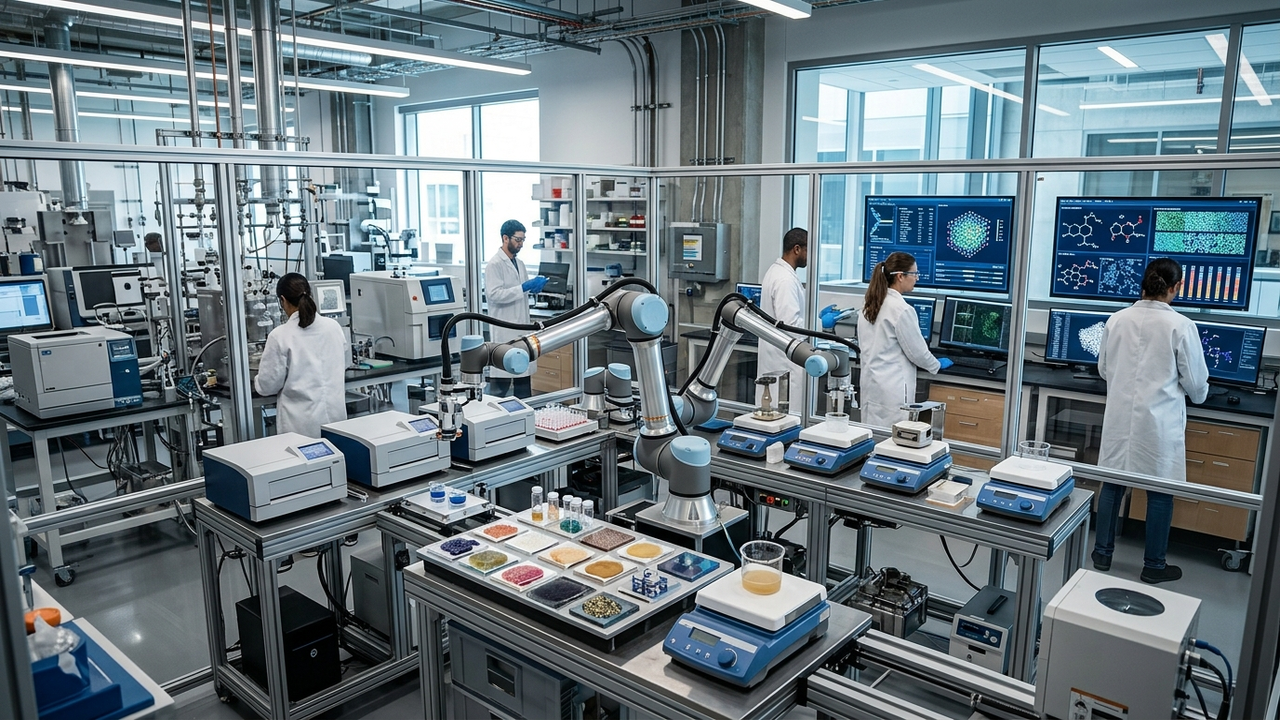
The evolution of AI-driven autonomous laboratories (autonomous labs) is dramatically accelerating the discovery process in materials science. Leading U.S. research institutions, including Lawrence Berkeley National Laboratory’s A-Lab, Carnegie Mellon University’s Materials Innovation Cloud Lab (MICL), and Texas A&M University’s Autonomous Robotic Metallurgist Materials Innovation Platform (ARM-MIP), are integrating AI and robotics to autonomously synthesize, characterize, and optimize new materials, significantly enhancing the pace of material invention.
Technical / Clinical Details
These autonomous labs operate on a ‘closed-loop’ system where AI algorithms generate scientific hypotheses, robots design and execute experiments based on these hypotheses, sensors collect and analyze data, and AI interprets the results to determine the next experimental steps. The A-Lab has successfully synthesized previously undiscovered inorganic compounds, while MICL provides a cloud-based platform allowing a broad range of researchers to participate in materials discovery. ARM-MIP specializes in the exploration of metal alloys, automating the characterization of new alloys under high-temperature conditions. These systems are reported to reduce material discovery time by up to tenfold compared to traditional human-led experimental cycles, enabling researchers to explore more complex and larger material design spaces.
Background & Context
Materials development is the foundation of scientific progress and industrial innovation, but the process has historically been challenging due to its time and cost intensiveness. The convergence of AI and robotics is emerging as a powerful solution to this challenge. The U.S. government and leading corporations are making substantial investments in autonomous labs as part of efforts to enhance national competitiveness. This initiative is expected to lead to the creation of innovative materials across diverse sectors, including clean energy, aerospace, construction, and biotechnology. Specifically, in the construction industry, there is a growing demand for more sustainable and high-performance alloys, coatings, and insulation, and autonomous labs are seen as playing a crucial role in accelerating their development, positioning the US at the forefront of this technological revolution.
Strategic Significance & Outlook
Autonomous labs are expected to continue their rapid evolution, expanding the frontiers of materials discovery. Refinements in AI models, improvements in robotic arm dexterity, and the integration of multi-functional sensors will enable more complex experimental protocols and finer material manipulation. In the future, these labs may become fully ‘self-driving,’ capable of autonomously designing, synthesizing, and optimizing new materials to achieve specific functional targets without direct human intervention. This will free the materials science discovery process from current bottlenecks, advancing at an unprecedented pace and bringing significant transformations to our daily lives and industries. Global collaboration and data sharing among research institutions could further amplify the benefits of this revolutionary technology, creating a worldwide network of innovation.
Source: https://www.architectmagazine.com/design/the-robots-are-inventing-materials-now/
Get our weekly technology intelligence — free
Receive an infographic that lets you judge at a glance whether each field’s analysis report is worth reading.
Subscribe Free — Weekly Tech Intelligence
By subscribing, you’ll receive Troy-Technical’s weekly technology intelligence newsletter.
- Your email and selected fields are used only to deliver the newsletter.
- We never share your information with third parties.
- You can unsubscribe anytime via the link in each email.
See our Privacy Policy for details.
Takes about a minute · Unsubscribe anytime





Comments