Background
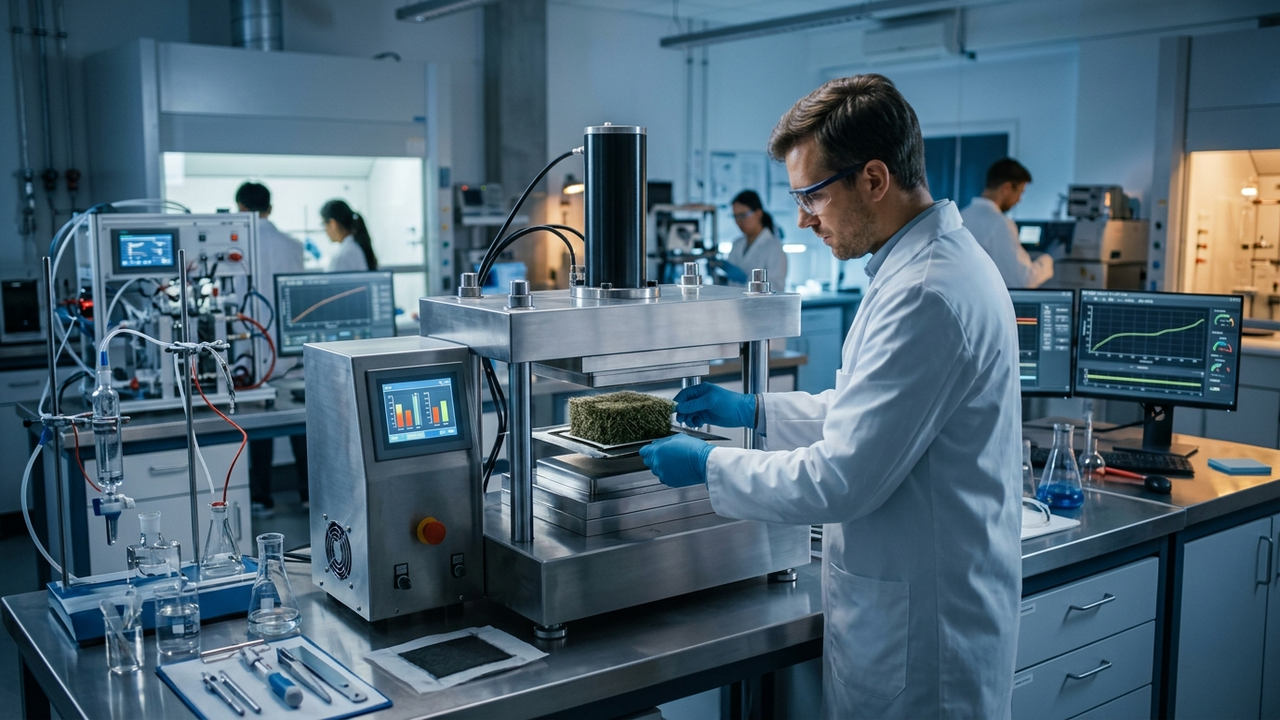
Polymer electrolyte membrane fuel cells (PEMFCs) are poised for widespread adoption in future automotive and stationary power applications, lauded for their high energy conversion efficiency and environmentally clean power generation. Despite their promise, significant hurdles remain for commercialization, particularly in achieving further performance enhancements, reducing manufacturing costs, and ensuring long-term operational stability. A critical factor directly influencing these performance attributes is the membrane electrode assembly (MEA) manufacturing process, especially the hot-press conditions. Historically, MEA fabrication has often relied on empirical approaches, underscoring a pressing need for scientifically-driven optimization.
Key Findings
A research group led by Professor Mika Eguchi at Ibaraki University has achieved a significant breakthrough by precisely defining the optimal hot-press conditions for membrane electrode assemblies (MEAs) in polymer electrolyte membrane fuel cells (PEMFCs, dramatically enhancing their power generation performance. Their comprehensive experimental results demonstrate that for MEAs incorporating the unique spherical carbon material “Marimo Carbon” in the catalyst layer, peak power output is achieved at a hot-press temperature of 155°C and a pressure of 460 N/cm².
The study meticulously examined the impact of hot-press temperature and pressure on both the structural integrity—including adhesion between the membrane and electrodes and the critical pore structure of the catalyst layer—and the ultimate power generation performance of Marimo Carbon-based PEMFC MEAs. These specific optimized conditions (155°C, 460 N/cm²) were found to foster superior interfacial contact and establish highly efficient mass transport pathways, aspects that were suboptimal under conventional or empirically derived hot-press settings. This precise optimization translates directly into improved current density and output voltage, significantly boosting the overall power generation efficiency and durability of PEMFCs. Marimo Carbon, distinguished by its uniform spherical structure and high specific surface area, is already recognized for its excellent performance as a catalyst support material.
These findings represent a crucial advancement towards developing high-performance fuel cells that leverage next-generation carbon materials like Marimo Carbon. By establishing these optimal hot-press parameters, the research not only contributes to reducing manufacturing costs and improving quality consistency for PEMFCs but also accelerates their practical implementation, paving the way for larger-scale MEA manufacturing and further material innovations vital for a sustainable hydrogen energy future.
Source: https://novaist.jp/articles/marimo-carbon-mea-optimal/
Get our weekly technology intelligence — free
Receive an infographic that lets you judge at a glance whether each field’s analysis report is worth reading.
Subscribe Free — Weekly Tech Intelligence
By subscribing, you’ll receive Troy-Technical’s weekly technology intelligence newsletter.
- Your email and selected fields are used only to deliver the newsletter.
- We never share your information with third parties.
- You can unsubscribe anytime via the link in each email.
See our Privacy Policy for details.
Takes about a minute · Unsubscribe anytime



Comments