Background
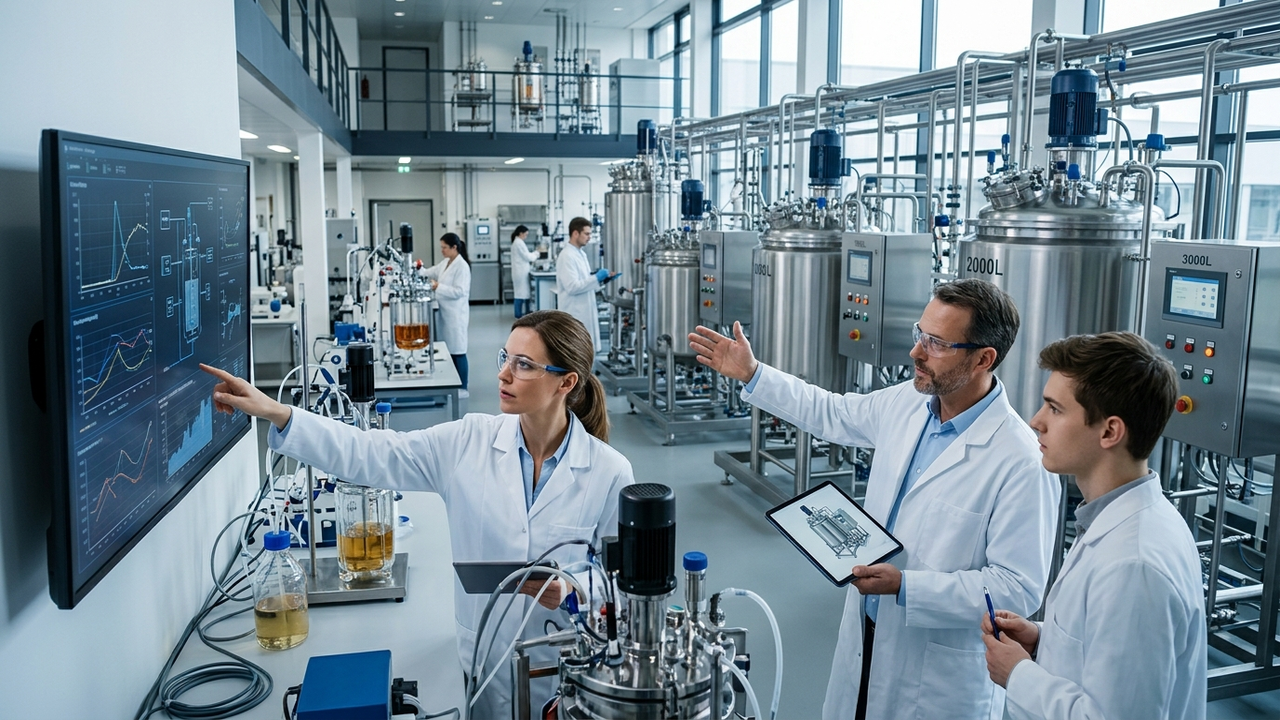
Driven by the escalating demand for cell and gene therapies and biopharmaceuticals, the pharmaceutical industry faces a critical challenge: producing these therapeutics economically and at scale. Reducing manufacturing costs and accelerating time-to-market are paramount for enhancing patient access and bolstering corporate competitiveness. However, biological processes are inherently complex, and a simplistic linear scale-up often precipitates unexpected issues, thereby necessitating advanced engineering and scientific understanding.
Key Findings
Bioreactor scale-up for bioprocess production is fundamentally an iterative process, defined by intricate trade-offs between flexibility, cell yield, and process design. Bioreactor specifications are demonstrably influenced by both the reactor’s size and the targeted cell yield. This insight profoundly suggests that a ‘one-size-fits-all’ solution is unattainable for commercial biopharmaceutical manufacturing, underscoring the imperative for tailored optimization specific to each product and process.
Technical Details
- Flexibility vs. Yield: Small-scale research and development bioreactors inherently offer high flexibility, enabling rapid testing of diverse conditions. However, they typically cannot achieve the high cell yields requisite for large-scale commercial production. Conversely, large-scale bioreactors, optimized for maximal yield, exhibit constrained flexibility for process modifications. Striking an optimal balance between these two aspects is paramount for efficient scale-up.
- Complexity of Process Design: Scaling a bioreactor transcends a mere volumetric increase; it necessitates maintaining or optimizing critical physical and biological parameters, including oxygen supply, mixing homogeneity, heat transfer dynamics, and precise pH control. These factors interact intricately as scale increases, rendering process design progressively more complex.
- Optimization of Culture Variables: Culture variables such as temperature, air pressure, agitation speed, and media composition directly dictate cell growth and the synthesis of target products. Conditions optimized successfully at a small scale frequently do not translate linearly to larger scales, thereby demanding comprehensive re-optimization at each stage of scale-up. For example, larger bioreactors often require elevated agitation speeds or increased gas flow rates to sustain adequate oxygen transfer efficiency.
- Unpredictability of Scaling: Performance data derived from small-scale systems often fails to accurately predict large-scale outcomes due to the emergence of scale-dependent factors like altered hydrodynamics, increased shear stress, and cell density gradients. Consequently, robust scaling strategies necessitate an integrated approach combining physical models, computational fluid dynamics (CFD), and empirical validation.
Strategic Significance & Outlook
The inherent challenges in bioreactor scaling can be substantially mitigated through the strategic integration of digitalization, artificial intelligence (AI), and machine learning. These advanced technologies are capable of analyzing vast and complex datasets to predict optimal process conditions, thereby significantly streamlining the often-iterative trial-and-error process. Furthermore, the burgeoning adoption of modular and flexible manufacturing platforms will empower companies to rapidly adapt to diverse production demands. Persistent research and development efforts, specifically aimed at reducing scaling unpredictability and fostering efficient manufacturing paradigms, remain critical determinants for the sustained growth and future trajectory of the biopharmaceutical industry.
Get our weekly technology intelligence — free
Receive an infographic that lets you judge at a glance whether each field’s analysis report is worth reading.
Subscribe Free — Weekly Tech Intelligence
By subscribing, you’ll receive Troy-Technical’s weekly technology intelligence newsletter.
- Your email and selected fields are used only to deliver the newsletter.
- We never share your information with third parties.
- You can unsubscribe anytime via the link in each email.
See our Privacy Policy for details.
Takes about a minute · Unsubscribe anytime







Comments