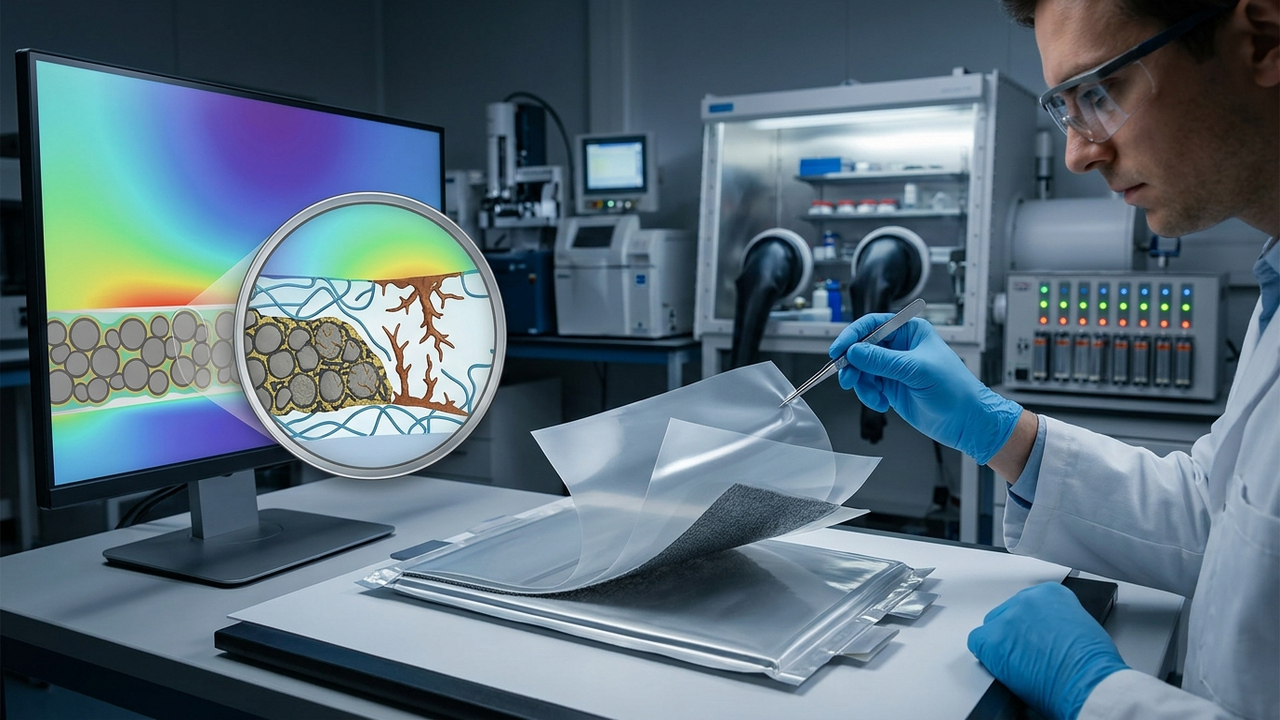
A groundbreaking tri-layer solid electrolyte has been developed, promising a dramatic improvement in the safety and lifespan of lithium-metal batteries, a key next-generation battery technology. This advancement represents a significant step towards enabling high-energy-density power sources.
Key Findings
- Development of a Tri-Layer Solid Electrolyte: Researchers have engineered an innovative tri-layer solid electrolyte by integrating polydopamine-coated lithium lanthanum zirconium oxide (LLZO) ceramic particles within a flexible triblock polymer network.
- Enhanced Mechanical Strength and Dendrite Suppression: This composite material significantly improves mechanical strength compared to conventional electrolytes and effectively suppresses the growth of lithium dendrites. Dendrite suppression is critical for safety, as dendrites can cause internal shorts and lead to battery fires.
- Enabling Safer, Longer-Lasting Lithium-Metal Batteries: This new electrolyte addresses fundamental issues of safety and longevity that have plagued lithium-metal batteries, contributing to the realization of highly reliable cells that maintain high energy density.
Technical & Clinical Details
The core of the developed tri-layer solid electrolyte involves LLZO particles, a lithium-ion conducting ceramic, coated with polydopamine. Polydopamine functions by uniformly covering the LLZO particle surfaces, which enhances the interfacial stability between the LLZO and the lithium metal anode. This coating facilitates more efficient lithium-ion transport. Furthermore, these coated LLZO particles are dispersed within a resilient triblock polymer network, composed of block copolymers. The triblock polymer significantly boosts the overall mechanical strength and flexibility of the electrolyte, allowing it to withstand the stresses induced by volumetric changes during battery charge and discharge cycles. This multi-layered architecture works synergistically to suppress dendrite formation on the lithium metal anode surface, both physically and electrochemically, preventing short circuits and performance degradation in the battery.
Background & Context
Lithium-metal batteries are highly anticipated as a next-generation battery technology, capable of achieving theoretically much higher energy densities than current lithium-ion batteries. This could dramatically improve the range of electric vehicles (EVs) and extend the operational time of portable electronic devices. However, the commercialization of lithium-metal batteries has been hampered by critical issues: safety concerns arising from lithium dendrite growth (leading to internal shorts and fires) and short cycle life. Previous research often focused on single solid electrolyte materials. This novel tri-layer composite electrolyte approach is innovative in its attempt to resolve these complex, intertwined challenges simultaneously by combining the advantages of different materials. This breakthrough provides new impetus and direction for the broader field of all-solid-state battery research.
Strategic Significance & Outlook
The newly developed tri-layer solid electrolyte significantly advances the path toward safer and longer-lasting lithium-metal batteries. If commercialized, this technology could enable EVs to travel greater distances on a single charge while providing inherently safer battery systems. Future research will likely focus on scaling up the manufacturing process for this electrolyte, reducing costs, and conducting long-term performance and stability validations in actual battery cells. This material technology holds the potential to accelerate the practical implementation of all-solid-state batteries and contribute to the realization of a sustainable energy society.
Get our weekly technology intelligence — free
Receive an infographic that lets you judge at a glance whether each field’s analysis report is worth reading.
Subscribe Free — Weekly Tech Intelligence
By subscribing, you’ll receive Troy-Technical’s weekly technology intelligence newsletter.
- Your email and selected fields are used only to deliver the newsletter.
- We never share your information with third parties.
- You can unsubscribe anytime via the link in each email.
See our Privacy Policy for details.
Takes about a minute · Unsubscribe anytime









Comments