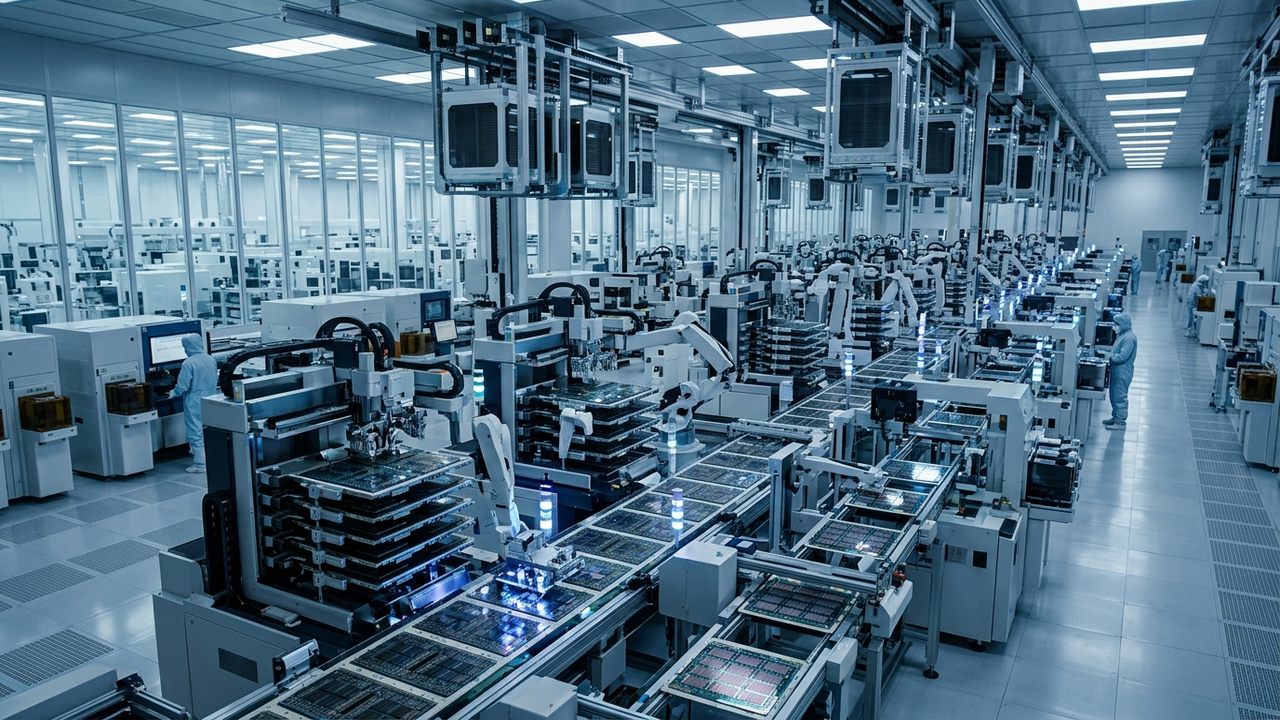
Key Findings: TSMC’s CoWoS Capacity Growth and Persistent AI Chip Shortage
Despite a remarkable nine-fold increase in TSMC’s monthly CoWoS (Chip-on-Wafer-on-Substrate) advanced packaging capacity over the past three years, a significant 10% supply shortage for AI chips continues. This persistent deficit highlights that the exponential growth in AI demand is outstripping even aggressive manufacturing capacity expansions, posing a critical challenge for high-performance AI accelerator development and deployment globally.
Technical & Market Details: NVIDIA’s Dominance and Next-Gen CoPoS Investments
By the end of 2026, TSMC targets a monthly CoWoS production capacity of 120,000 to 140,000 wafers. However, a substantial portion of this capacity is already committed to key customers, with NVIDIA securing an estimated 60% of TSMC’s CoWoS output for 2026. This allocation solidifies NVIDIA’s dominant position in the AI hardware market but leaves a competitive landscape for the remaining 40% among other leading AI chip designers such as AMD, Broadcom, and Google. The scarcity of CoWoS capacity, particularly in complex processes like Chip-on-Wafer (CoW) attachment and the manufacturing of silicon interposers with Through-Silicon Vias (TSVs), multi-layer Redistribution Layers (RDLs), and SoIC (System-on-Integrated-Chips) hybrid bonding, remains a critical bottleneck impacting production yields and throughput. These highly precise integration steps are key determinants of the overall supply chain’s efficiency and ability to scale.
Background & Industry Context: Geographical Concentration and Future Strategy
This situation underscores the inherent risks associated with the geographical concentration of AI hardware production in Taiwan. Experts project this concentration risk to persist until at least 2028-2029, raising concerns about geopolitical vulnerabilities and supply chain resilience. To mitigate these bottlenecks and address future demand, TSMC is aggressively investing in further expansion. The company plans to boost CoWoS capacity by over 60% by 2027. Furthermore, TSMC initiated an R&D line for the next-generation CoPoS (Chip-on-Panel-on-Substrate) advanced packaging technology in 2025, with mass production slated to commence between 2028 and 2029 at its facilities in Chiayi, Taiwan, and Phoenix, Arizona. These strategic investments aim to stabilize the future supply of AI chips and maintain TSMC’s technological leadership in advanced packaging.
Strategic Significance & Outlook: Impact on AI Industry and TSMC’s Pivotal Role
TSMC’s CoWoS capacity expansion is a pivotal factor influencing the global growth trajectory of the AI industry. Resolving these supply shortages would enable the release of a greater volume of AI chips into the market, accelerating the adoption and advancement of AI technologies across various sectors. The current constrained environment, however, highlights the fragility of the broader AI semiconductor supply chain. This vulnerability is prompting governments and corporations worldwide to explore diversification strategies and bolster domestic production capabilities. Through its proactive investments in cutting-edge packaging technologies, TSMC is poised to address these challenges head-on, continuing to play a central role in driving AI-driven technological innovation and shaping the future of high-performance computing.
Source: https://xenospectrum.com/en/cowos-packaging-bottleneck-nvidia/
Get our weekly technology intelligence — free
Receive an infographic that lets you judge at a glance whether each field’s analysis report is worth reading.
Subscribe Free — Weekly Tech Intelligence
By subscribing, you’ll receive Troy-Technical’s weekly technology intelligence newsletter.
- Your email and selected fields are used only to deliver the newsletter.
- We never share your information with third parties.
- You can unsubscribe anytime via the link in each email.
See our Privacy Policy for details.
Takes about a minute · Unsubscribe anytime






Comments