Key Findings
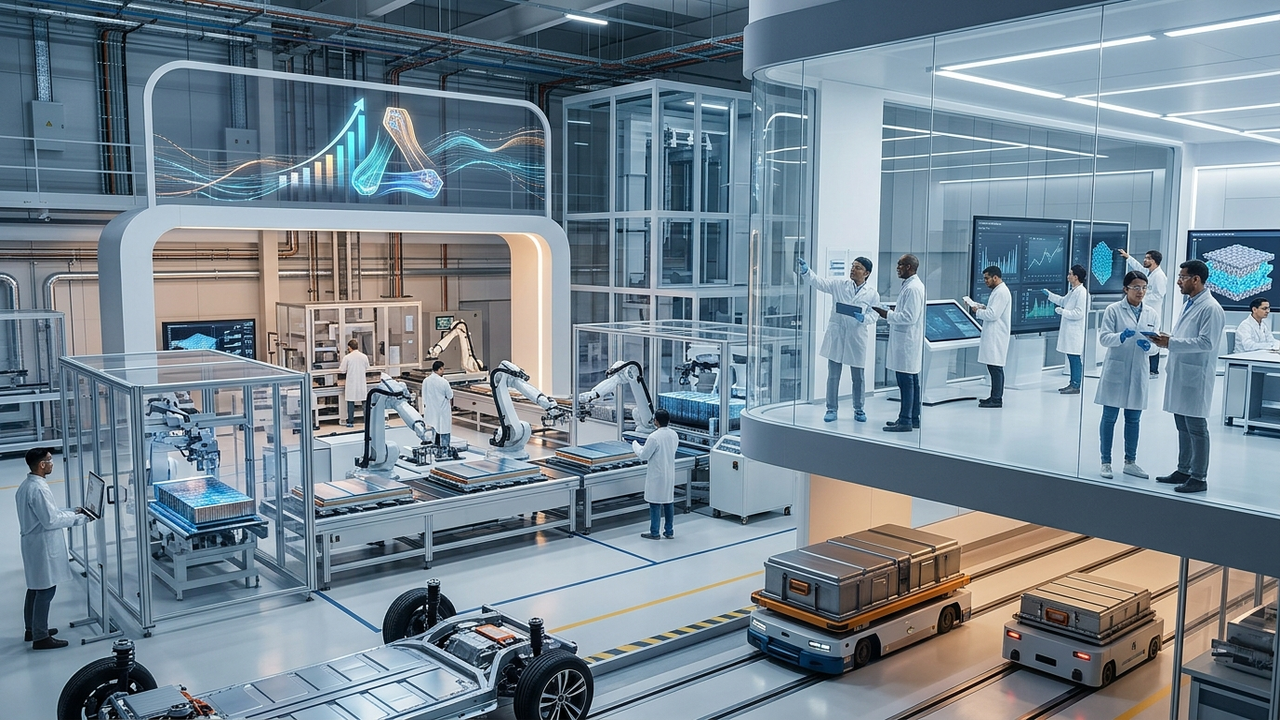
The global race in all-solid-state battery development is shifting its focus from merely enhancing material performance to the crucial phase of technical validation for mass production, as highlighted by TrendForce’s Q2 2026 report. Major Asian players, including Japan, China, and South Korea, are rapidly accelerating the establishment of supply chains for all-solid-state batteries, targeting both electric vehicles (EVs) and high-value-added applications such as drones, electric vertical take-off and landing (eVTOL) aircraft, and advanced robotics.
Technical Details
Japanese automotive manufacturers continue to play a pioneering role in all-solid-state battery advancement. Leading companies like Toyota, Honda, and Nissan have already established pilot production lines and are actively engaged in validation processes aimed at scaling up for mass production. Notably, Nissan has set an ambitious target to introduce EVs equipped with its self-developed all-solid-state batteries to the market by fiscal year 2028. This commitment underscores the industry’s drive to overcome the primary challenges of all-solid-state batteries: high manufacturing costs and scalability. Concurrently, South Korean and Chinese companies are vigorously pursuing their own technical roadmaps, conducting extensive pilot tests, with China particularly active in spearheading international standardization efforts.
Background & Context
All-solid-state batteries are widely hailed as a potential “game-changer” for EVs, offering significant advantages over conventional lithium-ion batteries in terms of enhanced safety, higher energy density, longer lifespan, and faster charging capabilities. However, significant hurdles have remained, primarily in establishing reliable mass production techniques, ensuring stable interfaces between solid electrolytes and electrodes, and drastically reducing manufacturing costs. Governments worldwide are providing strategic support for all-solid-state battery R&D for instance, Japan’s NEDO funds various projects, while China is taking a leading role in defining international standards. Initial commercialization is expected in niche, high-value sectors such like drones, eVTOLs, and robotics, where premium performance justifies higher initial costs, before broader adoption in the mass-market EV segment.
Strategic Significance & Outlook
The intensifying competition among Japan, China, and South Korea to build robust all-solid-state battery supply chains will shape the future of energy storage. Each nation and its key players are pursuing distinct technological approaches, with Japan often focusing on sulfide-based solid electrolytes and China exploring oxide-based and semi-solid solutions. Success in this technical validation phase is paramount for securing dominance in the next-generation battery market. The accumulation of data from pilot lines and the subsequent establishment of scalable manufacturing processes are critical factors that could significantly transform the EV landscape beyond 2030. Achieving cost-effective, high-volume production remains an essential prerequisite for widespread adoption across diverse applications, making the progress of these companies highly anticipated.
Source: https://36kr.jp/500754/
Get our weekly technology intelligence — free
Receive an infographic that lets you judge at a glance whether each field’s analysis report is worth reading.
Subscribe Free — Weekly Tech Intelligence
By subscribing, you’ll receive Troy-Technical’s weekly technology intelligence newsletter.
- Your email and selected fields are used only to deliver the newsletter.
- We never share your information with third parties.
- You can unsubscribe anytime via the link in each email.
See our Privacy Policy for details.
Takes about a minute · Unsubscribe anytime





Comments