Background
Nuclear power sources, specifically Radioisotope Thermoelectric Generators (RTGs), are critical for deep-space exploration missions, especially in environments where solar power is insufficient or non-existent. Historically, RTGs have relied on Plutonium-238, a resource largely monopolized by the U.S. and Russia, and plagued by scarcity. This supply constraint has been a long-standing challenge for many space agencies, including NASA. The development of an alternative, independent power source has become paramount for enhancing strategic autonomy in space exploration and redefining the balance of international cooperation and competition in space technology.
Key Findings
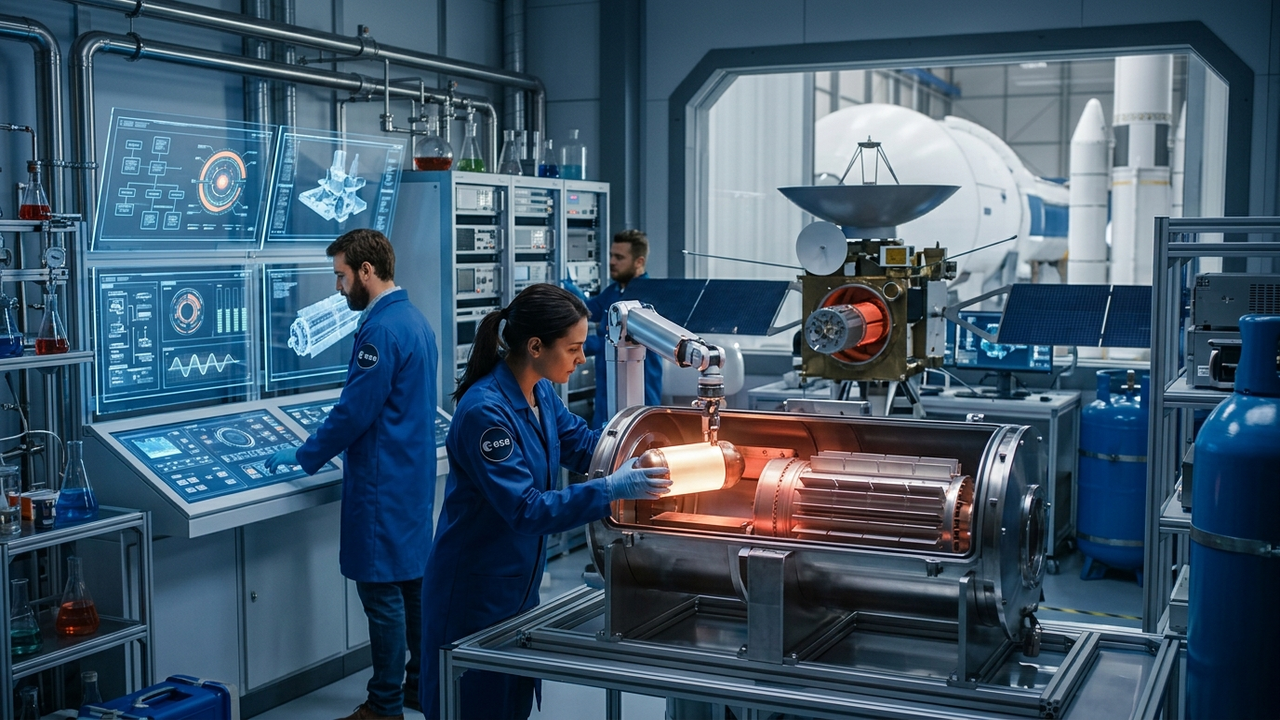
The European Space Agency (ESA) has achieved a significant breakthrough by developing a proprietary technology to extract Americium-241 from civilian nuclear waste. This process enables the successful manufacturing of their own Radioisotope Thermoelectric Generators (RTGs) powered by this isotope. These new Am-241 RTGs serve as a sustainable deep-space power source, boasting a remarkable half-life of 432 years—considerably longer than Plutonium-238’s 87.7 years. This extended half-life ensures a stable power supply for over a century, establishing Europe’s independence in deep-space exploration and poised to profoundly impact the geopolitics of international space development.
Technical Details
The core of ESA’s Americium-241 RTG development lies in highly efficient separation and purification techniques. These methods successfully extract Americium-241 from the nuclear waste streams generated by civilian atomic facilities. This innovative process yields a robust power source with an operational half-life of 432 years, far surpassing Plutonium-238’s 87.7 years. This extended longevity guarantees ultra-long-duration stable power delivery, making it ideally suited for critical applications such as permanent robotic infrastructure on the lunar far side and interstellar missions designed to span multiple centuries.
Strategic Significance
The successful development of the Americium-241 RTG grants Europe significant strategic flexibility for its future deep-space endeavors. This includes ambitious missions like probes to Jupiter’s icy moons, proposed interstellar probes venturing beyond the solar system, and the establishment of permanent bases and robotic infrastructure in challenging environments such as the lunar poles, which contend with extreme temperature variations and extended periods of darkness. Beyond its space applications, this technology represents an innovative avenue for effective nuclear waste utilization, simultaneously enhancing resource sustainability in space development. This breakthrough is set to consolidate new influence and leadership for Europe within international space initiatives, fostering greater strategic autonomy.
Source: https://theindex26.com/americium-241-rtg-esa-space-battery/
Get our weekly technology intelligence — free
Receive an infographic that lets you judge at a glance whether each field’s analysis report is worth reading.
Subscribe Free — Weekly Tech Intelligence
By subscribing, you’ll receive Troy-Technical’s weekly technology intelligence newsletter.
- Your email and selected fields are used only to deliver the newsletter.
- We never share your information with third parties.
- You can unsubscribe anytime via the link in each email.
See our Privacy Policy for details.
Takes about a minute · Unsubscribe anytime






Comments