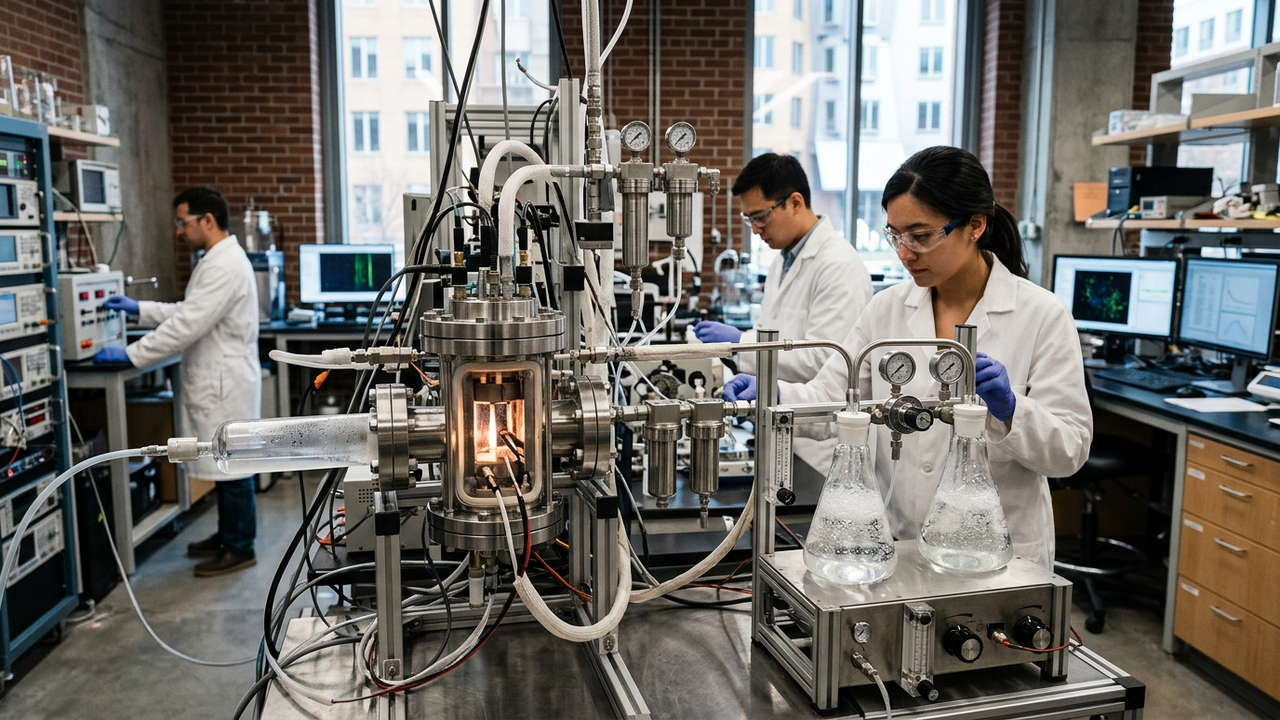
Researchers at the Massachusetts Institute of Technology (MIT) have developed a groundbreaking electrochemical method for highly efficient extraction of pure hydrogen gas from hydrogen carrier molecules such as ammonia. This new technology holds the potential to significantly reduce the operating temperature and energy consumption compared to conventional hydrogen production processes.
Key Findings
- Achieved significant energy reduction in hydrogen extraction from ammonia using an electrochemical approach.
- Demonstrated efficient generation of pure hydrogen gas.
- Enabled low-temperature hydrogen separation, reducing reliance on thermal energy input.
- Presented a cleaner and more sustainable pathway for hydrogen production, alternative to traditional thermal cracking.
Technical Details
The MIT researchers established a process using an electrochemical cell to decompose ammonia molecules and produce pure hydrogen gas. This process leverages a specific combination of catalysts and electrolytes to separate hydrogen ions (protons) from ammonia, which are then reduced to form hydrogen molecules after passing through a membrane. While conventional ammonia cracking processes demand high temperatures (approximately 400-800°C), this electrochemical method operates at much lower temperatures, minimizing external heat supply. This leads to reduced system complexity, improved energy efficiency, and enhanced equipment longevity. Furthermore, the hydrogen produced is of high purity, suitable for direct use in applications like fuel cells.
Background & Context
Hydrogen is recognized as a key energy carrier for achieving a decarbonized society, but its production, storage, and transportation pose significant challenges. Ammonia, with its high volumetric energy density for storage and transport, is considered a promising hydrogen carrier as it can be handled relatively easily as a liquid at ambient temperature and low pressure. However, efficiently extracting high-purity hydrogen from ammonia is critical for its practical application. Current thermal cracking methods are energy-intensive, with high equipment costs and environmental impact associated with high-temperature operation. MIT’s new technology has the potential to overcome these challenges, removing a significant bottleneck in utilizing ammonia as a hydrogen fuel.
Strategic Significance & Outlook
This electrochemical hydrogen extraction technology could significantly advance the realization of distributed hydrogen supply systems and on-site hydrogen production. For instance, using electricity derived from renewable sources like wind or solar power to generate hydrogen from ammonia could help stabilize power grids while enabling clean hydrogen production at the point of demand. Commercialization of this technology is expected to contribute to cost reduction and environmental impact mitigation across the entire hydrogen supply chain, accelerating the adoption of hydrogen in fuel cell vehicles, power generation, and industrial applications. Future research and development will focus on further scaling up and optimizing costs.
Source: https://news.mit.edu/2026/electrochemical-approach-turns-ammonia-into-pure-hydrogen-0909
Get our weekly technology intelligence — free
Receive an infographic that lets you judge at a glance whether each field’s analysis report is worth reading.
Subscribe Free — Weekly Tech Intelligence
By subscribing, you’ll receive Troy-Technical’s weekly technology intelligence newsletter.
- Your email and selected fields are used only to deliver the newsletter.
- We never share your information with third parties.
- You can unsubscribe anytime via the link in each email.
See our Privacy Policy for details.
Takes about a minute · Unsubscribe anytime








Comments