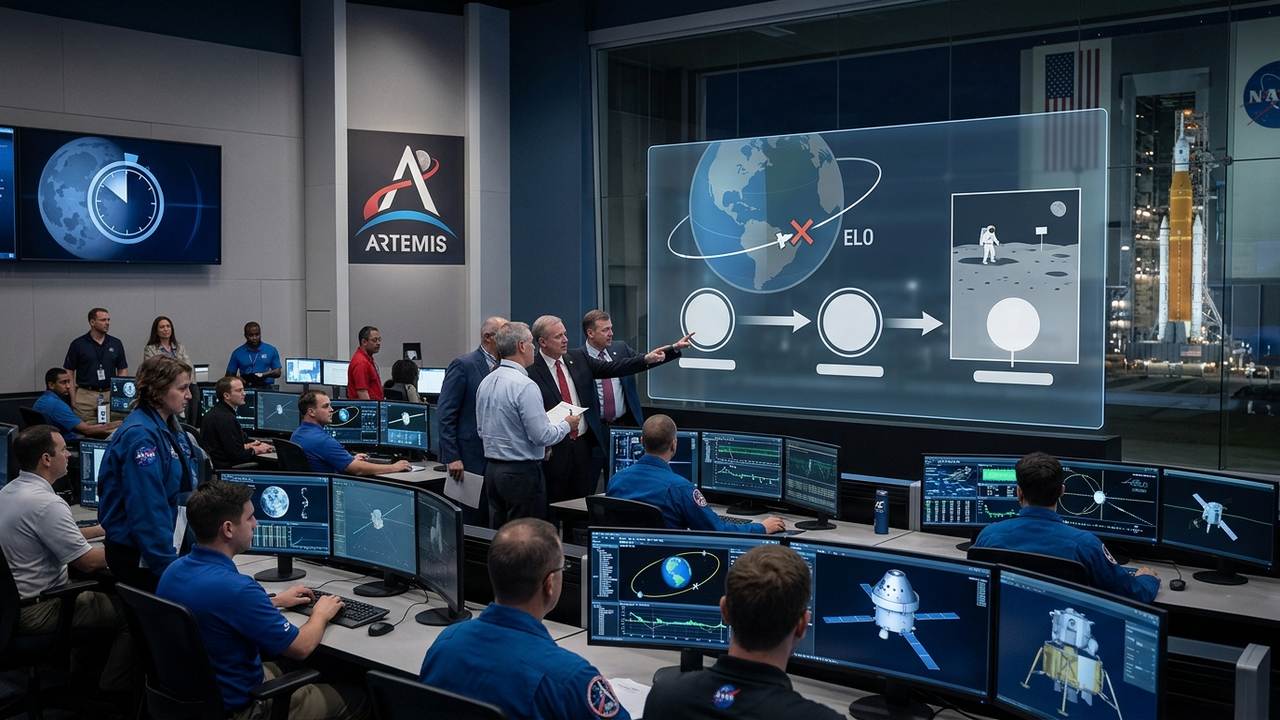
Key Findings: Artemis III Mission Redefined, Lunar Landing Pushed to Artemis IV in 2028
NASA has announced a significant redefinition of its Artemis III human lunar landing mission, shifting its primary objective from a lunar surface touchdown to a low-Earth orbit lander rehearsal in 2027. Consequently, the much-anticipated return of humans to the Moon’s surface is now projected for the Artemis IV mission in 2028. This strategic adjustment acknowledges delays in the development of critical deep-space landing technologies and underscores NASA’s commitment to prioritizing crew safety and mission success.
Technical & Operational Details: Lander Rehearsals and Multi-Partner Integration
The revised Artemis III mission profile will see a four-person crew, including Frank Rubio, focusing on extensive testing of the Human Landing System (HLS) in a low-Earth orbit environment. The mission will integrate the Orion spacecraft with two distinct lunar landers being developed by Blue Origin and SpaceX. Planned for a two-week duration, this orbital rehearsal will enable the comprehensive evaluation of operational procedures, safety protocols, and performance of these complex systems. The adoption of landers from multiple commercial partners fosters technological redundancy and competition, aiming to enhance reliability and cost-efficiency for future missions—a critical risk mitigation strategy for achieving lunar landing objectives.
Background & Industry Context: Evolution of the Artemis Program and Commercial Space Role
The Artemis program is NASA’s ambitious initiative to return humans to the Moon and establish a sustained lunar presence, ultimately paving the way for human missions to Mars. The successful lunar orbit by Artemis II in April 2026 marked a crucial step forward. However, the development of lunar landers, such as SpaceX’s Starship HLS and Blue Origin’s Blue Moon, involves intricate technical challenges and requires extensive integration and testing. This mission profile adjustment reflects a pragmatic adaptation in large-scale, advanced space development projects, ensuring technological readiness. It also highlights the increasing integration of government agencies with the private sector, where commercial entities play pivotal roles in delivering key capabilities for space exploration.
Future Outlook: Sustained Lunar Return and Foundation for Deep Space Exploration
The redefinition of the Artemis III and IV missions represents a critical step in building a robust foundation for a sustained human return to the Moon and, eventually, crewed exploration of Mars. The low-Earth orbit lander rehearsal is indispensable for maximizing the probability of a successful lunar landing and ensuring astronaut safety. This cautious approach is informed by lessons learned from decades of human spaceflight, aiming for long-term success in deep space exploration. Progress in this plan will significantly expand opportunities for scientific research, resource utilization, and international collaboration on the Moon, elevating humanity’s spacefaring ambitions to a new level.
Source: https://www.britannica.com/event/Artemis-III
Get our weekly technology intelligence — free
Receive an infographic that lets you judge at a glance whether each field’s analysis report is worth reading.
Subscribe Free — Weekly Tech Intelligence
By subscribing, you’ll receive Troy-Technical’s weekly technology intelligence newsletter.
- Your email and selected fields are used only to deliver the newsletter.
- We never share your information with third parties.
- You can unsubscribe anytime via the link in each email.
See our Privacy Policy for details.
Takes about a minute · Unsubscribe anytime







Comments