


Key Findings
The study reveals that friction measurements alone are insufficient to assess the integrity of antireflective nanostructures. Under lower mechanical loading, the friction coefficient remained relatively stable despite scanning electron microscopy (SEM) images showing clear structural modifications. However, under higher loads, the friction coefficient exceeded 1.0 by the 50th sliding cycle. After 50 cycles, average wear-track widths reached approximately 252 µm under a 0.1 N load and 388 µm under a 0.5 N load.
Technical Details
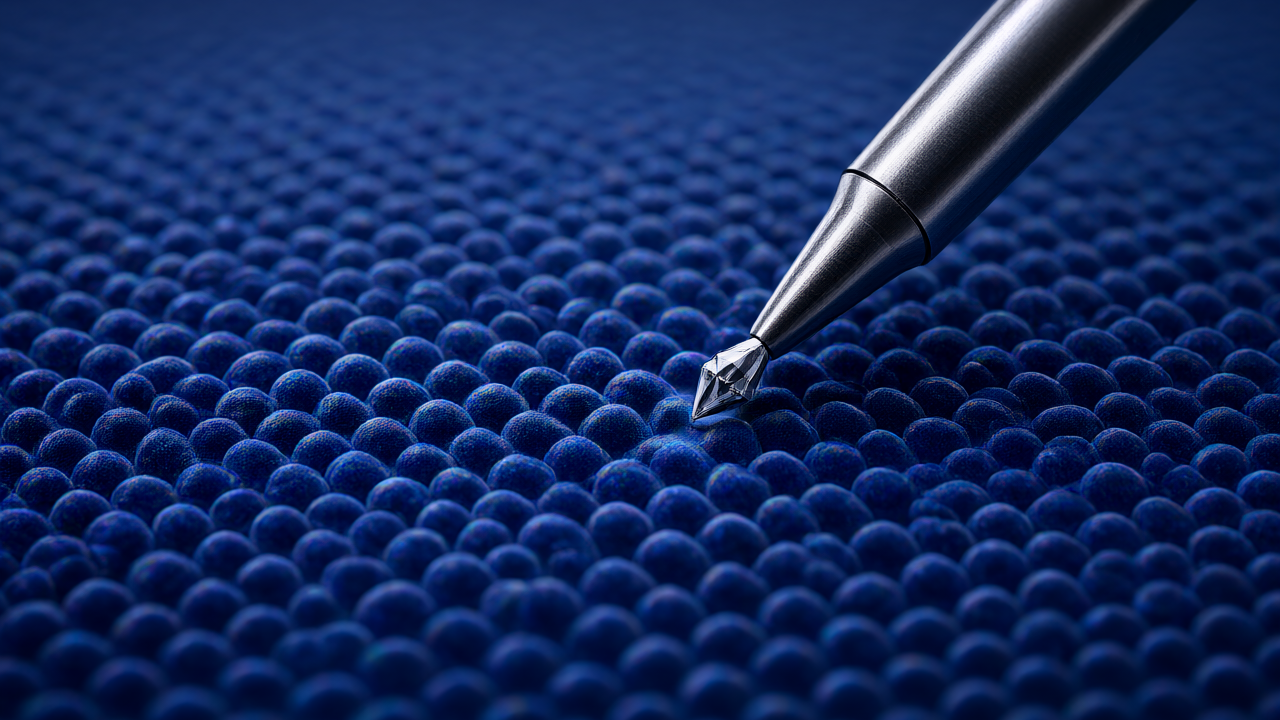
The researchers fabricated silicon surfaces (2.5 cm × 2.5 cm) featuring nanopillars with an average height of 434 nm and a diameter of about 100 nm. The fabrication process involved:
- Creating a silicon master mold via reactive ion etching using gold nanoparticles (formed by thermal dewetting) as a mask.
- Replicating the pattern onto an intermediate polymer stamp.
- Imprinting the pattern onto resist-coated silicon wafers using nanoimprint lithography.
- Transferring the final pattern into silicon via reactive ion etching.
To test durability, a 5 mm-diameter steel ball was slid across the surfaces without lubrication at a speed of 5 mm/s for up to 50 cycles, applying loads of 0.1 N and 0.5 N. The team monitored the friction coefficient, wear-track widths via optical microscopy, and nanopillar fracture and compaction via SEM.
Background & Context
The research, published in Surfaces and Interfaces, was conducted by a team from the International Iberian Nanotechnology Laboratory, the University of Minho, LABBELS – Associate Laboratory, and the University of Aveiro. The study shifts focus from optical performance to mechanical resilience, examining how these surfaces respond to repeated mechanical loading and environmental challenges such as cleaning operations.
Significance & Outlook
The findings indicate that initial damage is characterized by nanopillar fracture, which evolves into the accumulation and compaction of fractured material. This transformation progressively alters the surface morphology and increases friction under higher loads. Applying a tribological perspective is considered a critical step toward the practical integration of light-management nanostructures into the outer surfaces of photovoltaic modules.
Get our weekly technology intelligence — free
Receive an infographic that lets you judge at a glance whether each field’s analysis report is worth reading.
Subscribe Free — Weekly Tech Intelligence
By subscribing, you’ll receive Troy-Technical’s weekly technology intelligence newsletter.
- Your email and selected fields are used only to deliver the newsletter.
- We never share your information with third parties.
- You can unsubscribe anytime via the link in each email.
See our Privacy Policy for details.
Takes about a minute · Unsubscribe anytime