


Key Findings
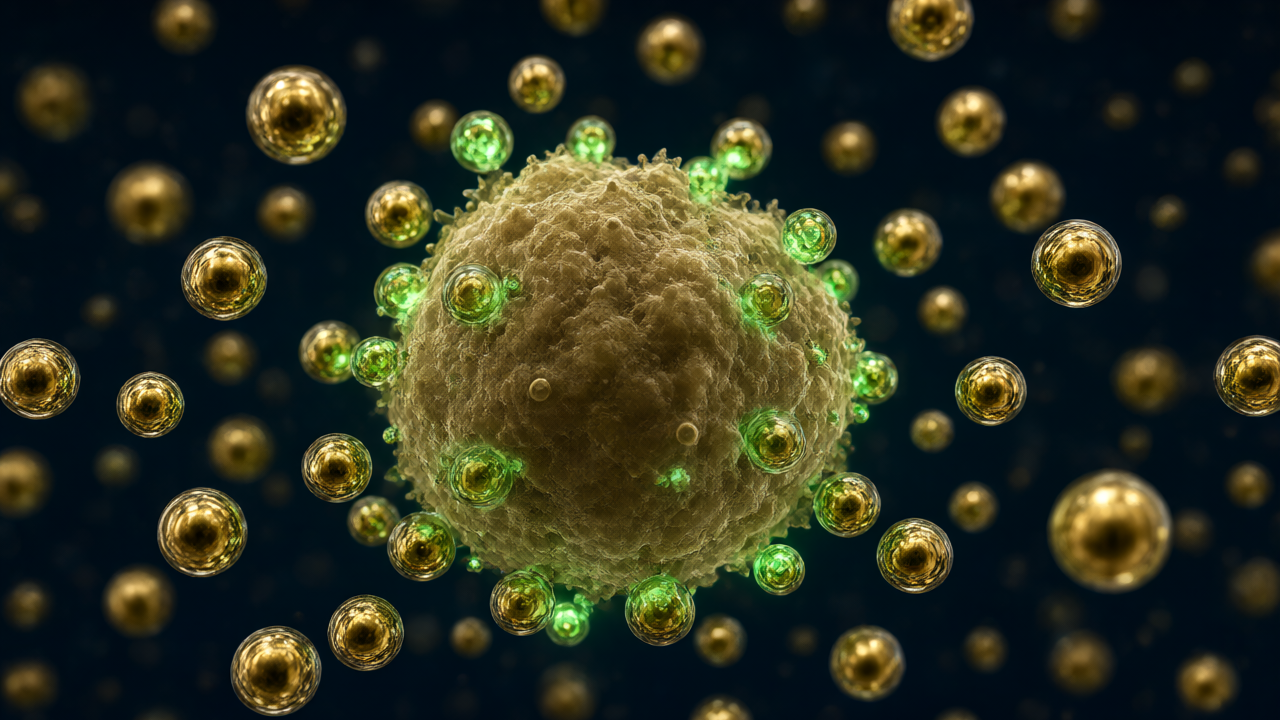
The BSA@Au/Tb-FA nanoparticles showed high biocompatibility and effectiveness as a bimodal imaging agent. In vitro tests using MDA-MB-231 cells revealed that cell viability remained above 80% at concentrations up to 250 μg/mL, with an IC 50 of 352 μg/mL. Hemocompatibility was confirmed with hemolysis values below the 5% ASTM safety threshold at 200 μg/mL. Notably, BSA@Au/Tb-FA exhibited significantly higher cellular uptake compared to non-FA-conjugated BSA@Au/Tb nanoparticles (p < 0.05) at concentrations of 25, 50, and 100 μg/mL.
Technical Details
The nanoparticles were synthesized and characterized via TEM, XRD, FTIR, XPS, and DLS, resulting in a spherical-like morphology with a mean particle size of ~10.68 ± 1.69 nm (n = 55). Imaging performance was evaluated using phantom models:
- SPCCT: The agent achieved an attenuation efficiency of 38.35 HU·mL·mg⁻¹, driven by the X-ray attenuation of gold (Au) and terbium (Tb) near their K-edge energies. Material decomposition showed a strong correlation between measured and experimental concentrations (R² = 0.98).
- MRI: Relaxivity values were measured at r1 = 1.42 mM⁻¹ s⁻¹ and r2 = 13.82 mM⁻¹ s⁻¹, indicating a dominant transverse relaxation effect suitable for T2-weighted contrast.
Background & Context
Triple-negative breast cancer (TNBC) is particularly difficult to treat and image because it lacks estrogen receptors, progesterone receptors, and HER2. TNBC accounts for 10–15% of global breast cancer cases and is characterized by rapid progression and high metastasis risk. Because single-modality imaging is often limited by biological heterogeneity, multifunctional nanoparticles are being explored to provide complementary anatomical and functional data.
Significance & Outlook
The study supports the potential of BSA@Au/Tb-FA as a bimodal imaging agent for TNBC. However, the authors note that because the cellular evaluation was limited to MDA-MB-231 cells without a receptor-blocking study, the enhanced uptake is not yet confirmed as folate-receptor-mediated targeting. Further preclinical and in vivo studies are required to establish safety, imaging performance, and targeting specificity.
Get our weekly technology intelligence — free
Receive an infographic that lets you judge at a glance whether each field’s analysis report is worth reading.
Subscribe Free — Weekly Tech Intelligence
By subscribing, you’ll receive Troy-Technical’s weekly technology intelligence newsletter.
- Your email and selected fields are used only to deliver the newsletter.
- We never share your information with third parties.
- You can unsubscribe anytime via the link in each email.
See our Privacy Policy for details.
Takes about a minute · Unsubscribe anytime