


Key Findings
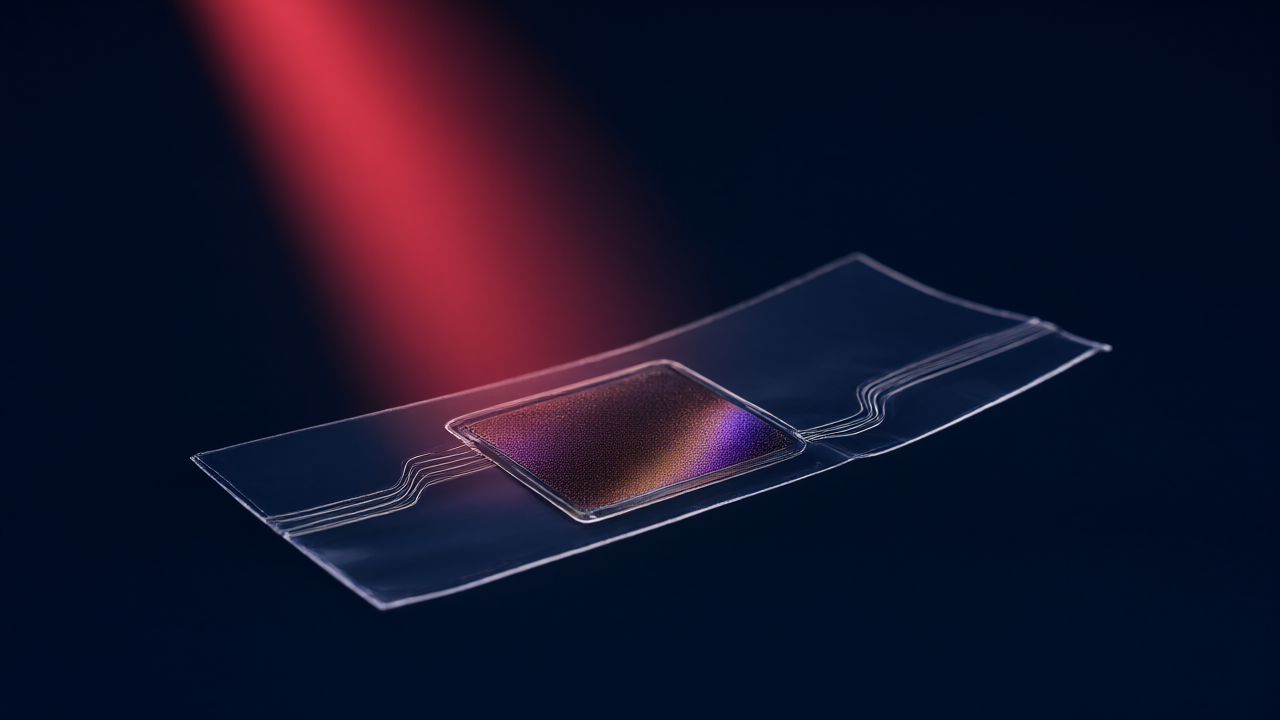
Tanaka, in joint research with the Torimoto Laboratory at Nagoya University, has developed a lead-free Ag-S-Te compound semiconductor quantum dot material responsive to near-infrared light. In performance evaluations, these quantum dots were used as a photodetection layer in a simple photosensor, achieving a maximum external quantum efficiency (EQE) of 18.4 percent for short-wave infrared (SWIR) light within the 1,200–1,700 nm wavelength range.
Technical Details
The Ag-S-Te material is designed for large-area production as it does not require vacuum processes and can be deposited using printing processes. The specific wavelength range of 1,200–1,700 nm provides several technical advantages:
- Reduced susceptibility to sunlight noise and adverse weather effects for outdoor sensing.
- Increased eye safety.
- Enhanced ability to penetrate biological tissue and various materials.
Background and Context
Infrared sensing is critical for 3D sensing, wearable devices, smartphone facial recognition, automotive LiDAR, industrial inspection, and biosensing. Traditionally, InGaAs has been the primary photodetector material due to its high sensitivity up to 1,700 nm; however, its reliance on complex vacuum processes leads to challenges in yield and mass-production costs. Furthermore, demand for indium is rising in AI data center semiconductors, perovskite solar cells, and smartphone displays.
While PbS quantum dots offer a lower-cost alternative via printing processes, they contain lead and are regulated under the RoHS Directive. The Ag-S-Te material addresses both the cost and regulatory limitations of these existing technologies.
Significance and Outlook
This development is expected to expand the adoption of high-performance infrared sensors in consumer electronics, automotive, and industrial sectors where cost and lead restrictions previously acted as barriers. The material will be presented at Okinawa Colloids 2026 (November 1–6, 2026) and nano tech 2026 (December 16–18, 2026).
Get our weekly technology intelligence — free
Receive an infographic that lets you judge at a glance whether each field’s analysis report is worth reading.
Subscribe Free — Weekly Tech Intelligence
By subscribing, you’ll receive Troy-Technical’s weekly technology intelligence newsletter.
- Your email and selected fields are used only to deliver the newsletter.
- We never share your information with third parties.
- You can unsubscribe anytime via the link in each email.
See our Privacy Policy for details.
Takes about a minute · Unsubscribe anytime