
Key Findings
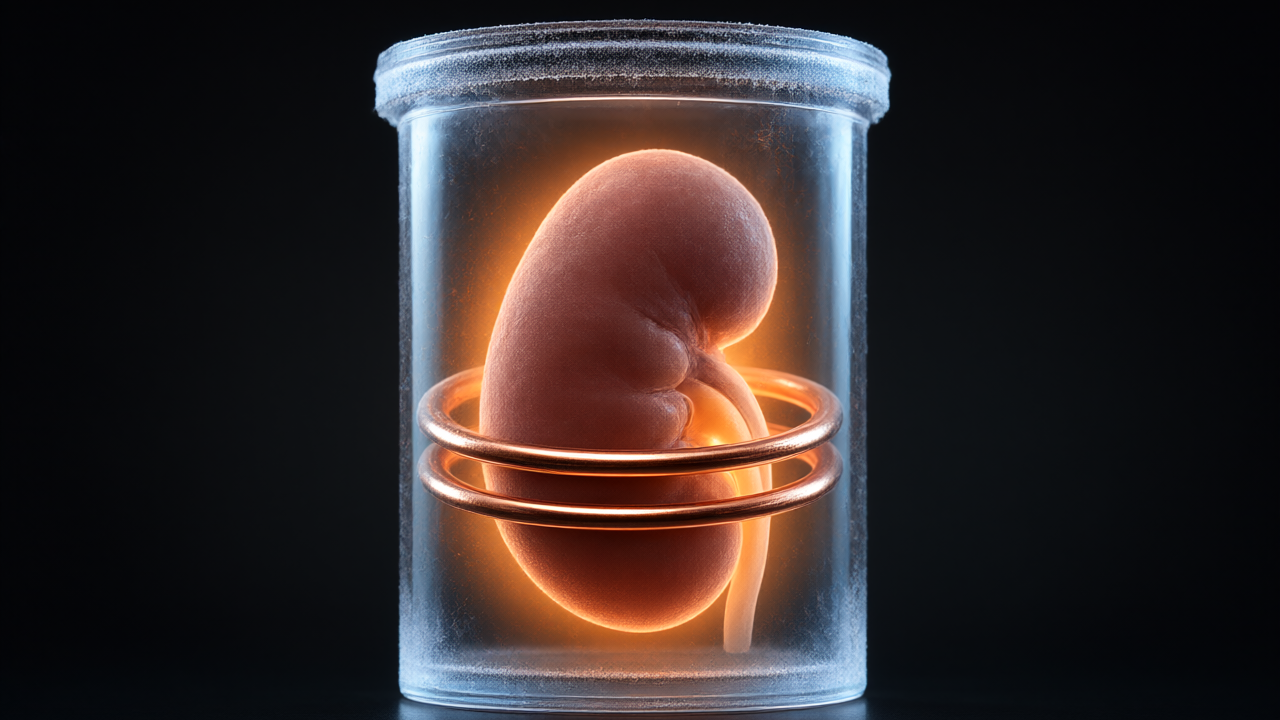
A pig kidney stored at −150 degrees Celsius for 366 days regained blood flow and metabolic activity, producing urine after rewarming. In separate transplant experiments, other kidneys treated with the same preservation method showed immediate blood flow and urine production upon transplantation into pigs. However, these observations lasted only two hours, and filtration remained impaired. The year-stored kidney was evaluated via machine testing rather than transplantation.
Technical Details
The team used vitrification to convert organs into an ice-free, glass-like state using a cryoprotectant formulation called PEZ42. The process involved a controlled perfusion starting at 4 degrees Celsius, with temperatures lowered below −15 degrees Celsius as concentrations increased to reduce toxicity. A 100-minute pause at −114 degrees Celsius was implemented to ensure uniform internal temperatures before final cooling to −150 degrees Celsius.
To overcome the risks of uneven rewarming, researchers employed nanowarming. This involved distributing silica-coated iron oxide nanoparticles through the blood vessels. An alternating electromagnetic field caused these particles to generate heat throughout the organ, warming the kidneys from −150 to approximately −10 degrees Celsius in 340 to 350 seconds.
Background and Context
The study, led by surgeon Erik Finger and mechanical engineer John Bischof from the University of Minnesota, focused on pig kidneys weighing between 84 and 132 grams. These organs are roughly 100 times heavier than the rat kidneys used in the team’s 2023 Nature Communications study, where organs stored for 100 days supported life. The larger size of pig kidneys increases the difficulty of rapid cooling and warming, as heat moves slowly through the tissue.
Significance and Outlook
Extending organ preservation from hours to months or years could improve recipient matching, transportation, and surgical preparation. However, this unreviewed bioRxiv preprint has not yet demonstrated long-term life support or tested human kidneys. The results indicate that while structural and partial biological functions can be recovered, the ability of these organs to sustain life remains unproven.
Get our weekly technology intelligence — free
Receive an infographic that lets you judge at a glance whether each field’s analysis report is worth reading.
Subscribe Free — Weekly Tech Intelligence
By subscribing, you’ll receive Troy-Technical’s weekly technology intelligence newsletter.
- Your email and selected fields are used only to deliver the newsletter.
- We never share your information with third parties.
- You can unsubscribe anytime via the link in each email.
See our Privacy Policy for details.
Takes about a minute · Unsubscribe anytime