


Key Findings
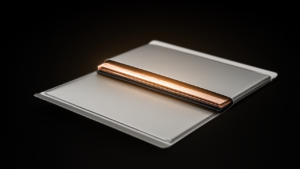
A collaborative team led by Professors Jinwoo Lee and Hee-Tae Jung at KAIST has addressed the limited lifespan of anode-free batteries. By adapting precision fabrication from the semiconductor industry, the researchers created a copper foil structure that ensures more uniform lithium accumulation and promotes a durable protective layer, overcoming the primary barriers to the commercialization of anode-free technology.
Technical Details
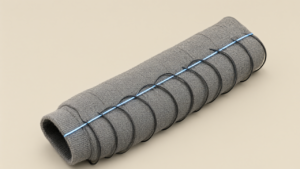
The team utilized secondary sputtering lithography (SSL) to create a pattern of microscopic tubes on the copper foil surface. Each tube measures approximately 300 nanometers in width and 150 nanometers in height. This architecture increases the available surface area for lithium deposition to roughly four times that of a standard flat sheet, preventing the concentrated buildup of needle-like dendrites.
Additionally, the researchers applied a 10-nanometer-thick coating of MXene, a two-dimensional material, to the foil. In experiments using a LiPF6-based electrolyte, this coating acts as a foundation that encourages the formation of a stable protective layer rich in lithium fluoride (LiF). This layer restricts the growth of lithium spikes and limits unwanted chemical reactions between the lithium and the electrolyte.
The team verified these results using advanced analytical methods, including:
- X-ray photoelectron spectroscopy (XPS)
- Time-of-flight secondary ion mass spectrometry (ToF-SIMS)
- Transmission electron microscopy (TEM)
Background & Context
Conventional lithium-ion batteries use graphite anodes to store lithium during charging. Anode-free batteries eliminate this material, allowing lithium to accumulate directly on copper foil. While this reduces overall battery weight and thickness—allowing more energy storage in the same space—it typically leads to rapid deterioration due to unstable lithium deposition and the formation of dendrites.
Significance & Outlook
Unlike previous attempts to extend battery life by adding more lithium or thicker coatings—which increased weight and negated the benefits of the anode-free design—this approach maintains the technology’s size and weight advantages. This breakthrough provides a pathway toward electric vehicles that can travel farther on a single charge without requiring larger battery packs.
Source: https://www.sciencedaily.com/releases/2026/10/261027063708.htm
Get our weekly technology intelligence — free
Receive an infographic that lets you judge at a glance whether each field’s analysis report is worth reading.
Subscribe Free — Weekly Tech Intelligence
By subscribing, you’ll receive Troy-Technical’s weekly technology intelligence newsletter.
- Your email and selected fields are used only to deliver the newsletter.
- We never share your information with third parties.
- You can unsubscribe anytime via the link in each email.
See our Privacy Policy for details.
Takes about a minute · Unsubscribe anytime