


Key Findings
The developed composite, designated C5/T4/A3, achieved an EMI shielding effectiveness of 72.75 dB while reflecting only 0.04 of the incident wave. The material demonstrates a low-reflection bandwidth of 3.40 GHz, with reflection remaining below 0.1, covering 81% of the X-band. These results were further validated through radar cross section simulations.
Technical Details
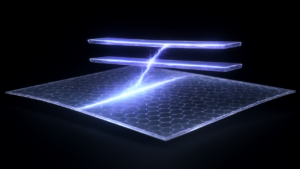
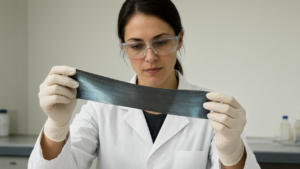
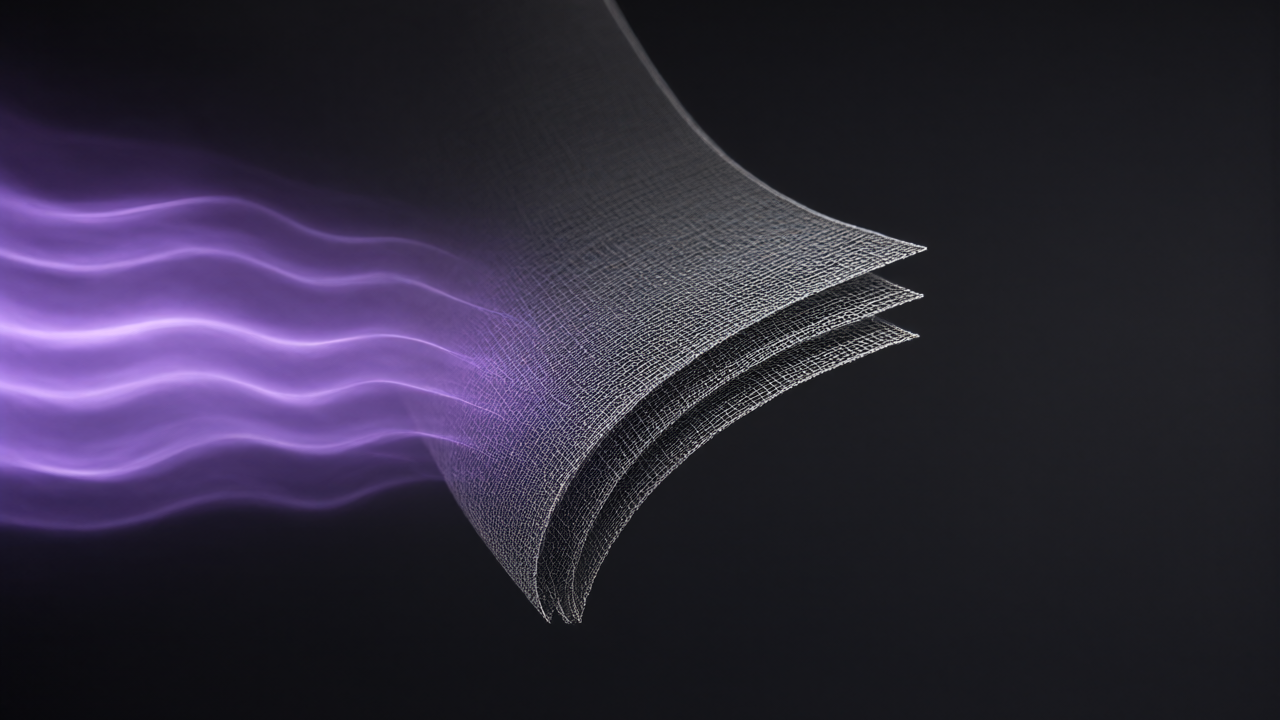
The material is built on a modified electrospun TPU film using a three-layer asymmetric architecture designed to optimize impedance matching and destructive interference:
- Top Layer: A porous network of nanofibers wrapped with carbon nanotubes, functioning as an impedance matching layer.
- Intermediate Layer: A precisely tuned layer designed to enhance destructive interference.
- Bottom Layer: A silver-coated nanofiber network that ensures complete reflection.
The research team systematically analyzed how interlayer thickness and the conductivity of the matching and bottom layers govern the overall shielding effectiveness and the proportion of absorption. A critical feature of this architecture is its modularity; the bottom layer is replaceable, allowing for the direct tuning of shielding effectiveness by varying conductivity without altering the core impedance matching and interference cancellation mechanisms.
Background & Context
Conventional EMI shielding designs often struggle to achieve high absorption and high shielding effectiveness simultaneously. This work presents an alternative to traditional Salisbury screens. The study, published in Advanced Composites and Hybrid Materials, focuses on harnessing the synergy between impedance matching and interference cancellation within a conductive nanofiber network.
Significance & Outlook
The modular approach provides a scalable route for designing high-performance, absorption-dominant EMI shielding materials. By allowing the replacement of the reflective layer, the design offers a tunable solution for specific electromagnetic interference challenges, providing a technical guideline for future development of asymmetric nanofibrous conductive networks.
Get our weekly technology intelligence — free
Receive an infographic that lets you judge at a glance whether each field’s analysis report is worth reading.
Subscribe Free — Weekly Tech Intelligence
By subscribing, you’ll receive Troy-Technical’s weekly technology intelligence newsletter.
- Your email and selected fields are used only to deliver the newsletter.
- We never share your information with third parties.
- You can unsubscribe anytime via the link in each email.
See our Privacy Policy for details.
Takes about a minute · Unsubscribe anytime