

Key Findings
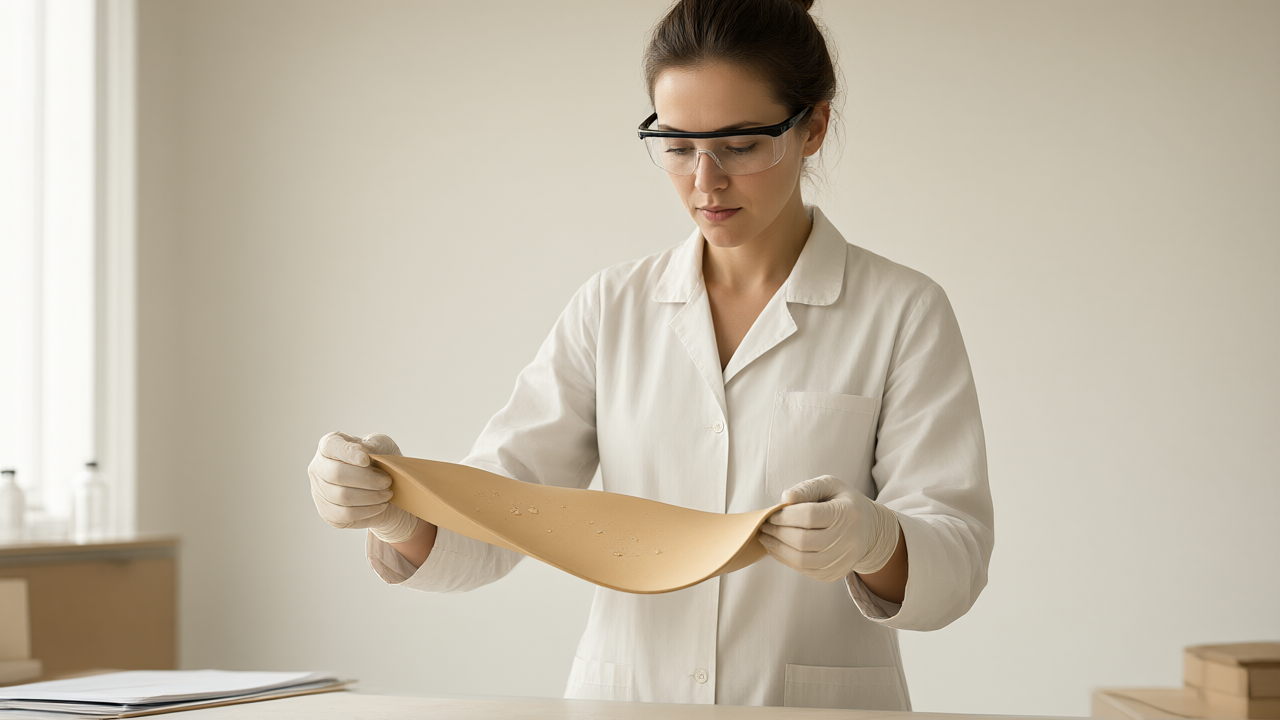
The engineered composite reaches a tensile strength of 57.3 megapascals and an elongation at break of 32.2 percent. By utilizing a woven fabric substrate, the material achieves a tear strength of approximately 50 newtons per millimeter and peel strengths between 8 and 9 newtons per millimeter, exceeding the 3 to 5 newtons per millimeter benchmarks required for leather bags and shoe uppers.
Technical Details
The material is constructed by coating a bacterial cellulose–collagen layer with a bio-based adhesive and pressing it onto a fabric substrate at 95 degrees Celsius under 1.0 megapascal for 5 minutes, followed by a 12-hour cure at 90 degrees Celsius. The adhesive is a cross-linked network formed by heating epoxidized soybean oil (ESO) with an aqueous citric acid solution. The optimal formulation, ESO-30/CA, contains 30 grams of epoxidized soybean oil and reaches gelation in 60 minutes at 90 degrees Celsius.
Water resistance is significantly enhanced through the adhesive’s non-polar alkyl chains and ester groups. While untreated bacterial cellulose has a water contact angle of 32.7 degrees, the cured adhesive alone reaches 118.8 degrees. In water soaking tests, the final composite gained only 1.54 percent mass in the first 2 hours.
Background & Context
Bacterial cellulose is a renewable alternative to mycelium materials because it is produced in static liquid cultures over days to a week. However, it is naturally brittle after drying and highly hydrophilic. Previous attempts to improve this using collagen and tannic acid achieved a tensile strength of 53.42 megapascals but remained prone to wrinkling and water absorption.
Significance & Outlook
Ashby plots indicate that the composite’s tensile strength, Young’s modulus, and density overlap significantly with natural leather. While flexibility and wrinkle resistance are improved—with woven and non-woven substrates reaching delayed recovery angles near 100 degrees—long-term durability remains a constraint, as surface cracking appeared after 5000 flexing cycles in a leather flexometer.
Get our weekly technology intelligence — free
Receive an infographic that lets you judge at a glance whether each field’s analysis report is worth reading.
Subscribe Free — Weekly Tech Intelligence
By subscribing, you’ll receive Troy-Technical’s weekly technology intelligence newsletter.
- Your email and selected fields are used only to deliver the newsletter.
- We never share your information with third parties.
- You can unsubscribe anytime via the link in each email.
See our Privacy Policy for details.
Takes about a minute · Unsubscribe anytime