
Key Findings
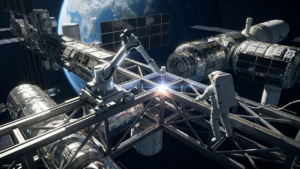
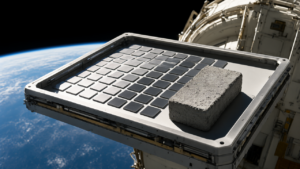
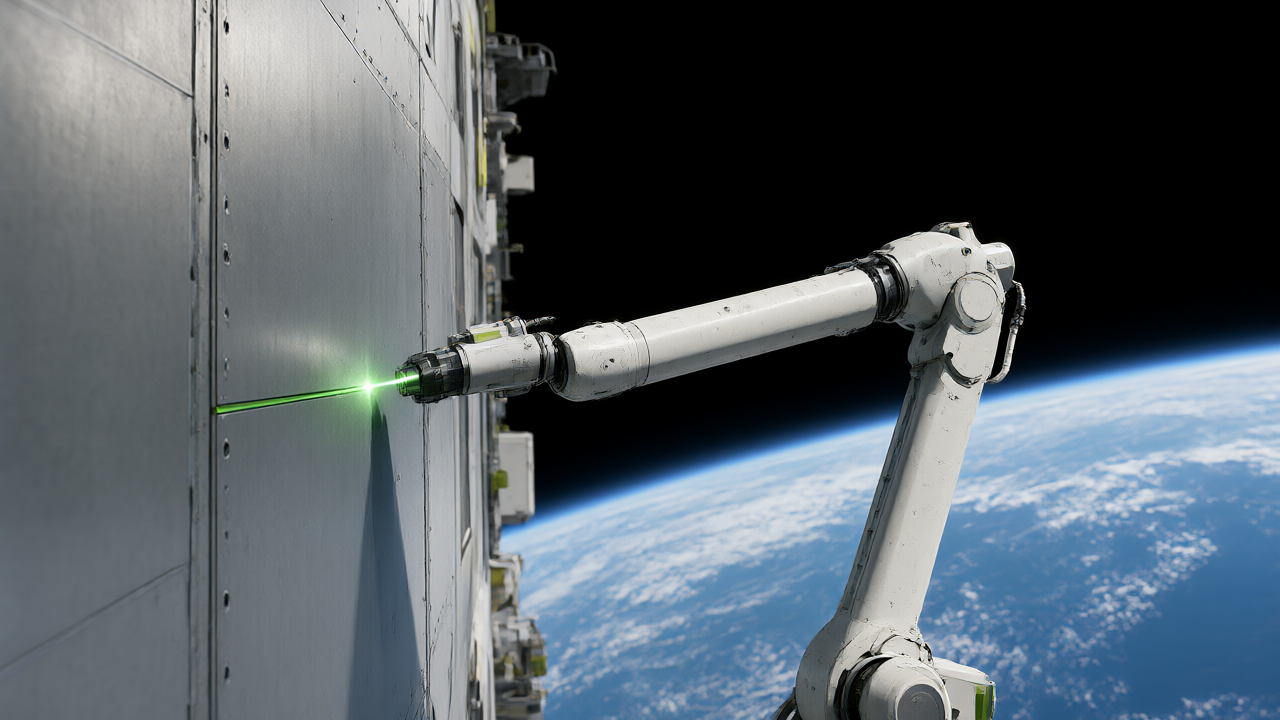
China has achieved a global first by performing a remote-operated laser precision cutting maintenance test on the exterior of its space station. The operation was carried out via teleoperation from Earth, marking a significant shift from previous maintenance missions that relied exclusively on astronaut extravehicular activities (EVAs).
Technical Details
The “Extra-vehicular Laser Maintenance Device” was developed within one year, moving from initial design and prototype to a flight-ready unit. To operate in the extreme conditions of space—characterized by high vacuum, strong radiation, and severe temperature fluctuations—the team overcame three primary technical bottlenecks: vacuum/radiation adaptability, millimeter-level high-precision positioning, and micron-level laser precision cutting.
The system integrates several specialized components to ensure accuracy:
- An “8+2” axis multi-degree-of-freedom fine-tuning mechanism.
- A three-degree-of-freedom precision capture mechanism.
- An advanced multi-level vision guidance system.
These technologies allow for intelligent high-precision positioning and micron-level laser thermal effect cutting despite the complex attitudes of the space station.
Background & Context
The project was a joint effort between Professor Huang Yu’s team at the School of Mechanical Science and Engineering of Huazhong University of Science and Technology and the Shanghai Space Power Institute (part of the China Aerospace Science and Technology Corporation Eighth Academy). This development follows two previous manual repair missions: one in March 2024 by the Shenzhou-17 crew and another in August 2026 by the Shenzhou-23 crew, both of which focused on repairing solar wings damaged by space debris.
Significance & Outlook
Regular maintenance is critical because space debris, traveling at speeds of 7 to 10 kilometers per second, poses a constant threat. While millimeter-sized fragments can reduce the transmittance and power efficiency of solar wings, centimeter-sized debris can penetrate hulls and destroy fuel tanks or pipelines. The transition to remote laser maintenance provides a high-precision, “minimally invasive” method to ensure the long-term safety and operational continuity of space station facilities.
Source: https://view.inews.qq.com/a/20261105A03M4X00
Get our weekly technology intelligence — free
Receive an infographic that lets you judge at a glance whether each field’s analysis report is worth reading.
Subscribe Free — Weekly Tech Intelligence
By subscribing, you’ll receive Troy-Technical’s weekly technology intelligence newsletter.
- Your email and selected fields are used only to deliver the newsletter.
- We never share your information with third parties.
- You can unsubscribe anytime via the link in each email.
See our Privacy Policy for details.
Takes about a minute · Unsubscribe anytime