


Key Findings
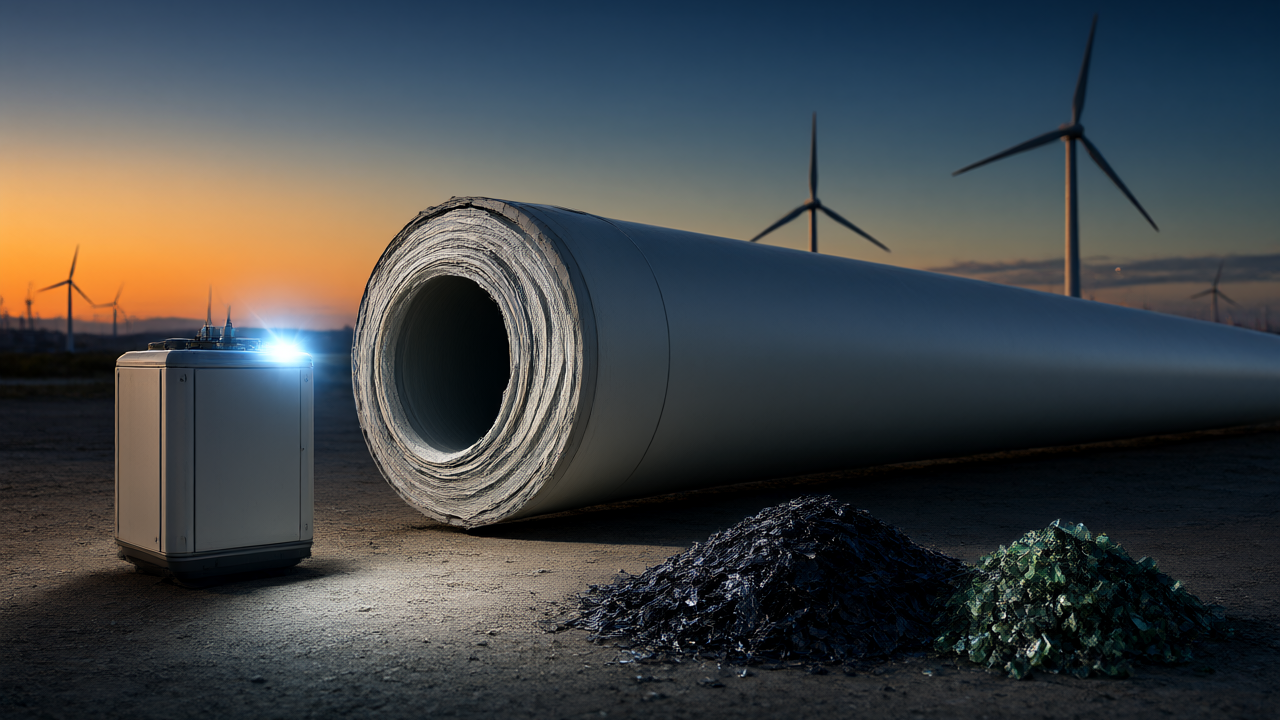
A study published in the journal Chem Circularity demonstrates a method to upcycle low-value wind turbine blade waste into high-value manufacturing materials. By utilizing flash Joule heating, researchers converted approximately 56% of a waste mixture into a composite consisting of 66% graphene and 34% silicon carbide. Integrating just 0.3% of these recovered materials by weight into resin improved tension resistance by 27% and bending resistance by 9%, while a 0.1% weight addition increased thermal diffusivity by 41%.
Technical Details
Wind turbine blades are typically composed of fiberglass (containing silica) and carbon-rich polymer resin. The researchers employed flash Joule heating, which applies a high-current electrical pulse to conductive raw materials, raising temperatures to 2,000 degrees Celsius or higher within milliseconds. At these temperatures, carbon reacts with silica to form silicon carbide—a heat-resistant compound—and reorganizes into graphene. The process was tested using a mixture of pulverized blade waste and nearly pure elemental carbon.
Background & Context
The extreme durability of turbine blades makes them difficult to break down, often resulting in them being sent to landfills. Current recycling alternatives are costly and carbon-intensive; pyrolysis costs roughly $460 per ton, and chemical dissolution costs about $1,800 per ton. In contrast, the flash Joule heating approach cuts greenhouse gas emissions by 92% and 83% compared to chemical dissolution and heat recovery, respectively.
Significance & Outlook
The process presents a potential shift toward a closed-loop manufacturing system where retired blades enhance the durability of new ones. While the recovered materials could generate a profit of $80 per ton, scaling remains a primary challenge. Experiments have progressed from 10-gram batches to a 200-gram reactor, though lead author Hao Bi of Tsinghua University notes that further optimization is required to ensure uniform heating and consistent product quality before the technology can be deployed at real wind farms.
Source: https://gizmodo.com/scientists-found-a-clever-second-life-for-dead-wind-turbine-blades-2000835746
Get our weekly technology intelligence — free
Receive an infographic that lets you judge at a glance whether each field’s analysis report is worth reading.
Subscribe Free — Weekly Tech Intelligence
By subscribing, you’ll receive Troy-Technical’s weekly technology intelligence newsletter.
- Your email and selected fields are used only to deliver the newsletter.
- We never share your information with third parties.
- You can unsubscribe anytime via the link in each email.
See our Privacy Policy for details.
Takes about a minute · Unsubscribe anytime