


Key Findings
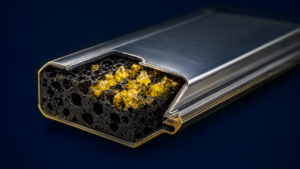
Researchers at the University of Córdoba in Spain have successfully developed a rechargeable zinc-air battery that uses vitamin B12 (cobalamin) as a catalyst. The prototype has demonstrated stability over up to 250 charge-discharge cycles, marking the first time the team’s biomolecule-based battery research has achieved rechargeability.
Technical Details
The battery was developed by the Physical Chemistry research group (FQM-204) at the university’s Chemical Institute for Energy and the Environment (IQUEMA). The technical implementation involves anchoring vitamin B12 to single-walled carbon nanotubes. This architecture was designed to prevent the vitamin from dissolving in the battery’s aqueous electrolyte due to its high water solubility, a process lead author Manuel Cano Luna describes as replicating how amino acids bind in proteins.
The catalytic process relies on the cobalt (III) core of the vitamin B12 to facilitate electrochemical reactions. Specifically, the catalyst enables two critical functions:
- During use: Converting oxygen into water.
- During recharging: Releasing oxygen.
Background & Context
Prior to this development, the research group explored other biomolecules as catalysts, specifically haemoglobin and catalase, which contain iron (II) and iron (III) respectively. While these previous iterations provided insights into biomolecule catalysts, they did not achieve the rechargeability seen in the current vitamin B12 prototype.
Significance & Outlook
Zinc-air batteries provide several advantages over conventional lithium-ion systems, including the use of abundant, recyclable zinc and the intake of oxygen from the surrounding environment, which reduces the overall weight of the unit. Additionally, the use of non-flammable aqueous electrolytes improves safety.
The researchers indicate that this development could lead to more cost-effective energy storage systems. Potential applications include the storage of surplus electricity generated from renewable energy sources.
Get our weekly technology intelligence — free
Receive an infographic that lets you judge at a glance whether each field’s analysis report is worth reading.
Subscribe Free — Weekly Tech Intelligence
By subscribing, you’ll receive Troy-Technical’s weekly technology intelligence newsletter.
- Your email and selected fields are used only to deliver the newsletter.
- We never share your information with third parties.
- You can unsubscribe anytime via the link in each email.
See our Privacy Policy for details.
Takes about a minute · Unsubscribe anytime