


Key Findings
A research team from Xidian University has developed a thin-film liquid coating that significantly enhances the stability of lithium-metal anodes. The protected anode demonstrates a critical current density of 3.5 mA cm⁻², which is more than four times the 0.8 mA cm⁻² threshold of unprotected lithium. In full-cell tests using a sulfide solid-state electrolyte, the coated cells retained 82.3% of their original capacity after 300 charging cycles, compared to only 43% for unprotected cells.
Technical Details
The “chemical armor” consists of a fluorine-containing silicone polymer and indium chloride. When applied, the mixture reacts directly on the metal to form a flexible hybrid layer measuring only 12 $\mu$m in thickness. The coating functions through three primary mechanisms:
- Mechanical Buffering: The elastic polymer network absorbs mechanical stresses caused by the expansion and contraction of the cell during charging.
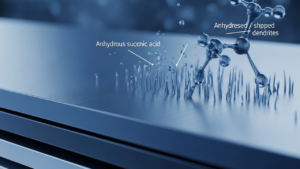
- Electronic Insulation: A formed lithium fluoride phase acts as an insulator to block electrons, preventing the initiation of dendrites.
- Ion Distribution: Lithium-indium alloy nanoparticles act as microscopic guides to distribute incoming lithium ions evenly, preventing the accumulation of spikes.
Background & Context
Pure lithium is a preferred battery material due to a theoretical energy storage capacity nearly ten times higher than the graphite used in current electric vehicles and smartphones. However, the formation of needle-like dendrites during charging can pierce cell barriers, leading to short circuits and fire risks. These defects have historically hindered the deployment of high-performance solid-state batteries.
Significance & Outlook
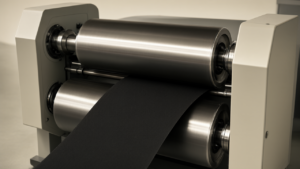
The liquid-based application process is compatible with standard roll-to-roll production lines via slot-die or gravure printing, eliminating the need for costly vacuum chambers. If scaled, this technology could lead to lighter batteries with significantly increased range and charging times comparable to traditional refueling stops. Beyond electric vehicles, the researchers suggest this approach could be applied to aviation and stationary energy storage for renewable energy, with potential for testing alternative metals such as tin or zinc in future protective layers.
Source: https://www.basicthinking.de/blog/2026/11/14/festkoerperbatterie/
Get our weekly technology intelligence — free
Receive an infographic that lets you judge at a glance whether each field’s analysis report is worth reading.
Subscribe Free — Weekly Tech Intelligence
By subscribing, you’ll receive Troy-Technical’s weekly technology intelligence newsletter.
- Your email and selected fields are used only to deliver the newsletter.
- We never share your information with third parties.
- You can unsubscribe anytime via the link in each email.
See our Privacy Policy for details.
Takes about a minute · Unsubscribe anytime